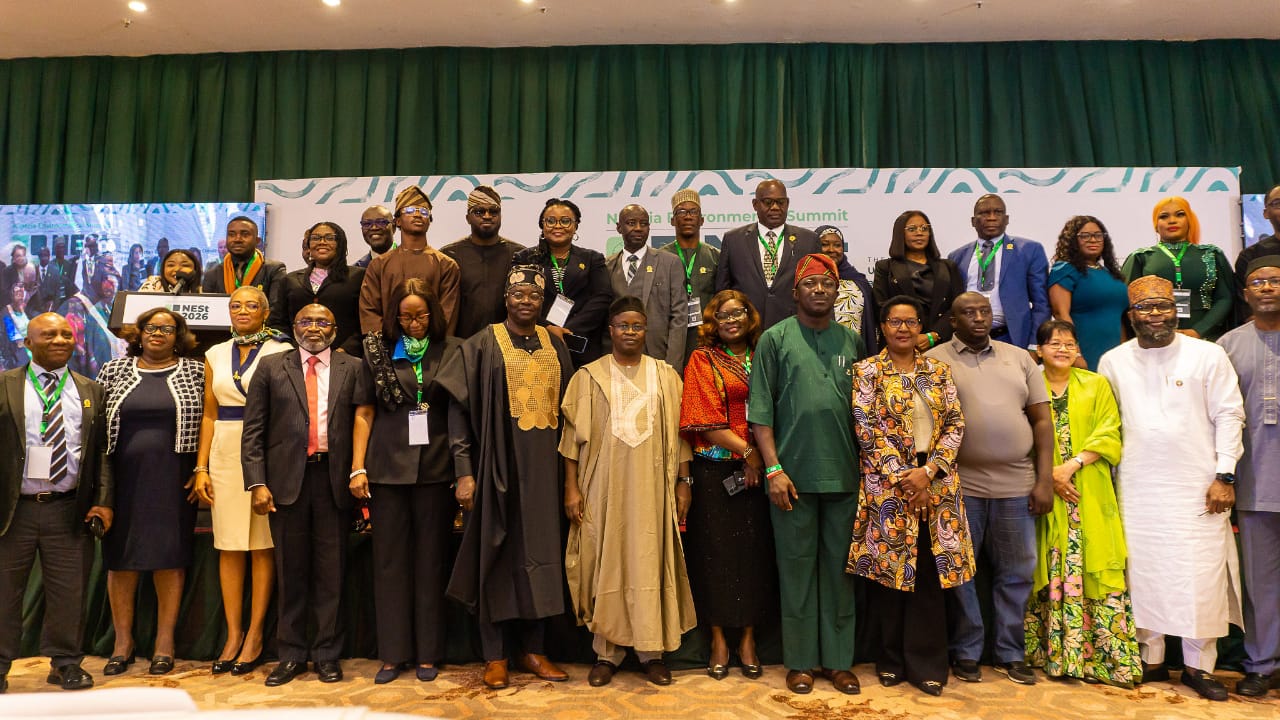
…as stakeholders call for unlocking Nigeria’s £20bn green economy potential.
By Gabriel Ewepu
ABUJA – IN a bid to conserve the environment, the Federal Government and the Nigerian Environmental Summit Group, NESUG, has called for upscaling green financing towards tackling climate change challenges and boosting job creation in Nigeria.
Speaking at the Nigeria Environmental Summit (NESt 2026) held in Abuja with the theme ‘Unlocking Nigeria’s Green Economy: Driving Climate Action and Strengthening Environmental Governance’, the Minister of Environment, Balarabe Abbas Lawal, represented by the Permanent Secretary in the Ministry, Dr Salihu Usman, said it is high time Nigeria takes its rightful position in order to maximally benefit from emerging climate and green investment opportunities including climate funds, carbon markets, public-private partnerships, blended finance mechanisms, renewable energy, ecosystem restoration, sustainable agriculture and waste-to-wealth initiatives that are enablers for environmental sustainability, economic transformation and job creation.
Lawal also said climate change has become a phenomenon that Nigeria and Nigerians are grappling with including flooding, drought, coastal erosion, biodiversity loss, pollution and pressure on ecosystems and livelihoods that had negatively impacted their lives.
He commended the NESUG for the initiative which brought together government institutions, development partners, investors, academia, civil society organisations and the private sector under one roof in one room to see what can be done to proffer solutions that are long standing to mitigate the impact of climate change on Nigerians as far as the environment is concerned.
The summit had in attendance over 1,450 physical and virtual participants, while who emphasised the need for collective action. The Summit also recognized renowned environmental leaders who had distinguished themselves as they were honoured with the prestigious Nigeria Environmental Sustainability Merit Awards (NESMA), for their contributions to sustainability and governance.
Award recipients included Prof. Oladele Osibanjo, Dr Ngeri Benebo, Chief Iganya Agene; San. Augustine Ebisike, Rev. Nnimmo Bassey and Ms Amina J. Mohammed. Also, Lagos, Akwa Ibom and Jigawa states were recognised for excellence in environmental sustainability.
The summit featured keynote presentations, technical sessions, policy dialogues, climate-health discussions, youth innovation showcases, exhibitions and networking sessions aimed at promoting green investments.
Participants included senior government officials, development partners, regulatory agencies, academics, environmental professionals, youth groups and private sector representatives.
He said: “We must unlock green finance opportunities and strengthen environmental governance through policy reforms, regulatory enforcement, accountability, stakeholder engagement and strategic partnerships that will accelerate Nigeria’s transition to a climate-resilient and sustainable economy.”
Meanwhile, the Minister said it is important to put in place innovative financing mechanisms in order to ensure the country achieve her developmental goals in line with environmental policies.
Also speaking, the Cluster Lead, Disease Control, World Health Organisation (WHO) Nigeria, Dr Mya Ngon, counselled that it is important to make health as the focus when deliberating on environmental issues as a government in terms of policies, and also the private sector should make it a priority in order to safeguard the health of Nigerians.
According to Ngon, while referring to the Nigeria’s 2024 Climate and Health Vulnerability and Adaptation Assessment, said it indicated that climate-related factors could account for up to 21 per cent of disease burden, saying the findings reinforced the need to pursue green economy solutions while protecting public health.
Meanwhile, earlier on, the NESUG Executive Secretary, Chem. Rita Michael-Ojo, urged stakeholder including the federal, state and local governments, private sector, development partners, communities, and Nigerians to get involved in innovative green financing.
Michael-Ojo explained that NESUG over the years had given support to sustainability initiatives using different approaches to ensure government institutions, experts, organized private sector, and development partners are active in doing what is expected of them about the environment.
According to her, “No single institution can solve Nigeria’s environmental challenges alone. NESt represents one platform where stakeholders unite to build a greener, healthier and more prosperous future for Nigeria.”
The Chairman of the NESt 2026 Multi-sectoral Implementation Team, Dr Edwin Isotu Edeh, in his remarks said the Summit came at the right time and it also serves as a call to transform environmental challenges into opportunities that would promote resilience, investment and inclusive growth to reduce the impact of climate change.
Edeh also highlighted daunting challenges of climate change as there has been high flooding, increasing air pollution issues, inadequate WASH services, poor waste management practices, therefore, “Environmental sustainability is no longer an environmental issue alone; it is an economic, health, investment and national security imperative.”
The Director-General, National Space Research and Development Agency, NASRDA, Dr Olumide Adepoju, said, “Within these challenges lie opportunities to build a better future for our youth.
“By pursuing sustainable environmental governance, we can transform ecological risks into valuable green assets and create wealth from environmental resources.”
The Resident Representative, United Nations Population Fund, UNFPA, Ms Muriel Mafico, noted that the worse hit are women and girls who often are challenged fiercely the risks that come with climate change impacts on communities.
Mafico also highlighted issues about gender-based violence, exploitation and disruption of reproductive health services due to displacement occasioned by climate change orchestrated disasters.
Also in a remark, Senior Special Assistant to the President on Public Health, Mrs Uju Rochas-Anwukah, revealed that the impact of climate change cost Nigeria about $1 billion annually, saying the Federal Government remains committed to addressing environmental challenges and promoting sustainability of policies
Disclaimer
Comments expressed here do not reflect the opinions of Vanguard newspapers or any employee thereof.