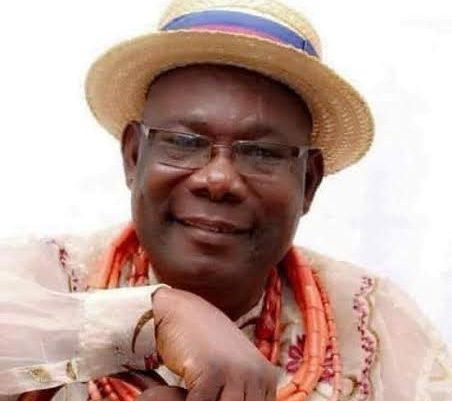
Omene
By Paul Olayemi
On Saturday, June 20, 2026, the community of Mosogar in Ethiope West Local Government Area of Delta State will come alive with celebration, as family, friends, dignitaries, and well-wishers gather at the Ejorhofo’s Residence along the Benin–Sapele Expressway to mark one of the most significant milestones in the kingdom’s recent history.
Chief Joe Omene, the Ejorhofo of Mosogar Kingdom , turns 80 years old — an achievement that commands deep reverence and joyful thanksgiving from all who know him. This is not merely the celebration of a man growing older; it is the celebration of a life that has touched communities, shaped institutions, and left an indelible imprint on the Urhobo nation. Eight decades of God’s grace and purposeful living deserve nothing less than a gathering of every life he has ever influenced.
Chief (Engineer) Joseph Orode Omene JP, was born into the rich cultural tapestry of the Urhobo people of Delta State, a heritage as deep as the Niger Delta waters that nourish the land of his forebears. From his earliest years, it became clear that Joseph Omene was a young man destined for distinction. He pursued the discipline of engineering with seriousness and intellectual rigour, earning his professional qualifications at a time when such achievements were rare and hard-won in Overseas. His engineering background was not merely a career path — it was a framework for how he would approach every challenge life placed before him: with precision, patience, and the calm confidence of a man who understands that structures must be built on solid foundations.
His professional credentials set him apart and opened doors across Nigeria and beyond. As he matured into a dominant philanthropist and a leader of high repute, his motivational speakership skills helped to shape the commercial and economic frontiers of the Urhobo nation.` Long before he held any formal title, Chief Omene was already a man people turned to for guidance, support, and direction. He understood that engineering the future of a people required more than technical knowledge; it required empathy, vision, and an unshakeable sense of responsibility to one’s community. These qualities would come to define every position of leadership he would later occupy.
Chief Joe Omene served as the President-General of the Mosogar Development Union , a platform through which he advocated firmly and consistently for the development and recognition of his home community. In that role, he tackled issues of infrastructure, communal identity, and historical justice with the same structured rigour he applied to his engineering work. Mosogar, located in the heart of Urhobo land, is a community with a proud and complex history, and Chief Omene stood as one of its most articulate defenders. His efforts to give the town a stronger voice in Delta State’s developmental conversation earned him the admiration and deep loyalty of his people.
The apex of Chief Omene’s public career came on December 19, 2014, when he was unanimously elected President General of the Urhobo Progress Union (UPU), the pan-Urhobo social and cultural umbrella body for all Urhobo worldwide. The UPU is considered one of the oldest and most consequential sociocultural organisations in Africa, with a history stretching back to the 1930s. To be elected its president was to stand at the very summit of Urhobo public life, bearing responsibility for millions of people across Nigeria, Africa, and the diaspora. Chief Omene accepted that responsibility with the gravity it deserved, pledging from day one to make the UPU more proactive, more responsive, and more present in the lives of ordinary Urhobo people.
Under his leadership, UPU made deliberate efforts to ensure the body was more alive to its responsibilities to the Urhobo nation and its people in contemporary times. One of the most visible hallmarks of his tenure was the aggressive expansion of UPU’s global footprint. He personally inaugurated new executive branches of the UPU in the United Kingdom, and oversaw the establishment of branches as far afield as Ghana, demonstrating his conviction that the Urhobo nation’s strength lay not only in its homeland but in its diaspora. These new branches brought thousands more Urhobo sons and daughters into the fold of organised community engagement, connecting them to their roots and to each other across continents.
During his tenure, Chief Omene also steered the UPU into the arena of national politics with an intentionality that reflected his belief in the power of organised ethnic advocacy. He acknowledged that UPU under his watch was involved in the 2015 general election, a development he said was fundamentally necessitated by the growing tendency amongst most Urhobo political leaders to pursue personal and group interests over that of the Urhobo nation.
This was a bold and consequential step — a declaration that the Urhobo people would no longer be passive observers in the political processes that shaped their lives. His willingness to engage decisively at the national level marked his presidency as one of the most active and outspoken in UPU’s long history.
As a retired engineer who later chaired the UPU Board of Trustees , Chief Omene never retreated from public affairs even after his presidency ended. He remained a voice of conscience and authority, speaking out on matters of grave national concern. When 16 military personnel were ambushed and killed during a boundary dispute in Delta State, Engr. Joe Omene publicly condemned the killings as “very sad” and “uncalled for,” and called on security agencies to carry out a thorough investigation and bring perpetrators to book. His voice in moments of crisis reminded Nigerians that some leaders do not grow quiet with age — they grow wiser, bolder, and more necessary.
In addition to his roles at the Mosogar Development Union and the UPU, Chief Omene has more recently distinguished himself as the National President of the Traditional Chiefs of Urhobo Land Association (TCULA), a duly registered body under Nigeria’s Corporate Affairs Commission. TCULA emerged at the centre of a significant debate within the Delta State Traditional Council, reflecting the important question of how Urhobo chiefs across kingdoms could organise collectively to advance their shared interests. As National President of TCULA, Chief Omene described any attempt to ban the association as unconstitutional and unenforceable, insisting that only the government has the authority to dissolve a legally registered body, and warning that TCULA would not hesitate to seek legal redress if necessary, which he later did.
This stand once again demonstrated a man who defends legitimate institutions with the same fortitude that has guided his entire public life.
At home in Mosogar, the na,e Ejorofo carries a particular weight that no formal title can fully capture. He brokered peace talks between rival community factions, working alongside other leaders to restore calm and protect the lives and livelihoods of Mosogar residents. His residence on the Benin–Sapele Expressway has served not merely as a private home but as a place of community consultation, where elders gather, disputes are heard, and young people receive guidance. The chieftaincy title of Ejorhofo — bestowed upon him by his kingdom — is in this light not merely ceremonial. It is the formal recognition of a truth that Mosogar has always known: this man belongs to the community as much as the community belongs to him.
The life of Chief Engr. Joe Omene is a study in the power of sustained commitment. From engineering lecture halls to community meetings, from the corridors of the UPU to the chambers of TCULA, and from the local streets of Mosogar to the Urhobo communities of the United Kingdom, his presence has always signalled seriousness of purpose and genuine care for his people. He is a father who mentored others’ children as faithfully as his own, a leader who treated every title as an obligation rather than an honour, and a proud son of Urhobo land who never forgot where he came from even as his influence spread across the world. The Urhobo nation will forever remember his purposeful and pragmatic leadership style.
As Chief Engr. Joe Omene marks this glorious 80th birthday on June 20, 2026, the celebration at his Ejorhofo Residence is an invitation for every life he has touched to come and say thank you. The Omene family has extended a warm hand of welcome to all — family, friends, well-wishers, and dignitaries — to share in a day of laughter, cherished memories, and heartfelt thanksgiving. The soft strains of highlife music, the colour and rhythm of Urhobo cultural tradition, and the warmth of generations gathered under one roof will frame an occasion worthy of the man being celebrated. Happy 80th Birthday, Chief Engr. Joe Omene — Ejorhofo of Mosogar Kingdom, former President General of the Urhobo Progress Union, National President of TCULA, engineer, peacemaker, patriarch, and eternal son of the Urhobo soil. May your years continue to be a blessing to all who have the privilege of knowing you.
Disclaimer
Comments expressed here do not reflect the opinions of Vanguard newspapers or any employee thereof.