By Gabriel Ewepu
ABUJA – IN a bid to boost crop resilience and yield, the Federal Ministry of Agriculture and Food Security, and the Korea-Africa Food and Agriculture Cooperation Initiative, KAFACI, have collaborated to establish a demonstration site in Abuja, where climate-smart practices for testing climate-smart practices.
This was made known at agricultural stakeholders’ engagement, where the Minister of State for Agriculture and Food Security, Dr Aliyu Abdullahi, while declaring the sessions open, emphasized the urgency of adopting locally adaptable, farmer-friendly, and climate-resilient technologies to drive productivity and food security.
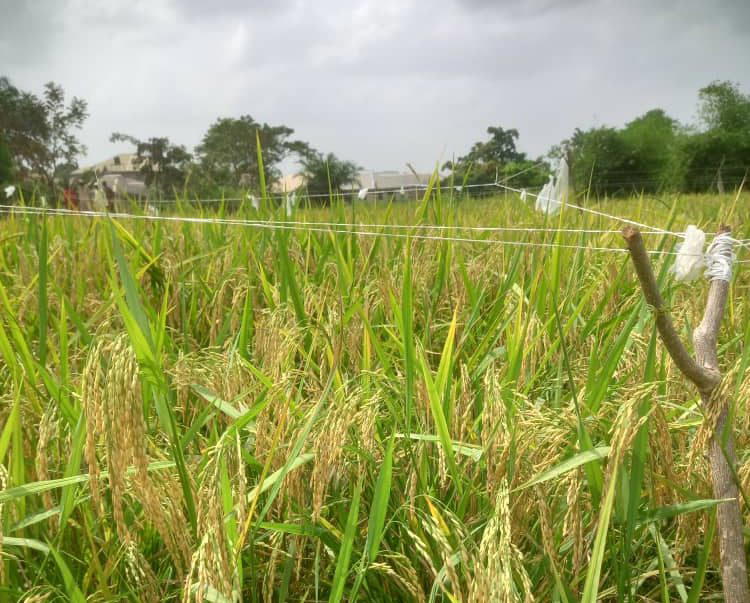
The stakeholders’ engagement was followed by site selection, soil surveys, land demarcation, secured inputs, and the sowing of FARO, while additional agronomic practices are still being implemented on the demonstration plot.
The anticipated outcome of this project is positive, as it aims to enhance soil health, boost rice yields, and reduce methane emissions. Thus, Climate-Smart Agriculture (CSA) is not merely an option but a critical requirement for Nigeria’s sustainable development.
In attendance were policymakers, researchers, extension agents, and farmers to co-create practical solutions.
CSA-KAFACI integrates agricultural advancement with environmental sustainability and climate obligations under the Paris Agreement.Innovative Solutions for a Changing Climate
In a joint Initiative of the Federal Ministry of Agriculture and Food Security and the Korea-Africa Food and Agriculture Cooperation Initiative, in a strategic response to the dual challenges of declining soil fertility and climate change, collaborated to launch a transformative initiative to develop and deploy climate-smart, soil fertility enhancement technologies, and pest control tailored to Nigeria’s agricultural landscape.
Through a series of high-level technical engagements, field demonstrations, and stakeholder workshops held across Abuja in 2025 and 2026, the initiative is laying the foundation for a more resilient, productive, and sustainable agricultural system.
Meanwhile, the Permanent Secretary, Federal Ministry of Agriculture and Food Security, Engr. Marcus Ogunbiyi represented by the Director, Agricultural Land and Climate Change Management Services, Oshadiya Olanipekun, explained that the initiative focuses on scalable, nature-based, and climate-smart technologies, including:Green manure systems, for example, Sesbania, to restore soil nutrients; Livestock manure and composting for organic soil enrichment; Alternate Wetting and Drying (AWD) to optimize water use in rice production; Biochar application to enhance soil structure and carbon retention; and Integrated Soil Fertility Management (ISFM) for balanced nutrient use.
The journey began with a technical exchange among experts in soil science, climate-smart agriculture, and pest management, fostering cross-disciplinary innovation.
This was followed by the establishment of a demonstration site in Abuja, where climate-smart practices are being tested on pilot plots using improved methods such as nursery-based rice cultivation and controlled field trials.
Some of the resolutions from the engagements produced clear and actionable pathways for implementation: Promotion of locally developed, cost-effective technologies suited to Nigeria’s agro-ecological conditions
Strong emphasis on use of local resources to reduce input costs and enhance adoption
Establishment of a robust monitoring and evaluation framework to track progress and impact Commitment to capacity building and training for farmers, extension workers, researchers, and policymakers Development of practical action plans for nationwide scaling and sustainability
Meanwhile, for a future built on healthy soils, plants and climate resilience, the initiative represents a paradigm shift toward climate-smart, resource-efficient, and farmer-centered agriculture.
By restoring soil health, reducing greenhouse gas emissions, and improving productivity, it directly contributes to: Enhanced food security and national resilience Increased farmer incomes and livelihoods Sustainable land management and environmental protection.
Disclaimer
Comments expressed here do not reflect the opinions of Vanguard newspapers or any employee thereof.