By Gilbert Joseph
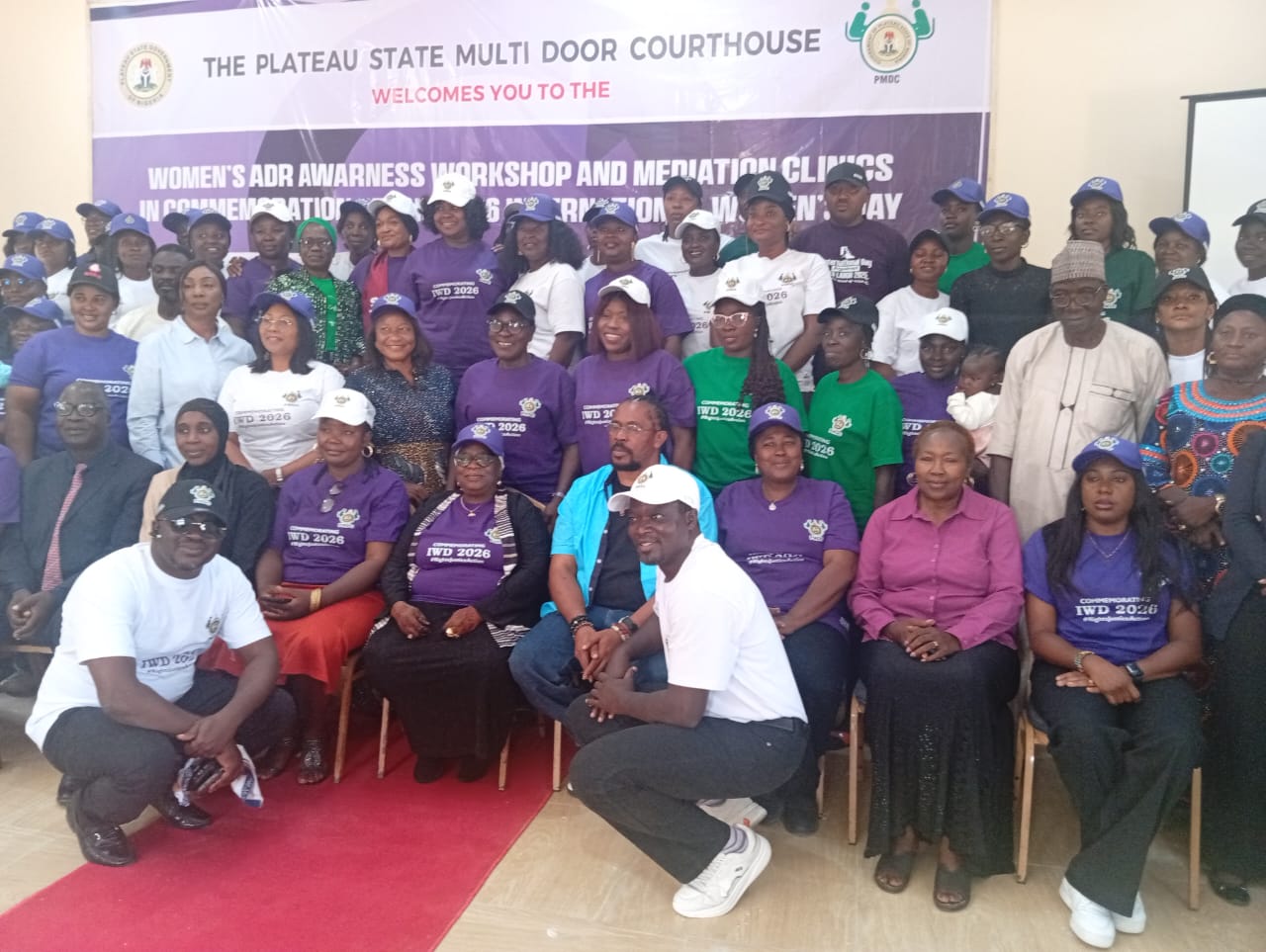
Jos – Efforts to improve women’s access to justice in Plateau State received a boost as the Plateau State Multi-Door Courthouse (PMDC), in collaboration with partners, convened an awareness workshop and mediation clinics in Jos to mark the 2026 International Women’s Day (IWD).
The initiative was supported by the Deutsche Gesellschaft für Internationale Zusammenarbeit- Sustainable and Inclusive Economic Development for Decent Employment in Nigeria (GIZ-SEDIN) programme.
The event anchored on the global theme, “Rights, Justice, Action for All Women and Girls,” and attracted women, legal practitioners, government officials and community women, with discussions centred on practical ways of making justice systems more inclusive and responsive to the needs of women.
Participants were introduced to various ADR mechanisms, through interactive sessions, which exposed them to how these approaches can resolve disputes more quickly, at lower cost and with less hostility than formal court processes, while also helping to preserve relationships and ease pressure on the courts.
Chairperson of PMDC, Justice Nafisa Musa, in her address, said the workshop was designed to confront persistent barriers limiting women’s access to justice.
She noted that factors such as fear, financial constraints, delays, illiteracy, stigma and institutional bottlenecks continue to hinder many women and girls from seeking redress.
“Rights may exist in law, yet remain unreachable in daily life. Where justice is difficult to access, silence often becomes a burden women are forced to carry,” she stated.
While highlighting the benefits of ADR, Justice Musa cautioned against its misuse.
“ADR must not become a tool for concealing injustice or compelling women into harmful compromise. It must be rights-based, gender-responsive and protective of the dignity and safety of women and girls,” she added.
Also speaking, the Director of PMDC, Roseline Baraje, explained that the programme was aimed at increasing awareness and encouraging women to take advantage of available ADR services.
“For many women, pursuing justice through conventional court processes can be challenging due to cost, time and complexity. This is why ADR mechanisms play a critical role in expanding access to justice,” she said.
She added that the mediation clinics offered free and confidential dispute resolution services, particularly for issues relating to family matters, business dealings, employment and property rights.
Providing further insight, the GIZ-SEDIN Advisor, Business Enabling Environment and Investment, and State Coordinator, Hauwa Mankilik, said the programme was structured to link justice with economic empowerment.
“Commemorating IWD 2026 offers a strategic moment to move beyond awareness to practical, system-level actions that remove structural barriers limiting women’s participation in economic and social life,” she said.
She explained that unresolved disputes often translate into financial losses, stalled businesses and reduced productivity among women.
“When disputes remain unresolved, they become mechanisms of economic exclusion. ADR provides a cost-effective, timely and relationship-preserving pathway to justice,” she stressed.
The programme also featured a women-focused mediation clinic, where trained professionals handled disputes in a confidential setting.
Some participants shared experiences on the benefits of ADR as two of them, Hannatu Gimba and Dorcas Ogbodo, said the PMDC helped settle long-standing inheritance disputes within their families, restoring harmony.
Diverse speakers in their goodwill messages expressed confidence that the initiative would boost awareness, build trust in justice institutions and equip women with practical skills for resolving disputes, while contributing to broader justice reforms in Plateau State.
Disclaimer
Comments expressed here do not reflect the opinions of Vanguard newspapers or any employee thereof.