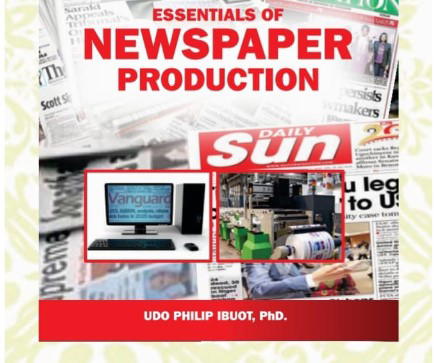
Author: Udo Philip Ibuot, PhD
Year: 2025
Subject Area: Journalism / Mass Communication / Newspaper Production
Review by Elizabeth Osayande & Ifunanya Ndigwe
Introduction and Purpose of the Book
Essentials of Newspaper Production is a practical book that explains how newspapers are produced from start to finish. The main aim of the book is to teach readers how news is gathered, edited, designed, and finally published. It is written mainly for mass communication students, journalism trainees, editors, and anyone who wants to understand how a newsroom works.
The book tries to solve a common problem in journalism training, which is that many people learn reporting but do not fully understand what happens to their stories after they are written. This book fills that gap by showing how stories move from reporters to editors, to designers, and finally to print or digital publication.
Summary of the Book
The book is divided into twelve chapters, and each chapter focuses on an important part of newspaper production.
Chapter 1 introduces newspaper production as a complete process. gathering news, printing and distribution. The chapter explains what a newspaper is, its role in society, and why proper production is important. The author made readers understand how different departments in a newsroom work together to produce a finished newspaper.
Chapter 2 focuses on visuals in newspaper production. It explains the importance of visual elements such as photographs, drawings, charts, and graphics in helping readers understand news better. The chapter shows how visuals attract attention, break long texts, and make stories clearer
Chapter 3 deals with newspaper and magazine sizes. The book explains different newspaper formats such as broadsheet, tabloid, and compact sizes. It shows how size affects layout, design, and reader experience.
Chapter 4 explains newspaper navigation elements. This chapter discusses items that help readers find their way around a newspaper, such as nameplates, mastheads, page numbers, section labels, folios, and index boxes. The book explains that good navigation elements make a newspaper easy to read and help readers quickly locate stories that interest them.
Chapter 5 focuses on editing in newspaper production. It explains the role of editors and sub-editors in checking stories for accuracy, clarity, grammar, balance, and fairness. The chapter shows how editing improves the quality of news and helps prevent errors, libel, and ethical problems.
Chapter 6 discusses headlines in detail. The chapter explains what headlines are, their types, characteristics, functions, and rules. It shows how headlines summarise stories, attract readers, and indicate the importance of news.
Chapter 7 focuses on news photographs and infographics. The author explains the role of photographs in telling stories and adding credibility to news reports. He discusses photo selection, captions, ethical use of images, and basic photo composition.
Chapter 8 focuses on typography. The chapter explains what typefaces and fonts are, how they are measured, and how they are used in newspaper production. It discusses the difference between serif and sans-serif typefaces and explains why certain fonts are better for headlines while others are more suitable for body text.
Chapter 9 deals with layout and page design. It explains how newspaper pages are planned and organised, including the placement of headlines, photographs, stories, and advertisements. The chapter showed the importance of balance, alignment, and white space in page design.
Chapter 10 focuses on copyfitting. The chapter explains how editors calculate and manage space on a newspaper page. It discusses the use of column inches and how headlines, photographs, adverts, and stories are measured and adjusted to fit available space.
Chapter 11 discusses desktop publishing systems. It explains how computers and publishing software are used to produce newspaper pages. The chapter describes the development of desktop publishing and how it replaced many manual production processes. It also explains how software such as Adobe PageMaker and Adobe InDesign are used in editing, layout design, and prepress operations in modern newsrooms.
The final chapter focused on computer-assisted newspaper production. It explains how information and communication technology has transformed news gathering, editing, and production. The chapter discusses tools such as computers, the internet, email, mobile phones, and digital cameras. It also explains the use of software like Adobe InDesign, Microsoft Word, CorelDRAW, and Photoshop in designing pages, editing images, and preparing newspapers for printing.
Key Ideas and Themes
One major idea in the book is that newspaper production is a structured and careful process. From the start, news gathering and editing to layout, typography, and printing, each stage depends on accuracy and teamwork. The book shows that errors at any stage can affect the quality and credibility of a newspaper.
Another key theme is that visuals and design are central to communication. Through chapters on visuals, typography, layout, navigation elements, photographs, and infographics, the book explains that newspapers are not meant to be read as plain text. Design choices guide readers, highlight important stories, and make information easier to understand.
The book emphasises the role of editors and production staff as gatekeepers. Editing, headline writing, and copyfitting are presented as responsibilities that require skill, judgment, and ethical awareness.
Technology is an important theme. The book explains how desktop publishing systems, computers, and software have changed newspaper production. However, it clearly shows that technology only supports the work, human judgment is still needed to make final decisions.
Evaluation and Analysis
Strengths
One major strength of the book is its practical approach. It explains what newspaper production is and how it is actually done. Chapters on editing, headlines, layout, copyfitting, and typography clearly are real newsroom practices.
Another strength is the clear explanation. Technical topics such as newspaper sizes, navigation elements, column measurement, fonts, and page planning are explained in simple language that students can easily understand.
The book is also strong in its coverage of visual journalism. The chapters on visuals, photographs, and infographics show how images support stories and improve communication.
In addition, the book is relevant to Nigerian journalism practice. The explanations fit the realities of local newsrooms, making it useful for students and trainee journalists in Nigeria
The organisation of the book is another advantage. The chapters follow a good flow of newspaper production
Weaknesses
One limitation of the book is its focus on print newspapers. While it discusses computers, desktop publishing, and digital tools, it does not really explore online journalism and social media news production.
Another weakness is the limited use of visual examples, more sample pages and images would have improved understanding.
Style and Organisation
The language of the book is simple and direct. It avoids unnecessary academic language, which makes it easy for beginners to understand.
The chapters are arranged logically, and ideas flow from one topic to another. Each chapter builds on the previous one, making the book easy to follow.
Relevance and Contribution
The book makes an important contribution to journalism education by explaining the production side of news, which is often ignored by teachers.
It is useful for training future journalists and editors, and it connects traditional newspaper practices with modern production technologies.
And because the content reflects Nigerian newsroom practice, the book is relevant to African journalism students and media people.
Conclusion and Recommendation
Essentials of Newspaper Production is a practical, and useful book for anyone who wants to understand how newspapers are made. It combines theory with real newsroom practice.
Although it could improve by adding more digital journalism content and visual examples.
The book is highly recommended for mass communication students and anyone interested in newspaper production
Disclaimer
Comments expressed here do not reflect the opinions of Vanguard newspapers or any employee thereof.