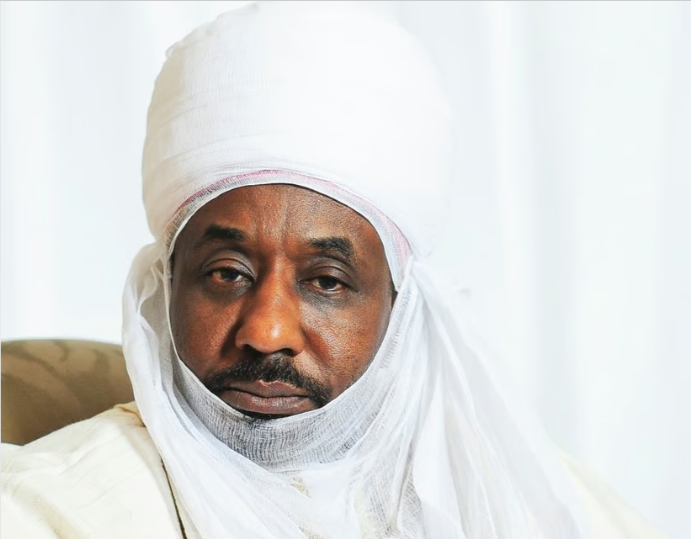
Sanusi
…Say FG must take responsibility for economic challenges
…Tinubu’s reforms already yielding results — Edun
…Otti calls for leadership discipline, human capital investment to unlock Africa’s prosperity
By Gift Chapi Odekina, Abuja
The Emir of Kano, His Royal Highness Muhammadu Sanusi II, and renowned economist and founder of Stanbic IBTC Bank, Dr. Atedo Peterside, have urged Nigerian leaders to embrace economic discipline, sincerity, and accountability in governance, warning that without these, the pains of current reforms may never translate into real gains for citizens.
Both spoke on Tuesday at the Oxford Global Think Tank Leadership Conference and Book Launch held in Abuja, where policymakers and economic experts deliberated on leadership and reform in Nigeria.
Peterside: ‘Reforms Must Be Matched With Accountability’
Dr. Peterside, a long-time advocate of economic transparency, commended the Bola Tinubu administration for removing fuel subsidies but cautioned that the real challenge lies in the management of the additional revenues generated.
“I’m somebody who believes in speaking the truth all the time. You could quote me in 2012 and quote me in 2025 — the issues remain the same,” he said.
“I’ll be the first to commend this government for removing the fuel subsidy — something we’ve been calling for since the first economic summit over 30 years ago. But the same president must also take responsibility for frustrating similar efforts in 2012.”
He warned that without strict accountability, the fiscal gains from subsidy removal and exchange rate reform could easily be squandered.
“Those measures improve fiscal balance and give all three tiers of government more revenue. But what’s the point of giving a thief more money if he’s only going to steal it? The real test is how that revenue is used — whether it’s to fuel 400 cars in a presidential convoy or to lift citizens out of poverty.”
Peterside argued that while painful reforms were necessary, “gain follows pain only when the right things are done afterward.”
He called for an inclusive economy that allows citizens to invest and thrive without political connections.
Sanusi: ‘Nigeria Ignored Sound Economic Advice’
The Emir of Kano, Muhammadu Sanusi II, also a former Governor of the Central Bank of Nigeria (CBN), traced Nigeria’s persistent economic challenges to a failure to act on sound expert advice.
“A failure to understand economics often leads to misplaced expectations,” he said. “There’s a role for the Central Bank, the Ministry of Finance, monetary policy, fiscal policy, and institutional reforms.”
Recalling the 2012 fuel subsidy protests, Sanusi said Nigeria’s current hardship could have been avoided.
“If we had allowed the Jonathan government to remove the subsidy in 2011, the pain then would have been a tiny fraction of what we’re facing today,” he stated.
Sanusi revealed that the CBN had projected minimal inflationary impact at the time and pledged to stabilize the economy within a year.
“I stood up and said, remove the subsidy today — inflation might rise from 11% to 13%, and I would bring it down in a year. We would not be having 30-something percent inflation today.”
He noted that while the CBN has since prevented hyperinflation and stabilized the naira, wasteful public spending remains the core problem.
“Why do we need 48 ministers? Why do we need dozens of vehicles in convoys? Until we address the size and cost of government, reforms will remain superficial.”
Sanusi also lamented the culture of sycophancy in governance, saying many leaders surround themselves with praise-singers rather than truth-tellers.
“People who tell leaders the truth are seen as enemies, while those who flatter them are rewarded. It’s not in your benefit to turn yourselves into praise singers — you disgrace your offices when you do that,” he cautioned.
Edun: ‘Tinubu’s Reforms Already Impacting Lives’
Responding, the Minister of Finance and Coordinating Minister of the Economy, Mr. Wale Edun, said President Tinubu’s reforms have brought about positive leadership change and economic renewal.
“Leadership changed in 2023 — and President Bola Ahmed Tinubu changed it for the better,” Edun said. “The most important aspect of our reforms is the human side — improving people’s daily lives, reducing transport and food costs.”
He disclosed that the federal government has established a transparent and accountable digital system providing direct payments to 15 million vulnerable households.
“Each beneficiary is identified by name and national identity number and paid digitally, either through a bank account or mobile wallet,” he explained.
Edun also announced a “work-based development program” approved by the National Economic Council to empower communities across Nigeria’s 774 local governments.
“This program will channel resources and funding to 8,809 wards to support small businesses and cottage industries,” he said, adding that reforms were designed to “reach the grassroots and improve lives.”
Otti: ‘Africa Needs Leadership Discipline, Not Just Resources’
Abia State Governor, Dr. Alex Otti, said Africa’s development would remain elusive unless leaders embrace discipline, education, and human capital development.
“No matter how much mineral wealth you have, without the right leadership, you will not make progress,” he said. “Natural resources without intellect become a hindrance to development.”
He emphasized that development is a human function, not a product of natural endowment.
“Some countries have advanced with little mineral wealth, while others with abundant resources remain poor. The difference is leadership discipline and intellectual capital,” he said.
Otti criticized Nigeria’s leadership recruitment system, describing it as one that “promotes mediocrity and chaos.”
“Our setbacks are the consequence of treating leadership development as a distant concern,” he said. “We mistake noise for courage and neglect character and competence.”
Highlighting his administration’s human capital agenda, Otti disclosed that 20% of Abia’s budget is devoted to education, while 15% goes to health.
“Our free and compulsory education policy doubled school enrollment within three months. We’ve recruited over 5,000 teachers and plan to hire 4,000 more,” he revealed.
“We’ve also functionalized over 800 of 1,200 planned primary healthcare centers across the state.”
Otti commended the organizers of the conference — including Professor Arun Mahadir and Dr. (Mrs.) Arunma Oteh, former World Bank Vice President — for advancing the conversation on leadership reform.
He described Oteh’s new book, “All Hands on Deck: Prosperity Through World-Class Capital Markets,” as a timely work offering “important leadership lessons and a new paradigm for national development.”
“At 65, Nigeria should be able to stand firmly and move forward with the resolve to fertilize the great estate our nation has been endowed with,” Otti concluded.
Disclaimer
Comments expressed here do not reflect the opinions of Vanguard newspapers or any employee thereof.