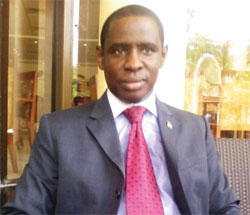
Banji Oyewunmi
On June 4th and 5th 2012, at the Shehu Musa Yar’Adua Centre in Abuja will be a beehive of activities. Leaders and stakeholders in the telecommunication industry will be converging there for the Nigerian Wireless Communications Expo (NWCE).
Speaking ahead of the expo, Banji Oyewunmi, Managing Director, Hayes Meridian Group, the organisers of the event, explains why Nigeria should go back to having at least one land-line per household, reports FRANKLIN Alli
What’s your company’s profile and track record?
Hayes Meridian Group was established in 1997 with Headquarters in London and offices in Honk Kong and Abuja. The Group is made up of four divisions. They are Hayes Meridian Communication (HMC), Hayes Meridian Information Technology (HMT0, Hayes Meridian Security (HMS) and Hayes Meridian Training (HMT).
The divisions operate distinctly, assisting both domestic and international radio communication systems, including clients with a wide range of solutions including secured two-way digital communication systems, security and defence solutions, information technology systems, training as well as equipping public order agencies and counter-terrorism professionals with the latest in protective equipment, explosives detection and disruption systems and high explosives mitigation technology.

Banji Oyewunmi
We actually started operation as social provider and in the last few years, we added radio communication as part of our offerings and that’s in response to demand when we moved into Nigeria. Originally, our core business is in IT, with focus on radio communication. As I said earlier, we‘ve been in operation since 1997. As a company, most of our deliveries have been in the UK. We have delivered for companies like the BBC, Police Offices in UK; more recently for the Ministry of Police Affairs and also for the Nigerian Police Force.
Right now in Abuja, we have Engineers who have just come back from training in Romania. Since we’ve been in Nigeria, we have Office in Abuja, but we train them abroad. We want them to be properly trained and equipped like any of Nigerians abroad. They get trained and come back here. I, for instance, have an IT background and I also have management background. That is why we are technologically based companies and we speak business terms.
Why did you choose Nigeria for the conference?
It’s a natural choice; I’m a Nigerian. The inspiration to organize this expo in Nigeria came when I attended the recently concluded International Wireless Communications Expo that took place in Las Vegas, Nevada, USA. The convention centre is not as big as this. In the summer people see Las Vegas as a place for gambling, conventions and expos and the rest of it and that’s entire industry on its own. Abuja can be like Las Vegas. Just because Abuja didn’t have water and beaches doesn’t mean things can’t happen.
When I saw how beautiful the expo was from the aesthetic point of it and all the value that came from it, I cried in my heart “Why can’t we have it in Nigeria? We have brilliant Nigerians as Engineers and IT software Consultant across the world and at home. If Nigerians don’t have visa to go there, why don’t we bring it home?
Must it be of the same size, I said no; but we must start from somewhere? I’m not the one who would say there is better climate and electricity in Ghana, let’s take it to Ghana. No. I can’t imagine anywhere else. The Americans won’t bring the expos here. So location was never an issue. It’s either Abuja or Lagos. If you hear that we are having an expo in Ghana it’s very embarrassing.
Why the choice of Abuja, bearing in mind most telecommunication companies is based in Lagos?
That’s a very good question. Originally when I came up with this idea, I gathered my team and informed them we would be having an expo mid March, and Lagos and Abuja seem obvious. But my CEO said the challenges of moving one expo from Abuja to Lagos or vice –versa, simultaneously is huge. The things coming from abroad we have to ship down in hundreds of kilograms and the rest of it. It became clear to me that most of the private sector companies, government agencies reside in Abuja.
And most of our clients that bare coming are based in Abuja. But we know we can’t ignore Lagos. In fact, most t of our colleagues and partners coming from abroad want us to have it in Lagos, and they were not happy when I said no, it’s not Lagos. You must understand this is something almost privately funded. By the time you multiply the resources and the cost, we are going to have one good expo, and before you know it it’s 2013 and we are going to have a second expo. We can even do it in both Lagos and Abuja.
What do you intends to achieve?
In fairness, my sense of reasoning is very altruistic; it wasn’t a Dollarised decision. In do we have to gain, In terms of what we have to gain, it’s nothing.” The expo is self-funded and we are not likely to breakeven. That’s not the point. Ultimately, if we succeed in just creating that environment where people can call themselves a community, where wireless community comes together, that is what we want to achieve.
For me, it’s an inward investment drive. There are too many broad-brand and telecom company out there who would like to come to Nigeria. I don’t think they will come here if there’s a trade fair to sell doors, engines and switches, etc. But if it is a specific industry-type expo, then, they would come. India is a natural hub for programmers. I am sure there are a lot of people here in Nigeria who can programme. We want to use the expo as a real tool for trade and investment.
What is required to participate in the expo?
We make no demand on anyone. Participation is free but if you want to be a speaker at the event, that is a different thing and there are certain requirements for speakers. You need to have a track record and know what you want to talk about. Just register free and turn up. In terms of exhibitors, we made it nominal. The expo is not about money.
What’s your assessment of the ICT sector in Nigeria?
The sector is currently dominated by foreign companies and foreign names. If you are a Nigerian company with Nigerian name looks for a job, of course the foreign company will get the job. I don’t understand that because it is the same Nigerians in the Diasporas that they will send to come and do the job. So the ICT policies and the rest should be localized.
They have to recognise that we have the intellect, and we can do a very good job. The fact that I’m a returnee is a good example and there are many more there that are good at what they do. About ten days ago I attended a meeting in London, the consultant got the job from one of the major government’s agencies and they were looking for local partners and from the meeting we had, it was clear from the discussion that a company in India got the contract but they have never been to Nigeria before but they got the contract. Now they are looking for local companies to execute it. I felt embarrassed.
They have never been here and they have no intention of coming. They will pay in foreign currencies-pounds sterling and Dollars and look for local companies to do the job. That ‘s our IT policy; we are hoping that if we can show that our companies which is fully Nigerian can deliver time and time, and other companies can do the same, there will be less dependency on foreign companies to execute contracts in Nigeria. Nigerians are good enough.
What informed your bias for Motorola products?
I don’t have a bias for them, I have relationship with them. Motorola is one of our partners. Others are American International Radio Inc; Safemobile, Silverage Group, Crosshall International and T3 Media & Communications. I’m agnostic when it comes to technology. If it works, it works.
Motorola and the two- way communications are the biggest and the best in radio communication systems. So, there is natural ability to try to gravitate towards what is the best, and the best is always evolving and we are a company looking towards evolving, too. So, we have a strategic partnership with them, a partnership that works. The Vice President of Motorola and the President of American International Radio (AIR) are coming to Nigeria for this expo, and it’ll be his first time, and I know that Motorola has been here for about 47 years. So, they accorded us that courtesy and respect, and I’m proud to be part of the Motorola family.
What will visitors to the expo see in terms of products?
From my point of view, we’ll be showcasing the best and the latest technology in wireless communication devices and solutions in the industry. At the expo, we will highlight positive impacts of wireless communications on sustainable development and provision of security.
How do you see the wireless industry in Nigeria and what are the challenges?
I know Nigeria is a difficult environment for doing business because you have to run generator, yet the profit margins of any ICT companies in the country is enough to compensate the challenges. Most of them are not even publicly quoted on the Nigeria Stock Exchange.
Clearly, their interest as to the nation is questionable. The second challenge is the total lack of collaboration among players in the industry. We can neither legislate nor mandate collaboration; the absence of enabling environment has made impossible for collaboration.
We are not asking companies to sell their industry’s secret, but please, there has to be much more collaboration. The third challenge is the enforcing organisation, the Nigeria Communication Commission (NCC) who is meant to enforce and regulate the player in the sector. Nobody checks for shoddy services.
It’s only in Nigeria that if the customer is not getting the right services, and there is no recourse. So those are the challenges including that of electricity and the rest of it. That is what makes the wireless industry difficult one in Nigeria. It’s a very difficult one; a slow one for that matter. I think the minimum standard is okay. The Caribbean is a small country.
It is not as big as Abeokuta, and has faster broad-band services than we have it here. It’s unbelievable. Some of them have mountainous volcanic eruptions environment but they have broadband services. We need to ask ourselves: Is it that government does not want us to have a better broadband. It’s the question I am asking. With more broadband there will be better transparency. It is like scholarship.
There will be more efficiency. If you have elections for example, nobody would think of rigging, when your CCTV shot reveals the voting, when the results are counted and sorted out; so, sometimes, I have the feelings that people intentionally allowed this things not to grow so that they could get away with whatever they wanted. With better communication technology there will be transparency and less corruption.
The other day, I was told by a friend of mine that armed robbers went to someone’s house and that they were there for an hour and half. I didn’t want to believe the story and I asked what he meant by an hour and half. I asked, couldn’t somebody called the police? He replied: “You’re not in London. There’s no signal. What did you mean there’s no signal? The robbers knew the response time is probably not there.
Can Nigeria do broadband and fix wireless together?
In all seriousness, you can’t have everything wireless. Everything can’t be via satellite. What we are saying is that we can’t do without landlines because wireless technology has their own interruptions. What happened if the satellites shift? If you really want better speed, you can’t depend on wireless. Again, wireless is not cheap. Your phone call on your landline is cheaper. So, the fact that we lost more than ¼ of landlines in NITEL is a shame. I don’t think we can avoid going back to having at least one landline per household.
This will involve digging the road again. We have to do it. There is no house abroad that doesn’t have landline; why do we think it isn’t a feasible option here in Nigeria. There’s so much we can do through the land lines but you can’t do through wireless.
At some point in time, NCC will have to face the fact that Nigeria needs one land line per household. It is something we can’t run away from. Also, there is security aspect to it. If there is a fix line to a house it is easy to trace but if there is no fixed line, you can’t trace the house. That is why in abroad, they don’t use mobile phones as something to do with your identity.
Disclaimer
Comments expressed here do not reflect the opinions of Vanguard newspapers or any employee thereof.