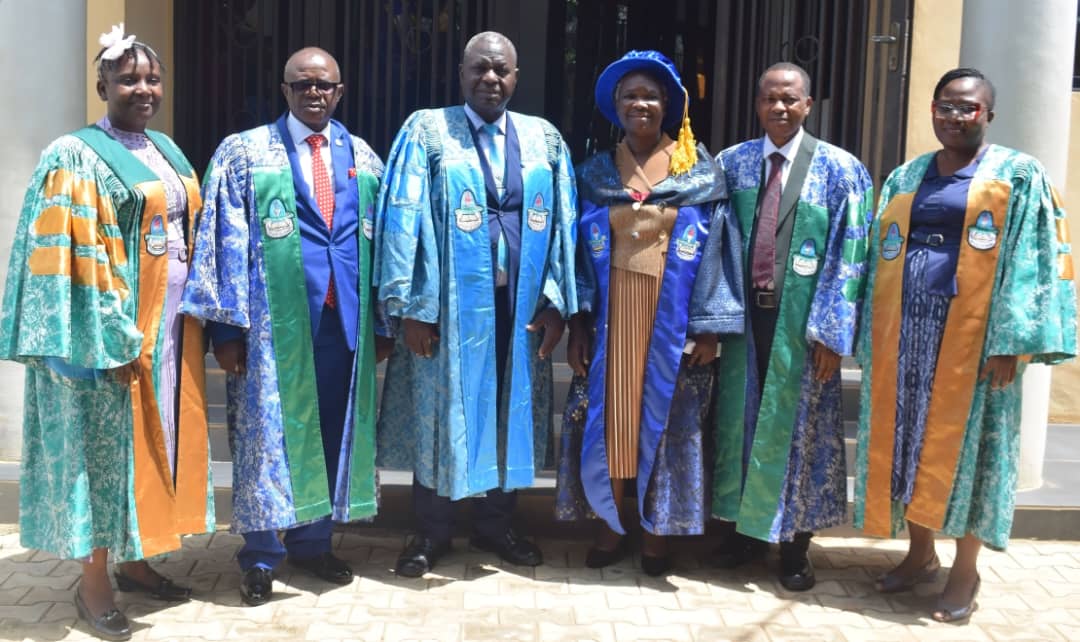
Crawford University Bursar, Mrs. Olukemi Ayeni; University Registrar Mr. Moses Itauma; Crawford University Vice Chancellor, Professor Reuben Jiya Kolo; the 10th Crawford University Inaugural Lecturer, Professor Comfort Moradeke Amire; University Deputy Vice Chancellor, Professor Isaac Aladegbola and University Librarian, Mrs. Elizabeth Lateef at the University 10Th Inaugural Lecture Recently.
By Elizabeth Osayande
Crawford University recently welcomed Professor Comfort Moradeke Amire for its 10th inaugural lecture, drawing attention to Nigeria’s alarming poverty statistics, with over 63% of the population—approximately 133 million people—classified as multidimensionally poor. The discussion centered on sustainable development as a vital solution to this persistent issue.
“The widespread poverty in Nigeria is exacerbated by rapid population growth, inflation, and governance challenges that hinder equitable resource distribution,” Professor Amire stated, highlighting the complexity of the situation. Despite being Africa’s largest economy, she noted that economic inequality, unemployment, and limited access to essential services continue to plague the nation.
In defining poverty, Professor Amire remarked, “It is the lack of basic necessities due to limited access to productive resources.” She elaborated on the characteristics of poverty in Nigeria, stating, “It is marked by unemployment, low-income rates, and inadequate access to healthcare and education.” By doing so, she emphasized that poverty can lead to dire consequences, warning of “hunger, malnutrition, increased crime rates, and mass migration” when left unaddressed.
To combat these challenges, she underscored the importance of capacity building, noting that it plays a crucial role in facilitating sustainable development. “Capacity building involves enhancing individual skills, institutional capabilities, and systemic frameworks,” she explained. She advocated for practical strategies such as vocational training programs, entrepreneurship development, and digital literacy initiatives to equip Nigerians, particularly youth and women, with the skills needed for economic empowerment.
“If all of us can collaborate and build the capacity of our people, they will not be dependent on the government or others,” Professor Amire urged, emphasizing the need for a collective approach. She also highlighted the potential for foreign direct investment, stating, “Capacity building can attract FDI; concerted efforts are required to achieve sustainable development goals for our country.”
Furthermore, Prof. Amire advocated for inclusivity, stating, “We must ensure that people with disabilities are not left out.” She stressed the urgency of tackling corruption and better harnessing the nation’s rich resources. “By doing so, there will be no reason to be poor,” she concluded, leaving the audience with a powerful call to action.
The event was attended by family members of the professor, school officials, and distinguished personalities, who engaged in a rich dialogue about Nigeria’s development landscape. Professor Amire’s insights underscored the critical intersection of capacity building and sustainable development as a pathway to a more prosperous and equitable Nigeria.
Disclaimer
Comments expressed here do not reflect the opinions of Vanguard newspapers or any employee thereof.