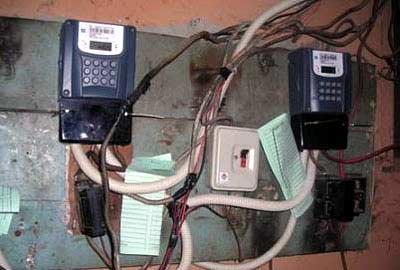
The recent Federal Government policy, which phased out the use of the analogue metering system in the country’s power sector, was widely acclaimed by most citizens, particularly electricity consumers, as very apt.
The pronouncement of the Minister of Power, Prof. Barth Nnaji, at a recent media chat that the estimated billing system for electricity consumers was now unacceptable somewhat elicited a lot of joy from many citizens.

Observers say that the newly introduced pre-paid meters would boost the revenue generation capacity of PHCN, if they are properly managed by those in charge.
They also note that pre-paid meters are more cost effective than the analogue meters, while they would neutralise some extraneous factors such as the charging of administrative costs on meters and the movement of PHCN staff from house-to-house in debt-recovery efforts.
Mr Charles Ihimodu, an Abuja-based banker, said that the introduction of pre-paid meters would consequently make electricity consumers to be more economical in their energy use.
“Just like users of pre-paid GSM billing systems, users of pre-paid electricity meters will now be more conscious of the need to maximise the use of the money used in buying vouchers.
“This will consequently eliminate wastage, as electricity consumers will be more rational and careful in their energy consumption,’’ Ihimodu said.
Sharing similar sentiments, Mrs Lillian Anueyiagu, a resident of the Federal Capital Territory (FCT), said that the pre-paid meter, which was recently installed in her house, was far better than the analogue type she was formerly using.
She conceded that she was now more careful about her electricity consumption, as there was no longer any room for her to “leave my lights on unnecessarily again.’’.
Analysts contend that the pre-paid meter system will aid efforts to eradicate some of the current challenges facing PHCN, particularly those relating to the use of the analogue type of meters.
They, however, insist that efforts should be intensified to provide electricity consumers with functional prepaid meters because of their comparative advantages over the analogue meters.
Mr Muyiwa Ogunlesi, an Abuja-based pharmacist, noted that the new digital meter could not be tampered with because of its in-built anti-interference facilities.
“Instances abound where some cheeky consumers tamper with the measuring devices of the analogue meters so as to cheat or pay less for the electricity they consume.
“When the pre-paid meters are installed and fully in operation, it will save appreciable funds for the PHCN, as those officials in charge of meters’ reading and bills’ distribution would no longer be needed.
“The savings could be used by PHCN to upgrade its facilities or for any other development purposes,’’ he said.
Sharing similar sentiments, Mrs Ginika Chukwuedo, a teacher, said that the new metering system, if properly coordinated, would boost PHCN’s customer trust since the pre-paid meters’ measuring and billing systems were fully automated.
“Since the whole idea is about `pay-as-you-go’ charging system, electricity consumers will now be quite eager to pay their bills so as to enjoy uninterrupted power supply.
“One major reason some people give for not paying their electric bills is that the old billing system was not fair. They also complain that in spite of PHCN’s erratic power supply, they still get huge estimated bills at the end of the month,’’ she said.
Chukwuedo stressed that the new prepayment meters would reduce corrupt tendencies among PHCN officials.
“Since customers are required to pay their bills upfront; the era of collecting bribe to re-connect defaulting customers will end. Don’t forget the fact that the new electricity meters automatically disconnect consumers whenever they run out of credit,’’ she said.
The Minister of Power, Prof. Nnaji, has been using every available opportunity to drum up support for the prepayment meters.
He stressed that the new meters, when fully installed across the country, would significantly reduce the administrative costs incurred on the running power industries.
Nnaji expatiated that the new metering system was an electronic, automated system which could effectively tackle the current problems of load shedding in the country.
Besides, the minister said that the era of deploying PHCN staff to read meters in individual homes to ascertain the quantity of energy consumed was gradually fading away with the advent of pre-paid meters.
Nnaji explained that the new meters would enable PHCN and Independent Power Producers (IPPs) across the country to know the actual demand for energy in Nigeria, adding that such knowledge would enable them to plan for the number of people using their energy.
Dr Sam Amadi, the Chairman of Nigerian Electricity Regulatory Commission (NERC), also vouched for the effectiveness of the pre-paid meter, saying that it would engender energy efficiency, while fostering a change of attitude in the way consumers used electricity.
Amadi, who said this at a two-day workshop organised for electricity consumers and stakeholders in Abuja last year, also noted that energy producers would get the right pricing for their products.
He stressed that the envisaged attitudinal change in electricity consumers and energy producers would lead to greater efficiency in energy utilisation, as both investors and consumers would get appropriate tariffs and adequate energy for the people’s use.
Mrs Grace Eyoma, the Commissioner for Government and Consumer Affairs in NERC, said that the commission had been encouraging the use of prepaid meters by electricity consumers because it would be in the best interest of power-distribution companies and their customers.
She said that the use of pre-paid meters would protect electricity consumers from the menace of “crazy bills’’ and mass-disconnections by the utility companies.
“It will also assist the consumers to efficiently manage their consumption patterns and conserve energy,’’ Eyoma said.
Mr James Chijioke, the National President, Electricity Consumers Association of Nigeria (ECAN), once complained at a workshop in Abuja last year that electricity consumers “are not happy with the less than transparent billing process currently in place in the country’’.
He specifically frowned at the Meter Maintenance Fee (MMF) which consumers were forced to pay along with their monthly electricity bills, saying that no maintenance works were carried out on the meters at the end of the day.
“Every month, consumers are compelled to pay between N300 and N5,000 as MMF, whereas the meters have not been maintained since 2005.
“By our survey, a cursory estimate of direct consumers of electricity in Nigeria is conservatively put at between 30 to 40 million and these are the people who pay MMF.
“Using the average of N500 per consumer for our calculation, PHCN generates about N20 billion from MMF every month and this translates to about N240 billion every year.
“Even with these huge funds in the pool, some communities experience total blackout for months just because a 300KVA transformer, which costs less than N2 million, has broken down.
“Nevertheless, in the electricity bills given to consumers, there is what is referred to as fixed charges, which we believe should be pooled in a trust fund to finance the replacement of faulty electrical components.
“However, consumers complain that most times, they are made to pay for such replacements even when such exigencies are already provided for in the monthly bills they pay,’’ he said.
Chijioke called on the management of PHCN to stop further collection of MMF and other “unjustifiable charges’’ from electricity consumers.
Observers say that Chijioke’s position is very apt, especially when the NERC had issued a directive to the PHCN to stop further collection of meter maintenance charges from consumers.
Regrettably, however, officials of the PHCN have yet to implement the directive, to the chagrin of electricity consumers in states of the federation.
The complaints notwithstanding, observers say that efforts should be made to increase the distribution of the new pre-paid meters to enable more electricity consumers to have access to the innovative gadget.
However, Mr Debo Adegoke, the Public Affairs Manager of PHCN in Abuja, said sometime last year that a total of 117,000 free prepaid meters would be installed for PHCN customers in Abuja Municipal Area Council and its environs, under a World Bank-assisted programme.
He said that the prepaid meters were also being installed in satellite towns such as Jikwoy, Nyanya, and Kubwa, while the installation of the meters in Karu had also commenced.
Adegoke said that the provision of the free prepaid meters for the areas was bankrolled by the World Bank so as to enable all PHCN customers to enjoy the same billing system.
He said that the old billing system would be discarded once prepaid meters were installed for all PHCN customers.
Mrs Jane Okemini, the Business Manager of PHCN in Nyanya, FCT, said that the PHCN had concluded arrangements to install pre-paid meters for its customers in Nyanya, Karu, Mararaba and Masaka neighbourhoods.
She said that the meters would be supplied to customers in these areas free of charge since the World Bank was financing the programme.
“All our customers within this network would be properly metered on free prepaid meters. So, they would be sure of what they are paying for, as they would pay according to their consumption,’’ Okemini said.
She said that the old “flat-rate’’ billing system would be jettisoned as soon as prepaid meters were installed for all PHCN customers.
Mr Joseph Ciroma, Assistant General Manager (Distribution) of PHCN in Wuse, Abuja, however, conceded that one extraneous factor affecting the installation of prepaid meters for residents of the area was the free nature of the meters’ acquisition.
“For the simple fact that the meter is given out free of charge, a lot of people are coming out for it before it gets exhausted,’’ he said.
He also said that the PHCN still had a lot of public sensitisation campaign to carry out to stimulate the people’s interest in the pre-paid meters “because whenever they see our officials, who are around for the meter installations, they usually feel agitated.’’
Ciroma said that the World Bank and Federal Government would spend N3 billion to procure 117,000 prepaid meters, which would be installed for customers in Karu, Mararaba, Kubwa and Gwagwalada.
Observers say that the use of pre-paid meters by PHCN will go a long way in transforming the country’s power distribution processes.
Efforts should, however, be made to standardise all processes involved in the meters’ acquisition, utilisation and maintenance, they add. (NANFeatures)
Disclaimer
Comments expressed here do not reflect the opinions of Vanguard newspapers or any employee thereof.