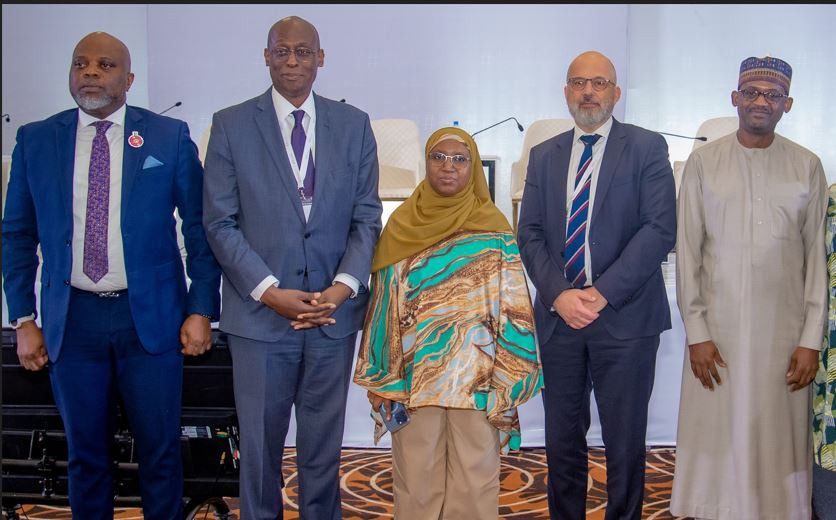
L-R: Special Adviser to the President on Economic Matters, Dr. Tope Fasua, representing the Vice President, Kashim Shettima; Assistant High Commissioner (Operations), United Nations High Commissioner for Refugees, UNHCR, Raouf Mazou; Chief Executive Officer, Outsource Global Technologies, Ms. Amal Hassan; Special Adviser on Solutions to Internal Displacement, UNASG, Robert Piper, and Vice President, Tropical General Investment (TGI Group), Farouk Gumel, during the 2024 Africa Roundtable on Private Sector Solutions to Internal Displacement themed ‘Bridging Futures: Converging for Solutions’ organised by UNHCR in Lagos on Thursday.
By Esther Onyegbula
As part of efforts to advance private sector solutions for internally displaced persons (IDPs) and other impacted communities, business leaders from across Africa gathered in Nigeria for the 2024 Africa Roundtable to explore innovative ways the private sector can support these communities.
The two-day event was organized by the United Nations High Commissioner for Refugees (UNHCR) in collaboration with the Nigerian government, the Special Advisor to the United Nations Secretary-General on Solutions to Internal Displacement, and co-hosted by the International Organization for Migration (IOM) and the United Nations Development Programme (UNDP).
Globally, IDPs—those forced to flee their homes but remaining within their country’s borders—outnumber refugees. By mid-2024, an estimated 72.1 million people were internally displaced worldwide, with about 50% residing in Africa. Conflict remains the leading cause of displacement, accounting for over 90% of cases globally. Additionally, climate change—particularly floods and droughts—has increasingly driven displacement, with recent flooding displacing over 5.7 million people in Sub-Saharan Africa.
IDPs often face prolonged displacement with limited access to basic services, legal protection, and economic opportunities. This hinders their ability to meet essential needs, contribute to economic development, and increases their reliance on humanitarian aid, thereby exacerbating social tensions within host communities.
Speaking at the event, United Nations Special Advisor on Solutions to Internal Displacement, Robert Piper, said, “We have a new generation of solutions plans that promise to move millions of internally displaced persons onto solutions pathways. The private sector has a vital role to play—by creating jobs, supporting entrepreneurship, and driving economic growth. We need capital, ideas, creativity, and markets. Success depends on it.”
Despite this potential, fragile environments in many affected countries pose significant challenges to private sector investment due to high risks and the absence of enabling regulatory frameworks. Discussions focused on overcoming barriers to investment, emphasizing the need for collaboration between governments, development banks, and the private sector to unlock opportunities in these regions.
Participants—including governments, development actors, private sector companies, civil society, and international organizations—discussed key areas where the private sector can drive durable solutions and generate livelihood opportunities. Solutions highlighted included modernizing agricultural practices, expanding access to finance, enhancing climate resilience, fostering innovation through technology, investing in durable solutions, and improving digital connectivity.
These investments not only address immediate needs but also build long-term resilience, contributing to economic recovery and stability in fragile contexts.
Vice Chairman of Tropical Investments Group (TGI), Mr. Farouk Gumel, emphasized, “It’s time for the private sector to recognize the immense potential and responsibility in addressing internal displacement, especially at our doorstep. By leveraging our resources and expertise, we can create sustainable solutions that support displaced and host communities while driving economic growth and innovation. To operate effectively in displacement contexts, it is crucial to establish a favorable regulatory environment, implement de-risking strategies, and foster public-private partnerships. By addressing these areas, we can ensure that the private sector contributes meaningfully and sustainably to the well-being of displaced populations and their hosts.”
In Nigeria, the Katsina State Government, UNHCR, and TGI have partnered to support 5,000 IDPs in the state. The government is providing land, irrigation, and subsidies, while TGI offers private sector expertise, cooperative capacity building, financial services, and market access. UNHCR will facilitate community engagement, beneficiary selection, and a one-stop shop for essential identification, documentation, and protection monitoring. The project aims to promote self-reliance and sustainable solutions for IDPs through job creation in agriculture and inclusion in government socio-economic programmes.
Emphasizing the importance of engaging the private sector, Vice President of Nigeria H.E. Kashim Shettima said, “We cannot be successful without the active engagement of the private sector. A healthy, comfortable population is essential for the continued growth of private sector enterprises, the robustness of purchasing power, and emotionally stable workers.”
The roundtable brought together over 250 participants from 11 countries, focusing on nations with the highest populations of IDPs, including Burkina Faso, the Central African Republic, and Chad. Other countries discussed included Niger, Ethiopia, Mozambique, Nigeria, Somalia, Sudan, and South Sudan—all grappling with significant displacement challenges.
Assistant High Commissioner for Operations at UNHCR, Raouf Mazou, remarked, “Achieving self-reliance and socio-economic inclusion of these populations should be the goal. The private sector plays a key role in creating jobs and enhancing access to services. This roundtable was crucial in fostering discussions on overcoming barriers and finding mutual benefits for sustainable solutions to displacement.”
Disclaimer
Comments expressed here do not reflect the opinions of Vanguard newspapers or any employee thereof.