…As Zulum directs Salary increase for Medical Doctors
By Ndahi Marama, Maiduguri
The Coordinating Minister of Health and Social Welfare, Prof. Mohammed Ali Pate, and his counterpart Minister of State for Health, Dr Iziaq Adekunle Salako have decried that the incessant strike in the health sector is not only demarketing the sector and the various professional bodies within the system, but it is a major stumbling block to the Universal Health Coverage (UHC) agenda.
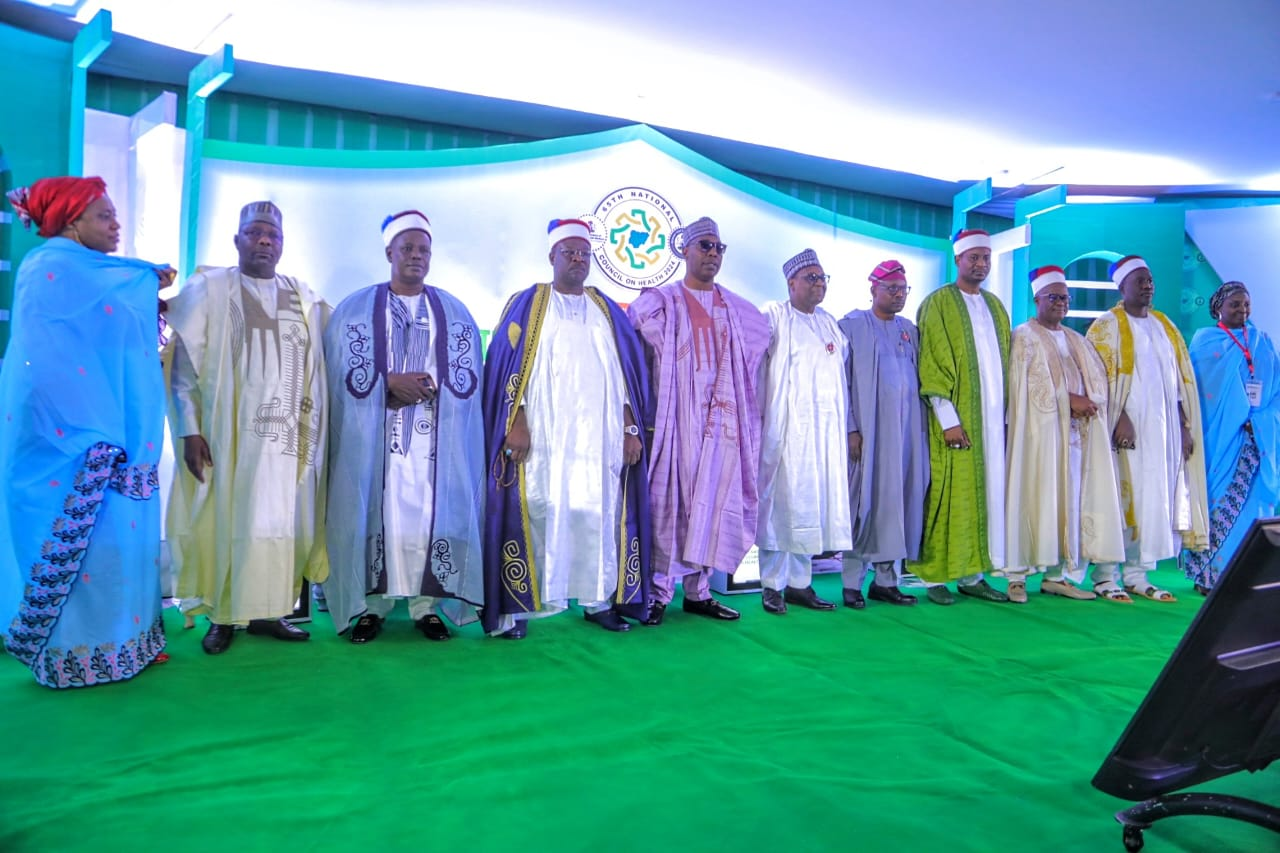
The duo made the declaration at the opening Ceremony of the 65th National Health Council (NHC) meeting 2024 in Borno state, with the theme: ‘Accelerating Pathways to Universal Health Coverage: Strategies for 2030 Success’.
The occasion which has Governor Babagana Zulum of Borno state as Guest Speaker, also attracted Commissioners of Health from the 36 states of the federation, heads of development partners like, WHO, UNICEF, and other medical experts who converged at the Mohammed Indimi Centre for Distance Learning, University of Maiduguri.
The Ministers said, “the strike declared by Medical and Dental Consultants’ Association of Nigeria (MCDAN) is uncalled for, as it has crippled medical services across the country, and appealed to the striking workers to call off the strike for the interest of mankind, stressing that, all their demands would be fulfilled by the federal government”.
This is as Governor Zulum, who declared the occasion open approved a pay rise for medical doctors in the state civil service to match the one earned by those working with the federal government.
Delivering his keynote address, Professor Pate said, the 65th NCH meeting is a testament to President Bola Ahmed Tinubu’s commitment to improving the health and well-being of every Nigerian, from the bustling cities to the non-governmental communities.
His words: “My presence here today is a testament to our unwavering commitment to advancing the health and well-being of all our citizens.We are here because we recognize that health is not merely a sector, but a fundamental pillar of the progress and stability of any society.
“We are as well reminded of the responsibilities we carry and the great potential we have to transform the health sector across our nation.
” As we gathered here, we have very tangible things that we can say we collectively achieved in collaboration between the federal government, all the state governments, our local governments, our partners, private sector, civil society.
“The power of collective effort in advancing the health of the population cannot be over-emphasized.And we are beginning to see the results. Since the unveiling of this Health Sector Renewal Investment Initiative, His Excellency, Mr. President, announced that health is back on the front burner. That was in December 2023, after we came back from Haiti.
“This administration has worked diligently, hand in hand with the states and with all partners to advance the health and well-being of Nigerians. Across the four pillars and the three anomalies that we laid out. On the governance pillar, I think we have a lot to say, because we signed the compact with all the state governments.We managed to have coherence around the data of where are we going in the health sector. We had the Joint Annual Review (JAR) that told us that child mortality is beginning to go down.
“We still have a lot of work to do in other areas. We know that utilization of services has increased, but that Nigerians also are dealing with the cost of care and affordability. We do know that in terms of performance across the country, some of our states have done very well and some have a lot of catching up to do. And we’ve responded to citizens’ needs, understanding their perceptions, their perspective, and reporting back to them.That is the spirit of governance.
“On the second pillar, to improve our population health outcomes, we still have some tangible results that we can celebrate. The fact that we have had four out of the last eight meetings of the Ministerial Oversight Committee for the BNCBF, and there was 46 billion Naira (N46 billion) to the more than 8,000 primary health care centers in Nigeria on time, I think speaks volumes to the cooperation between the federal government and the states.
“We announced we will train 120,000 frontline health workers. We’ve done more than 43,000 of those, and we’re on our path. And that is a testament to the collective efforts of the federal government and the states. We’ve expanded the medical relief program to provide targeted support to ensure that the poorest and most vulnerable access products when they need them.
“The revitalization of primary health care has been underway, and more will be revitalized. I think we have visibility to almost 4,000 in collaboration with the states.On the human resources policies, we have had the human resources workforce migration policy approved, which was started at the Council on Health, but it’s really going a long way in expanding the training of our health workers. The federal government will also state doubling the quotas for medical schools, pharmacies, nurses, and others. I think there are a lot more that we can mention in terms of learning across the health professions, which we have been able to do.
“On the affordability side, through the NHIA, the obstetric complication of BPM, we’ve had more than 1,000 women already being prepared for their obstetric fistula complications free of charge since that initiative was announced. In addition, in an effort to reduce the maternal mortality, we know that at least 30 primary health care centers, secondary facilities, are able to offer similar services. These services are being impaneled by the NHIA, and more will be impaneled.By the end of the year, we’ll have less than 100, and they will have reimbursement for NHIA to offer these free services for emergencies for women when they face obstetric complications, including cesarean sections”. Prof. Pate stated.
Also in his remarks, the Minister of State for Health, Dr. Iziaq Adekunle Salako, said
since his recent redeployment to the Federal Ministry of Health and Social Welfare, has been intense and most rewarding.
“I was privileged to on my first week in office participate in the Joint Annual Review of the Sector Wide Approach for the Nigerian Health Sector Renewal Investment Initiative which was like a crash programme on the the new direction the Nigerian health system is headed and within 3 weeks, I am here at the National Council on Health.
“The Renewed Hope Agenda of President Bola Ahmed Tinubu GCFR for the health sector is to provide to all Nigerians, particularly the vulnerable population; qualitative, accessible, affordable and responsive healthcare services that does not put the Nigerians in financial hardship. Universal Health Coverage (UHC) by 2030 for us is therefore not just a slogan or a catchphrase but a commitment that is backed by a robust pathway to deliver on it in an inclusive, equitable and evidence driven manner”. Salako said.
……Zulum approves pay rise for Borno doctors, to match FG level
Meanwhile, the Borno State Governor, Babagana Umara Zulum who was the Special Guest of Honour at the event, approved a pay rise for medical doctors in the state civil service to match the one earned by those working with the federal government.
Zulum directed the state head of service and the commissioner of health to liaise with the relevant federal government agency to bridge gaps in payment between medical doctors working for the state and those with the federal government.
The governor ordered that the pay rise be implemented from the 1st of December 2024.
“Link up with the relevant federal government agency and ensure there is no disparity between salaries of the federal government workers and those working with the state government,” Zulum said.
He added, “As of December 1, medical doctors working with Borno State government will receive the same salary as those working with the federal government.”
The governor also stated that Borno has since complied with the Abuja Declaration, which requires every state of the federation to allocate at least 15% of its annual budget to health care.
“I am proud to share that Borno State has taken significant steps towards meeting the Abuja Declaration. In our recent budget, we have prioritised health infrastructure, increased access to maternal and child health services, and allocated resources for critical disease control programmes,” the governor reiterated.
Governor Zulum also recalled that the state government has paid for the residency allowance amounting to over N300m for doctors working with the state hospitals and over N100m to support the indigenes of Borno working with other health facilities across the country.
The Shehu of Dikwa, Ibrahim Ibn Umar El-Kanemi, who represented the Shehu of Borno, led other Emirs, chiefs, and traditional title holders to the occasion.
Others in attendance include heads of agencies under the Federal Ministry of Health, the 36 commissioners of health across the country, UN health agencies and development partners.
Also in attendance were senior government officials, including the Special Adviser to the President on Health, Dr Salma Anas Kolo, Special Assistant to the President on Public Health, Uzu Rochas-Anwikah, permanent secretary of the Federal Ministry of Health, Daju Kachollom, among other delegates.
Disclaimer
Comments expressed here do not reflect the opinions of Vanguard newspapers or any employee thereof.