By Ebunoluwa Sessou
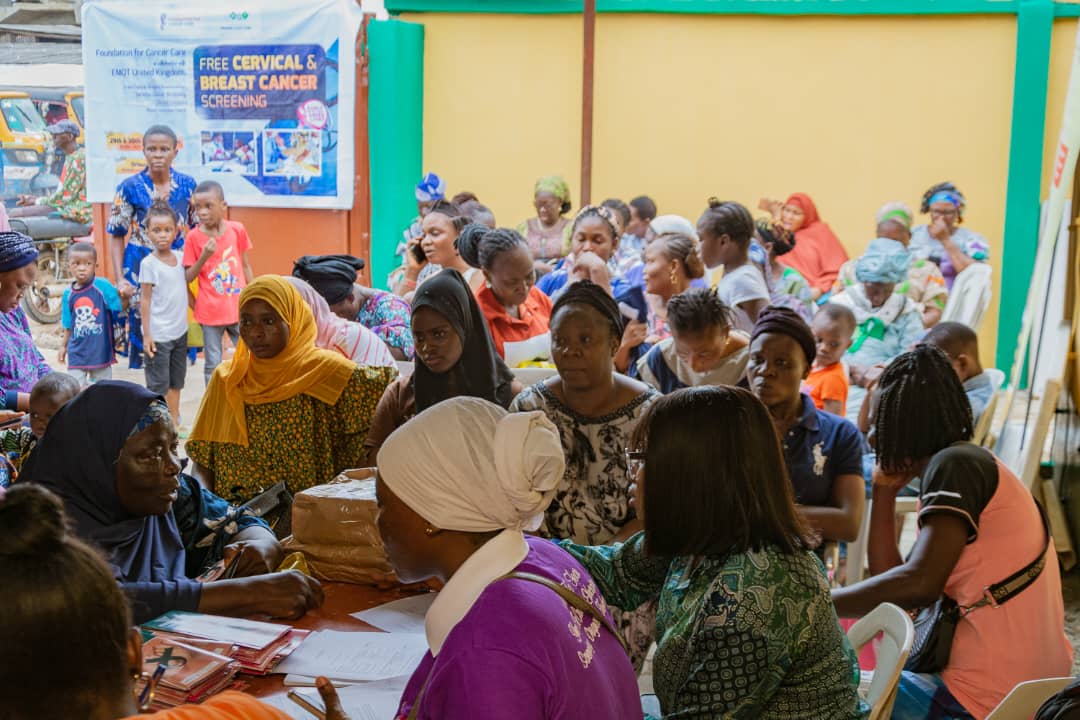
More than 200 women and girls were screened at the just concluded two days free screening on cervical and breast cancer organised by Foundation for Cancer Care in collaboration with Emerging Markets Quality Trails, EMQT United Kingdom.
The event was a bid to help women and girl children detect cervical and breast cancer early.
Speaking during the 2days free screening which took place at Primary Health Centre, Orisumbare, Founder and Chief Strategy Officer, EMQT, Shalom Lloyd, lamented that cancer is a disease that affects people.
Adding that, in Africa, over 95 percent of patients with cancer die due to late diagnosis.
According to her, early detection saves lives.
“Why should people die over a disease that if detected early could be prevented? Our responsibility is to allow people know the importance of treatment in cancer cases.
“This is why we decided to partner with Foundation for Cancer Care. The exercise was organised to address screening and treatment. Once we uncover an abnormality, we will ensure treatment takes place immediately.
“Raising funds is not just to organize program but sponsor treatment of cancer including mammogram, investigation and treatment. As much as funds are available to take care of patients’ treatment, the foundation will not hesitate to do so. This is to encourage more people to join in the fundraising against cancer.
“In Enugu, we screened about 450 women on breast and cervical cancer and we uncovered 33 cervical issues and 14 breast lumps and two breast cancer patients and were treated. We have been doing it for a while and our matrix is early detection saves lives.
“Our goal is to bring clinical trials and drug development into Nigeria so that patients can have access to medicine. The way the foundation has structured the program to be able to diagnose patients abnormally.
A Clinical researcher, Dr. Tina Barton, PhD, said that the screening exercise was an opportunity for people to detect their health status on time. If you detect early, the cost of the treatment is minimized and cheaper.
“As an experienced clinical researcher, we want to ensure that what we want to do is to get pharmaceutical companies to include Nigeria in our global clinical trials so that if there is a new medicine, it can be available in Nigeria as much as possible.
“For women who are afraid of screening, I will advise them to put off their fears and ensure early screening so that they could get help from people who have committed their resources into addressing issues of cervical and breast cancer”, she said.
In his reaction, Program Manager, Foundation for Cancer Care, Tolulope Adeyoola Oladipupo, disclosed that the foundation’s target was to screen 200 women on breast and cervical cancer and to provide treatment for abnormal findings.
“Our program at the foundation for cancer care was designed to reduce the death statistics especially for the indigents and under-served in society through education and awareness, cancer screening and treatments. Clinical examination, blood pressure, blood glucose check also help.
“Every 30 seconds one person is diagnosed with cancer in Nigeria and 70 percent of these diagnoses lead to death.
“We are committed to treat women with abnormal findings and ensure that others are well diagnosed. We want to ensure we capture cancer early so that when it is detected early, it can be treated early. The foundation is ready to support patients financially”, she said.
Speaking on the challenges, Tolulope, said. “Penetrating the community was a challenge and that is why we are calling for support from the community health system to ensure that the process of accessing the community is smoother. Funding is also a challenge especially for cancer treatment.
“We commend the people who funded the program, for their commitment. With the involvement of groups like this, taking up the responsibility to ensure that people at the grassroots have access to screening and treatment would be possible.
“We hope that more corporate individuals would take on this responsibility to be able to work with organisations like ours that have been proven to be ethical and authentic.
Disclaimer
Comments expressed here do not reflect the opinions of Vanguard newspapers or any employee thereof.