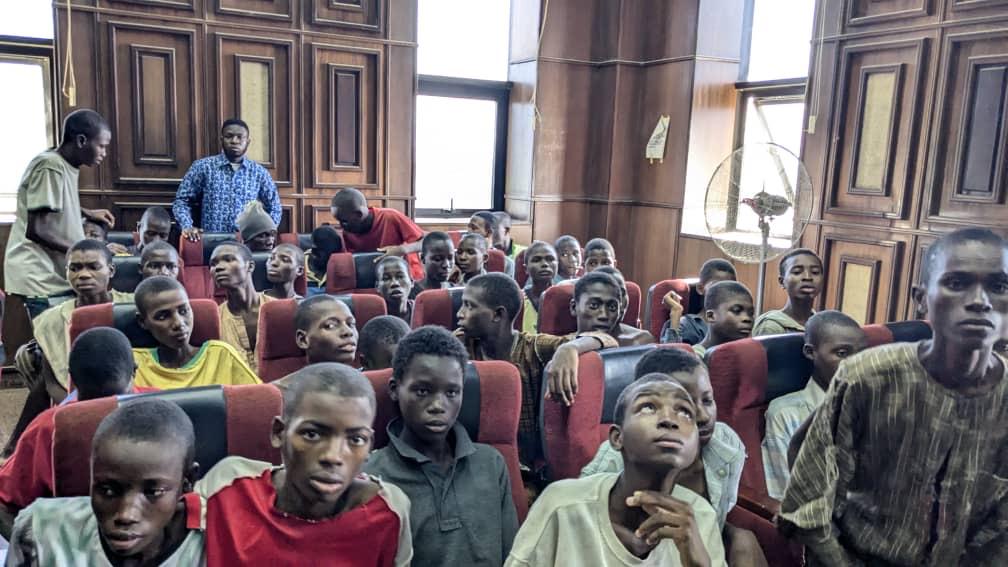
File image of some of the minors in court.
By Funmi Ajumobi
In response to the unlawful detention of minors labelled as “child offenders” or “children in conflict with the law,” Barrister Akinlami, a social development legal practitioner and child advocacy expert, has said that it is the state that should face scrutiny, not these vulnerable individuals.
He argued that a government that deprives its children of education, healthcare, shelter, sanitation, and hygiene; that holds them for 93 days without sufficient food, clothing, or medical care; and that imposes an unachievable bail condition of 10 million Naira along with two sureties of the same amount—conditions that these impoverished yet valuable children cannot fulfil until January 25, 2025—should be held accountable for its shortcomings rather than shifting blame onto its children.
Akinlami analysed the legal framework to determine whether the Nigerian government and its judicial system have upheld or violated the protections guaranteed to children in such situations.
He asserted that the Federal High Court lacks jurisdiction based on Section 149 of the Child’s Rights Act, 2003, which states: “There shall be established for each State of the Federation and the Federal Capital Territory, Abuja, a Court to be known as the Family Court (in this Act referred to as ‘the Court’) for the purposes of hearing and determining matters relating to children.”
Section 151(1)(b) further emphasises: “Subject to the provisions of this Act and in addition to such other jurisdiction as may be conferred on it by any other law, the Court shall have unlimited jurisdiction to hear and determine…any criminal proceedings involving or relating to any penalty, forfeiture, punishment, or other liability in respect of an offence committed by a child, against a child, or against the interest of a child.”
Moreover, Section 204 of the Child’s Rights Act, 2003, states: “No child shall be subjected to the criminal justice process or to criminal sanctions; a child alleged to have committed an act that would constitute a criminal offence if he were an adult shall be subjected only to the child justice system and processes outlined in this Act.”
Regarding children’s privacy in legal matters, Section 205 mandates: (1) The right of the child to privacy specified in Section 8 of this Act must be upheld at all stages of child justice administration to prevent harm caused by undue publicity or labeling. Consequently, no information that could lead to the identification of a child offender shall be published.
Section 216(1) stipulates that parents or guardians must attend court proceedings: “The parents or guardian of a child offender charged before the Court for an act constituting a criminal offence shall attend all stages of the proceedings and shall have the right to participate.”
Additionally, Section 207(1) calls for a specialised unit within the Nigeria Police Force: “There shall be established, in the Nigeria Police Force, a specialised unit…composed of police officers who frequently or exclusively deal with children.”
Finally, Section 212 outlines that detention pending trial should be a last resort: (1) Detention pending trial shall (a) be used only as a measure of last resort and for the shortest possible duration; (b) wherever feasible, be replaced by alternative measures such as close supervision, care by family members, or placement in educational settings. (2) While in detention, a child must receive care, protection, and all necessary individual assistance—including social, educational, vocational, psychological, medical, and physical support—appropriate to their age, gender, and personality.
“Given these clear mandates, it is up to Nigerians to determine whether the Nigerian government and its legal system have honoured or neglected the rights and protections owed to these children,” Akinlami added.
Disclaimer
Comments expressed here do not reflect the opinions of Vanguard newspapers or any employee thereof.