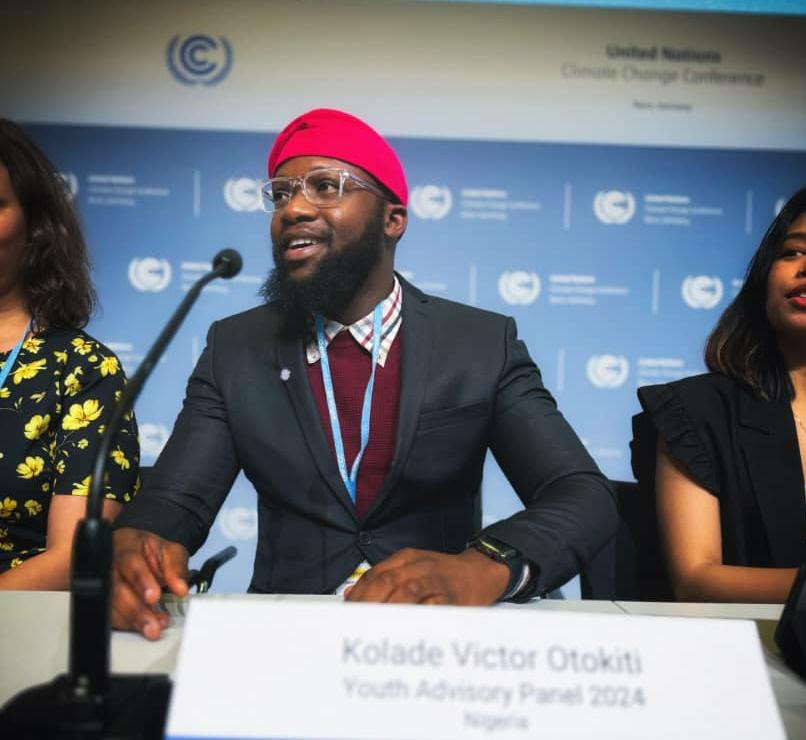
In the face of escalating climate crises, Kolade Victor Otokiti is making waves with research and global engagement efforts, carving a unique path that could reshape how we approach climate resilience.
With hands-on experience and a diverse educational background spanning spatial sciences, environment and development, and urban and regional planning, Kolade brings a multidisciplinary approach to tackling one of the most pressing issues of our time.
When asked about the rationale behind his diverse academic background, he said: “The challenges we face do not fit neatly into academic silos, nor should our skills and solutions.”
This approach is evident in his research, where he adopts a combination of qualitative, quantitative, and GIS techniques to analyse contemporary societal issues such as climate vulnerabilities. His proficiency in GIS has allowed him to critically conduct analyses of climate and provide recommendations for climate-resilient human settlements.
Kolade explained that a distinctive characteristic of his work is its community-centric approach. “Top-down policies often fail because they do not account for local realities; real change happens when communities are empowered to develop their own resilience strategies and are regarded as equal participants in decision-making processes,” he said.
His recent publication, “Collective Action for Transformative Change: The Case of Helston Climate Action Group (UK),” reinforces his point, demonstrating how local initiatives can drive broader societal shifts towards sustainability. “What is happening in Helston is not isolated; these are examples of global trends. By studying these local efforts, we can uncover insights that resonate across communities worldwide, including Nigeria,” he reiterated.
Kolade’s impact extends beyond academia. As a climate change activist, he has shown leadership on multiple fronts. Representing YOUNGO, he participated in the 19th meeting of the Executive Committee of the Warsaw International Mechanism for Loss and Damage at the UN Campus in Bonn, Germany. At COP28 in Dubai, he was part of a youth contingent advocating for more inclusive and innovative approaches to climate action.
“We are not just talking about future impacts anymore; for many communities in the Global South, climate adaptation is a present-day survival strategy,” he said.
Kolade is also one of the twelve young leaders selected for the Youth Advisory Panel at the Global Centre on Adaptation (GCA) in the Netherlands. In this role, he provides strategic advice on youth engagement, supports advocacy efforts to advance global climate adaptation efforts, and raises awareness among young people to drive the adaptation agenda.
Exemplary, he co-hosted an event with 1,500 registrations from 116 countries, highlighting the challenges and opportunities for youth engagement in fostering nature-based solutions and climate-resilient infrastructure. The topic aligns with one of his articles, which examines potential nature-based solutions for addressing climate impacts. This synergy underscores that he is not only committed to researching and advancing scientific understanding of climate issues but also passionate about educating and inspiring widespread action, embodying a truly dedicated holistic climate action.
Kolade has successfully coordinated numerous roundtables, workshops, and events, fostering dialogue among climate change adaptation enthusiasts. For instance, he co-led a working group on the youth adaptation forum at SB60, Bonn, Germany. Together with the participants, they devised strategies for youth involvement in national adaptation plans (NAPs), methodologies for climate risk assessment, and preparations for the forthcoming Youth Adaptation Action Day on October 12, 2024.
Despite winning prestigious scholarships, presenting at international conferences, and writing research articles, Kolade remains focused on the bigger picture. “Every flood, every heatwave, and every failed crop is a reminder of what is at stake; our work is not just about publishing papers or attending conferences. It is about securing a livable future for communities around the world,” he said.
As the world continues to experience the vicious onslaught and cascading impacts of climate change, Kolade’s work offers a blueprint for scientifically sound and socially equitable climate adaptation solutions. “We are not just studying climate change; we’re living it, adapting to it, and actively helping to shape a more resilient future for all,” Kolade concluded.
Disclaimer
Comments expressed here do not reflect the opinions of Vanguard newspapers or any employee thereof.