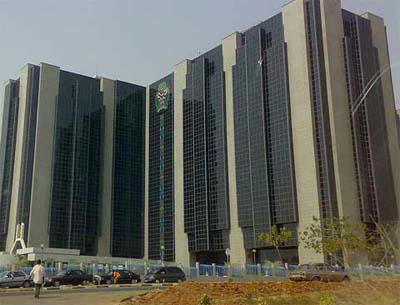
The Central Bank of Nigeria, CBN, headquaters, Abuja
By Adisa Adeleye
AS a critic of the Central Bank`s tightening Monetary Policy, the latest announcement that the benchmark rate would remain unchanged at the moment is a pleasant news. After reviewing the economy in the year 2011, the Central Bank`s Monetary Policy committee has come to a sensible decision that the policy should remain unchanged.
It should be realized that the same committee has changed the MPRI six times from 6.25% to 12%; also Cash Reserved Requirement (CRR) has moved from 1% to 8% while Liquidity Ratio (LR) remains 30% from 25%. The position of the economy today is that of upward movement of GDP without corresponding growth in employment.
The government has promised an era of economic transformation which would ensure macroeconomic stability and growth without inflation. Inflation has been the scourge of the present administration and the Central Bank Governor has assumed the self assigned role of a celebrated hunter looking for the elusive dangerous animal styled Inflation.
In layman`s view, Inflation could be described as `too much money chasing too few goods`. Anytime there is a prospect of too much money in the economy, Central Bank has always been too ready to load its gun with the bullets of mopping the `excess liquidity` at a cost to the nation.
For clarification, Inflation is a process of rise in prices. Thus, an inflationary process could come about as a result of change in demand or supply condition, or both, but the essential feature is that demand exceeds supply at the current price.
This is likely to occur once the zone of full employment is reached. In a developed economy, full employment is reached with 3% unemployment or less but there is no exact percentage that could be given at the point where the inflationary process might occur.
The reason for increase in demand might be due to many reasons, one of which may be a general increase in salaries and wages of workers or deliberate action of government to increase the supply of money through its expenditure. In the case of Inflation, increase in income would come about through increases in prices while output (supply of goods) remains unchanged.
The increase in income comes about because of an increase in output with constant prices. Once the initial price rise has taken place, some people will be better off and some worse off. Those who are charging higher prices would be better off and are likely to spend more, fuelling the process of Inflation.
Those who are worse off because they have the higher price goods are likely to react firstly in order to maintain their expenditure in real terms – this would mean an increase in their money expenditure and they may continue to use their savings in order to do this.
In addition, they are likely to react strongly in order to maintain their income in real terms. The likely example is that workers would demand through their unions increase in wages which is most likely to be granted by businessmen who would then increase the prices of their products.
Increasing costs brought about by defensive reaction can form part of the process of demand inflation. Because of the defensive reaction once the process is set in motion, there is no certainty that the process of increase in income could come to an end.
However, in the Nigerian situation where there is a large pool of unemployment (about 24%) and idle capacity in the manufacturing plants, any increase in income would likely lead to increase in demand, and increase in output (supply) and employment opportunities.
Thus, in combating the cost of inflation, it is necessary to distinguish between demand and cost induced one. For instance, measures taken to lower the level of effective demand would not necessarily solve the problem of inflation if it is cost inflation. Cost inflation might likely arise from the defensive reactions of workers or other factors to the threats to their real income.
As I have noted in this column many times before, the answer to demand inflation is to widen the avenues of supply. The attempt to suppress inflation through rise in interest rates has not been successful. The current inflation rate is still over 10% while unemployment rate is about 24%.
Massive investment
It is interesting to note that the Central Bank has now fully realized that massive investment in infrastructural development and strengthening of domestic manufacturing processes are surer ways of maintaining economic growth and employment generation.
There should be hardly any room for a tightening monetary policy in an economic transformation agenda. As stated by Mallam Sanusi Lamido, `I am satisfied that thithening at this point will be too pro-cyclical and unlikely to reverse any inflationary consequences of supply side shocks`.
I agree with the new emphasis of the Central Bank Governor on development of agriculture and manufacturing process as necessary for the economic growth of Nigeria. On agriculture, emphasis should now be placed on aid to small farmers in respect of weeding, planting of high yield seeds, harvesting, transportation and marketing of their products.
If farmers could get their products to the market and get immediate cash for their products, the incentive will be there to stay on the farm and produce more. This calls for transformation of the rural areas in the provision of modern amenities. Other rich nations at one time or the other directly or indirectly supported their local farmers.
On the question of the exchange rate, it is questionable or economically wise to fix the value of the naira so low as to make importation of essential goods and equipment so high as to affect development. An import dependent nation like Nigeria would rely on favorable exchange rate in its transformation agenda, even at this time that there are prospects of downward trends in economic activities in the rich and developed countries of the world.
Irrespective of what others might think it might be desirable to operate a multiple system of exchange rates to solve our economic needs. The present exchange rate of about N158 to 1$US would turn us into a country of users of second hand products because we cannot afford the prices of modern imported items.
A meaningful economic agenda should therefore, embrace expansion of supply of goods at home to minimize heavy reliance on import, increase in agricultural output to feed the nation and wise management of our oil resources.
Disclaimer
Comments expressed here do not reflect the opinions of Vanguard newspapers or any employee thereof.