….Say data reportage needed in achieving SDG-10, 16
By Ebunoluwa Sessou
United Nations, United Nations Population Fund, UNFPA as well as Africa Centre for Development Journalism, ACDJ have charged journalists in Nigeria to be actively involved in governance by playing a vital role in holding politicians as well as those in civil service accountable.
The media was also charged to keep citizens informed of issues and giving voice to the voiceless by giving data analysis of situations happening within the country.
Speaking, on the backdrop of the Sustainable Development Goals, SDGs -16, the United Nations Resident and Humanitarian Coordinator, Matthias Schmale in his keynote address said, the SDGs-16 which is devoted to ensuring public access to information and independent media, stated that, an informed citizen is an essential element of the development process.
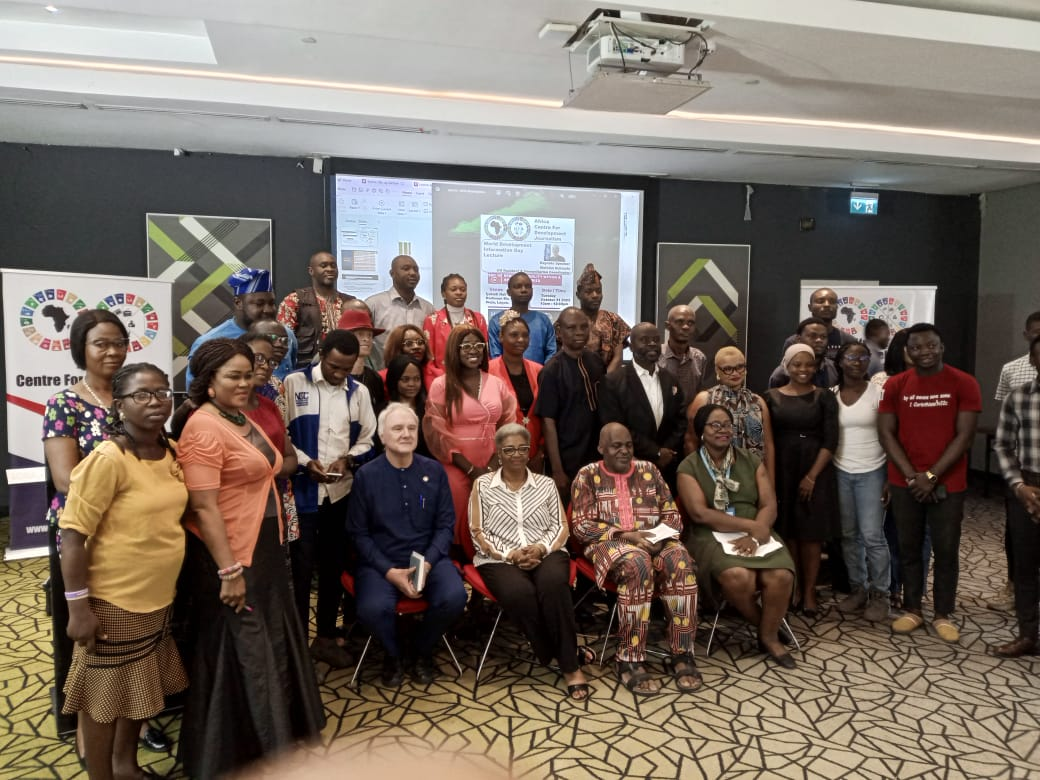
While speaking at the event to commemorate the World Development Information Day Lecture organized by the Africa Centre for Development Journalism, ACDJ, Schmale reiterated that the media is a stakeholder in the achievement of the Sustainable Development Goals, SDGs-16.
According to him, “Since the SDG was launched in 2015, 30 percent more countries have adopted laws to guarantee public access to information. Adding that the right to seek, receive and impart information and ideas through any media, is enshrined for all people, everywhere in the universal declaration of Human Rights which marks its 75the anniversary this year.
“The theme of this year’s World Development Information Day 2023 established by the UN General Assembly in 1972 is apt and timely;, “The Mobilization of public opinion for the Sustainable Development Goals”, Schmale lamented that series of cascading crisis has halted progress towards the SDGs and in some cases sent it into reverse. “The disruptions of conflict, climate change, Covid-19 have hindered global efforts to alleviate poverty, eradicate hunger and reduce inequalities.
Nigerians must be well informed about the objectives of the 2030 agenda, the role of the federal and state government in achieving the goals, the benefits of pursuing the SDGs to the Nigerian people, the struggles at the halfway point and the outcomes of the SDGs summit.
“A Nigerian public well informed about basic development issues is likely to put constructive pressure on policy makers at the federal and state levels to act with more urgency and more ambition. Changed public opinion can lead to changed public policy and action”.
However, he noted that the UN Sustainable Development Cooperation Framework for 2023-2027 which was jointly signed by UN and the government of Nigeria in November 2022, include the Cooperation framework for SDGs to bring about transformative initiatives that goes beyond the business-as-usual approach towards high impact action which will move the needle.
In his contribution, Rotimi Sankore, Editor-in-Chief, ACDJ, stated that data analysis is crucial in the reportage of the sub-national issues including education, health, stability, insecurity, humanitarian crisis.
With the population growth of the country, it is pertinent for investment to kick off in the area of education, health, and infrastructure, if not there would be chaos.
Population growth is not a problem in itself but if the investment growth does not commensurate with the population, it is indeed a problem.
Citing the statistics of Nigeria, he said, Nigeria has 20million children out of school, 33percent unemployment, 53percent youth unemployed, 60 million illiterate, 63 percent population/133 in multi-dimensional poverty.
There is a need to work on human development that could help address developmental crises. Investment in education in the North East, and North West is crucial in order to bring peace in those areas.
Mr. Koessan Kuawu, OIC/Representative, United Nations Population Fund, UNFPA speaking on importance of census identifying and reaching diverse communities/resolving inequalities, who was represented by the Dr. Esther Somefun, stated that the objective was to enhance understanding of the importance and significance of human centred sustainable development.
She explained that population data serves as the foundation for informed evidence-based national planning to achieve the 40percent of SDG indicators. Adding that census can provide reliable data either directly or through population projections.
Disclaimer
Comments expressed here do not reflect the opinions of Vanguard newspapers or any employee thereof.