By Dickson Omobola
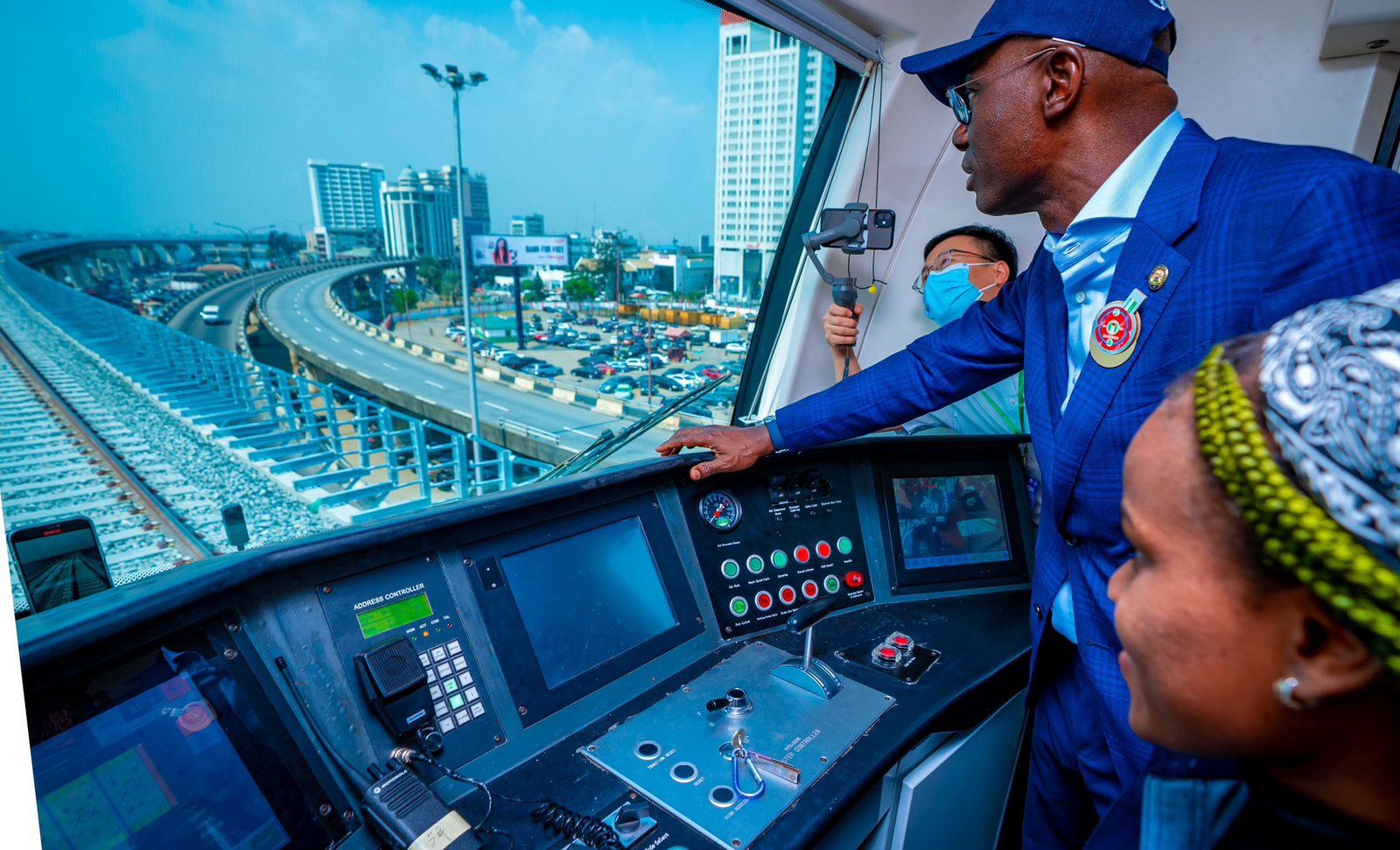
Monday, September 4, 2023, was a day of joy for Governor Babajide Sanwo-Olu of Lagos State, who conducted the maiden Blue Rail ride that threw Lagosians into a jubilant mood.
As early as 8:00 am, anxious residents had converged on the Marina railway station ready to embark on an inaugural voyage with their governor.
Under the gentle warmth of the Lagos sun, Sanwo-Olu, who dazzled in a striped suit and blue shirt imprinted in Lagos Metropolitan Area Transport
Authority, LAMATA, emblem, arrived at the train station alongside his wife and key officials set to chaperone his passengers. Although, beyond the glitz and razzmatazz that embraced the historical affair, disorganization due to a culture of clumsiness stalked the exercise.
While the Blue Rail, a representation of modernity and advancement in the nation’s economic nerve centre, was poised to kick start a new dawn as it stood erect on the tracks gazing at its guests, the sense of optimism and elation among Lagosians could not be concealed.
As the governor prepared to board the train, the atmosphere became charged with many rushing to get on board with him.
The feeling of confusion, which greeted the occasion, was made dire as riders, who included officials of the Lagos State Residents Registration Agency,
LASRRA, LAMATA, and security personnel scampered to get on the cars.
While few were able to get seats and enjoy the momentous sightseeing, many
were forced to stand with little or no space to move around.
Head train conductor
Before the ride, an ecstatic SanwoOlu, in the expansive edifice where the train was to depart, described himself as the head train conductor, saying: “I am your head train conductor today on this maiden trip and it is my delight to welcome all
my colleagues, train operators and everybody who will ensure that we
have a fantastic ride. Everybody, please join us from Marina to Mile 2. Thank you very much.”
No ‘hold your change’ Sanwo-Olu, who also spoke in Yoruba language, added that the
system of payment was a departure from the norm, noting: “Wo n gba owo lori train eleyi o, eleyi oun se ‘hold your change’. Change yin ni kadi yin. E make sure pe e ti ni cowry kadi yin lo wo. Ti e ba de ma koja e, ki ni kan wa nibe yen, e ma
fi kadi yin han si, ilekun yen a de si fun yin.
“E je ka wonu e woro wo, a so kale layo ati alafia. Ti e ba de fe pada pelu e, e ma so kale ti aba de Mile 2. Atu lowo pada, a de gbe wa pa dawa. Gbo gbo eto yen lati se sile o, e maje ka rush. Se egbo be? Oruko mi ni Babajide Sanwo-Olu, emi ni
head train le ni. Se eripe mo ti mura dada?
“(We don’t take money on this train. There is nothing like ‘hold your change’. Your change is your card. Do ensure you have the cowry card with you. If you intend to go
in, there is something over there where you can display your card, then the door will open. Please let us go in gently. We will all journey in peace. If you don’t intend to return with the train, you can drop at Mile 2. We have made all the
arrangements, please don’t rush. My name is Babajide Sanwo-Olu, the head
train for today. Can you see that I have dressed well?)”
Trip
Taking off from the Marina station at exactly 9:13 am, the railway vehicle
snaked through the megacity’s island for its mainland during which it uncovered the aesthetics and filth that combine to make the Centre of Excellence a peculiar city.
On one part was the breathtaking skyscrapers flanked by the lull of the
ocean, on another, was the dilapidated buildings swaggering in corrugated iron
sheets and tainted by dumping grounds.
Also, the first lady, Dr Ibijoke SanwoOlu, beaming with smiles, could be heard speaking while accompanying her husband, the ‘conductor’, to give directions.
“Congratulations, we are all making history actually,” she said.
Punctuated by a 90-second stop at each station, the 13-kilometre journey was completed in less than 30 minutes. With various stops at the National Theatre, Iganmu and Alaba stations, the train arrived at Mile 2 at 9:41 am on the dot, to the delight of everyone on board.
Experiences
Expressing her joy at the hitch-free journey, a student of Eko Akete Senior Grammar School, Saka Aishat, who was on a train for the first time, said: “The feeling is really awesome and fantastic. I think the rail system is far more efficient and reliable than the roads. It took only few minutes to get to Mile 2 from Marina.
As a precautionary measure, we were told not to relax on the railings, eat or drink
because it is risky.”
Mr Moshood Olawale, on his part, said though he enjoyed the ride, he would have
loved it if the rail network extended beyond Mile 2.
“I feel so lovely and I like it. I would love to ride again because it is convenient
and fast. I joined the train from National Theatre to Mile 2. I think it is affordable, however, I wish the track doesn’t stop at Mile 2. If it was Okoko, it would not only be lovely but comfortable as I won’t have to stop at Mile 2 and take a bus to Okoko,” Olawale said.
Background
Even though Lagos State’s first civilian governor, Alhaji Lateef Jakande, had
envisioned a rapid transit system for the megacity before the then Head of State,
Major General Muhammadu Buhari, terminated the Metroline project in 1985,
in 2003, Governor Bola Tinubu, reignited hopes with the $135 million Greater
Lagos Urban Transportation Project, managed by LAMATA.
In April 2008, the Lagos State Government approved N70 billion for construction of the Okokomaiko – Iddo – Marina Line, with an estimated completion date of 2011. However, the project suffered many delays due to lack of funds.
In September 2011, LAMATA planned to acquire H5-series subway trains from Toronto, refurbishing and converting them for the Blue and Red Lines.
But in January 2015, they switched to Chinese-built trains, ordering 15 with an option for 14 more.
August 2018 saw a pivotal agreement with Alstom that resulted in a thorough rail line
review. It was announced that the Blue Line would open for passengers by 2022, with plans for electrification.
In January 2022, Governor Babajide Sanwo-Olu declared the purchase of two Talgo VIII trainsets for the Red Line in Wisconsin.
On January 24, 2023, former President Muhammadu Buhari inaugurated the first
phase of the Lagos Mass Transit Blue Line Rail Project, marking a milestone in Lagos State’s journey toward a modern rail network, which kick-started operation on Monday.
76 trips
Head of Corporate Communication, LAMATA, Mr Kolawole Ojelabi, who spoke to Saturday Vanguard, disclosed that the train operators were shooting for 76 trips daily, warning that passengers must adhere to its safety precautions.
“You don’t bring drinks on the train, you don’t eat on the train because it’s electric powered.
We are angling for 76 trips everyday when it begins full operation. It is N750 from Marina to Mile 2; from Mile 2 to National Theatre is N500.
If you are travelling between two stations, for instance, from Mile 2 to Alaba, is 200. Because the government has implemented a 50 per cent discount, it will also apply. The trip that is 750 will now be 375, the trip that is 500
will be 250 and the trip that is 400 will be 200.
“At peak period, it can carry up to a thousand passengers. For now, we will start at
6:30 am from Mile 2 and end operation at 10:00 pm, but ultimately, service will
end at 11:00 pm. We have four cars in each train set and we have three train sets
with security on board,” he said.
Integrated payment system Also speaking, Rail Architect, LAMATA, Mr Dipo Osobu, who hailed the Lagos State government for the landmark accomplishment, said the train can carry a thousand people at a go.
He said: “This train should be able to carry over a thousand at any point in time. The standard speed of the train should not go beyond 70-kilometre per hour.
“Obviously everybody is excited about it as it is a developmental achievement on the part of government and also a benefit for the general masses of Lagos State, who are faced with traffic gridlock on a daily basis, especially along Mile 2 to Marina, which can take hours.”
On the train design, he said: “The design for the train was conceptualsed based on the need for every passenger to enjoy the public transport system. We have factored in the functionalities and passengers mobility in terms of movement and ease of access. For each station, there is something we call a paid area and the unpaid area.
“To get into the stations, you will need to go into the concourse area where you can tap in your card on the ticket validator. It then gives you access into the paid section where you can board the train to your destination.”
Challenge
With the nation prominent for a lack of maintenance culture, which has taken the
country a thousand steps backward, the Blue Line’s potential to sustain the purpose for which it was constructed is dependent on many factors, particularly the managers’ ability to continuously inspect and repair all facilities connected to it – a task that could prove uphill given the country’s history of abandoning care for major projects.
Disclaimer
Comments expressed here do not reflect the opinions of Vanguard newspapers or any employee thereof.