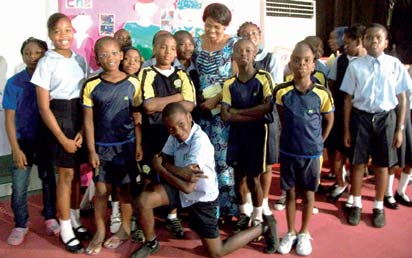
Students of NLNG Residence Area Primary School, grant Bonny River State with prof. Akachi Ezeigbo.
By McPhilips Nwachukwu
Apex Nigeria’s Gas company, Nigerian Liquefied Natural Gas, NLNG the sponsors of the $100,000 literature and Science prizes, last week went a step further in its commitment to encouraging creativity and writing among Nigerian youths. This, the company demonstrated in the Bonny Island of River State, where it organized a reading programme around the theme; Meet the Authour.
The choice of setting for the programme was very strategic because, the organizers, NLNG owns what would be called its operational base in the historic Island of Bonny , where it has about six trains that extracts and exports gas across the world.

Students of NLNG Residence Area Primary School, grant Bonny River State with prof. Akachi Ezeigbo.
The programme, which has the 2007 co winner of NLNG Prize for Literature, Professor Akachi Adimora-Ezeigbo, renowned water colourist painter and motivational speaker, Sam Ovraiti and three journalists; McPhilips Nwachukwu of the Vanguard Media Lagos, Anote Ajeluorou of the Guardian and Ozoluo Uhakheme of The Nation is part of the company’s community social responsibility for her host community.
Specifically, the event, Meet the Authour programme which drew participants from the NLNG Residence Area Primary School as well as students from Senior &Junior Girls School, Finima, Senior &Junior students of Bonny Grammar School as well as Junior &Senior students of Community Secondary School Abalambie was meant to simply demystify the road to success.
By bringing two accomplished resource persons: serial award winning writer and professor of English, Ezeigbo and an award winning painter and illustrator, Ovraitti to engage and interact with the students according to Ifeanyi Mbanefo, Corporate Communication Manager of NLNG is one sure way of recommending worthy role models to children.
“ Our invitation to Professor Adimora Ezeigbo stemmed not just from our partnership in the Nigerian Prize for literature project of which she was a past winner and Chief Judge for 2011 edition, but from being a writer, who consistently writes beautiful stuff.” He said.
Explaining further why the programme was brought to Bonny, Mbanefo said:
“ Enquiries from schools as to whether students will ever get to meet with winners of the NLNG sponsored prizes, since they are not usually invited to award ceremonies had set us thinking.
“ So we decided that with little effort, we can bring writers to dialogue with students, and in doing so realize the dreams of many of our young ones.”
Starting with students of the NLNG Residence Area Primary School, the programme kicked off with Ezeigbo, whose 2007 co winner of the NLNG Prize, My Cousin Sammy was the adopted reader for the occasion.
In the course of the meeting, Ezeigbo interacted and dialogued with the students. While encouraging them to read since reading has the capacity to helping them realize what ever professional desires they may have in life, She also revealed what informed her interest in writing children’s literature as well as some of the experiences that shaped the story, My Cousin Sammy.
According to her,” My own children read mostly books that were written by foreign authors, therefore I decided to write for them and other children books with local contents and cultural values.”
About the book, My Cousin Sammy, Ezeigbo explained that, “ it is influenced by events in my life and in the life of my daughter. If you want to write, you must be very observant. In the book I also tried to talk about our culture. Today not many children speak our indigenous languages. But it is possible for you to speak your own language as well as other three languages in this early years of your development. Language is very important. It is the carrier of your culture.”
After her session with the students, painter Ovratti took over the students, whom he made to attempt visual illustrations of either the characters or the setting or any other aspects of the novel that attract their interest.
On the second day of the programme, which took place at Ibani Town Hall, Grand Bonny students drawn from the four secondary schools mentioned earlier were also spoken to by the two resource persons after which, some of the schools were invited to give stage adaptation of the story.
It was also at Ibani Town Hall that the three journalists mentioned in this report were invited to also speak to the students on the influence of books in their own lives. When it was the turn of this reporter, he demonstrated to the students how what Professor Ezeigbo described as detailed observation of the environment and experience can shape a story.
He read a poem in process, which he wrote on his second day in Bonny Island to the students. The poem titled, Memory Tide reads as follows:
In this Island
I listen quietly to the Sea
recite eternal memory
wafting through Ocean waves
cymbals of pains
buried in beach sand
Here I sift through sea weeds
Searching for symphonies of stifled
Laughters
And the sea sings eternally of
Ibani:
Coming and going
Along tidal waves.
Here and here at auction beach
Where memories of the past
Weave through sea waves
In an inflamed Island.
Disclaimer
Comments expressed here do not reflect the opinions of Vanguard newspapers or any employee thereof.