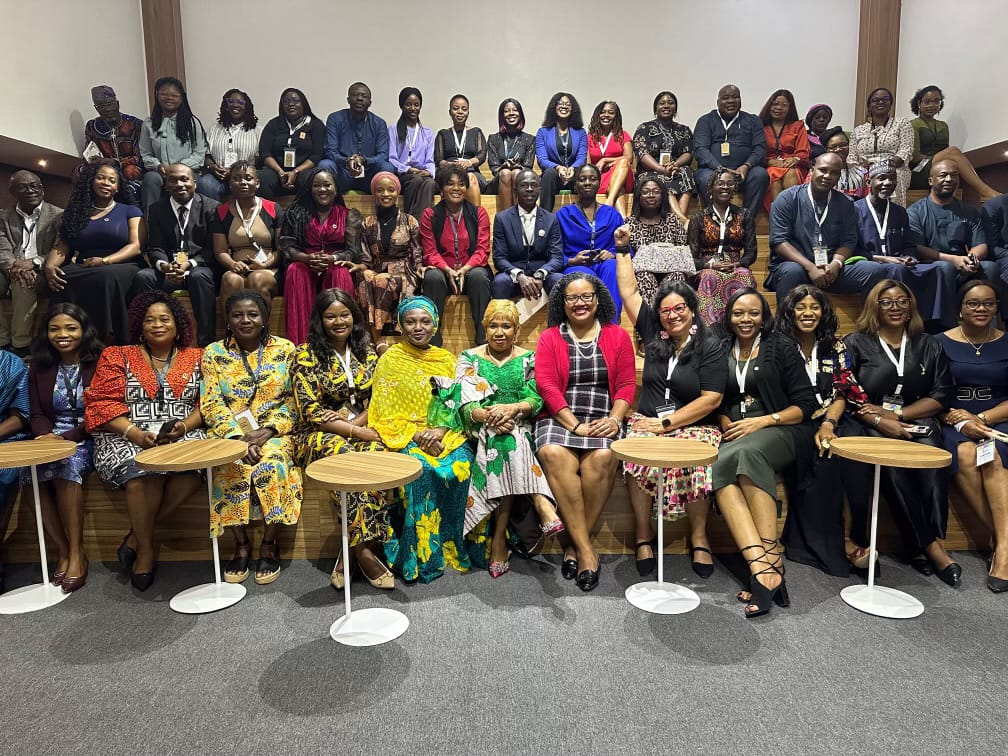
U.S. Consulate Deputy Political and Economic Chief Kenise Hill with participants of the first Nigerian Climate Resilience Salon in Lagos.
…..organizes first Nigerian climate resilience salon
By Ebunoluwa Sessou
In a bid to address the effects of climate change on women across Africa and Nigeria in particular, the U.S. Consulate General has said that it would continue to fight against the negative effects of climate change especially as it affects the livelihood of women.
This was disclosed recently during the first Nigerian Climate Resilience Salon held in Lagos that brought together women-led organizations, climate-tech entrepreneurs as well as representatives from public and private sectors who are leading efforts to combat climate change in their communities.
The Nigerian Climate Resilience Salon was organized by Shelley Taylor, Silicon Valley technology veteran and Folawemi Umunna, an alumna of the U.S. Department of State funded International Visitors Leadership Program, with support from the U.S. Consulate General Lagos.
At the event U.S. Consulate Deputy Political and Economic Chief Kenise Hill noted that including women in climate action will help create a more sustainable and equitable future for all.
Hill explained that the shared priority of protecting the environment is another example of the close relationship and cooperation that exists between the people of Nigeria and the United States.
“Climate change is a threat that sees no borders,” U.S. Consulate Deputy Political and Economic Chief Kenise Hill said.
“We are glad to enable this dialogue that gives voice to the women with lived experience of climate impacts and to facilitate their collaboration with women who have developed strategies for creating greater resilience to find shared solutions to our global, shared challenge of climate change.”
Taylor, Convener of the Nigerian Climate Resilience Salon, explained that climate change exacerbates gender inequalities and developmental gaps. She noted that women have a unique perspective on environmental issues as they often bear the brunt of climate shocks and stresses.
“One of the goals of the Climate Resilience Salons is to help some of the women working in nonprofits to transform their work into businesses where they can generate profits from climate solutions, increasing their family wealth and influence in society. Existing climate tech founders need help scaling their solutions into other regions and across borders too,” Taylor added.
Climate Resilience Salon is a coalition of partners who come together in different countries and regions to support women in finding solutions to climate impacts through events and a growing supportive network.
Environmental conservation is central to the Biden-Harris Administration’s foreign and domestic policy. As such, the U.S. Mission supports initiatives that protect the environment.
Also, Dr. Blessing Irabor-Oza, President Organization of Women in International Trade, OWIT, Nigeria, lamented that the impact of climate change on women has not been emphasized and that is reason for the first Climate Resilience Salon programme which comes up with a solution on how climate change has impacted women in terms of their businesses, health as well as their means of livelihood.
According to her, “In Nigeria, the issue of climate change is a serious issues. Last year, the impact of the flooding that took place was overwhelming. Houses were summerged, farmlands were washed away and at the end the women are the most affected.
“The UN framework says over 80 percent of women have been impacted negatively by climate change. Climate change affects our reproductive system, means of livelihood, infrastructure, roads are destroyed. It is a challenge to know that there is no road from the city to the rural area.
“Talking about the impact of climate change on women would go along way to support both the government and the citizenry to profile solution that would mitigate this climate change.
“We do not have another country to turn to so the essence of the programme is to come up with a white paper that would be given to all the stakeholders so that they could understand from the perspective of the women on what the issues are.
“Most women do not know the danger in cooking with firewood. They do not know that it could blind people’s eyes. For them, cooking with firewood makes food sweet. Some women go through hard times due to climate change.
“The programme was designed in a way to bring people from different backgrounds who come together to discuss their issues. It is also an avenue to enlighten us on better ways to use clean energy.
“There is need to create awareness and synergy among people that would disseminate the information.
There is an information gap especially on the policies of government on climate change. It is a whole chain.
“We need information on climate change so as to hold government accountable as well as different key players.
“There is need to spotlight the relevant policies of government on climate change, she said.
On her part, Folawemi Umunna, Co-founder, Climate and Ecological Protection Initiative, CEPI, said, “The programme has been scheduled to be regional in nature and whatever resolution to come up with would be put in a white paper and share with relevant stakeholders.
“Our hope is that whatever policy that emanates from this white paper would be sustained so as to be able to solve our own personal climate issue and not the generated ones.
“One of the reasons for this Salon was to make it local and that was why the participants at the event were people who have had negative effects of climate change in their communities and their lives.
“We also consider that lots of those policies are copy and paste but with the investigation conducted among the people who have been badly affected by climate change, we could say that it is real. We are profiling solutions that have to do with our communities.
“With the new government in power led by Asiwaju Bola Tinubu, we are hopeful that those policies would be implemented. This is the time for women to be part of climate change solution and be incorporated into the system.
Disclaimer
Comments expressed here do not reflect the opinions of Vanguard newspapers or any employee thereof.