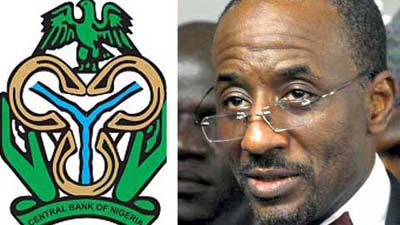
CBN Gov, Sanusi Lamido
By Babajide Komolafe
LAGOS — Mainstreet Bank, Keystone Bank and Enterprise Bank, which took over the assets of the three nationalised banks, yesterday, dismissed the court order restraining them from dealing in the assets of former Afribank, Bank PHB and Spring Bank.
The Central Bank of Nigeria, CBN, and the Nigeria Deposit Insurance Corporation, NDIC, also said they were not aware of such court order.
On Tuesday, Justice Charles Archibong of the Federal High Court sitting in Lagos, granted the order restraining the three banks, following an ex-parte application, by some shareholders of the banks, who are challenging the revocation of their banks operational licence by the CBN and take over of their banks by NDIC and the Assets Management Corporation of Nigeria, AMCN.
The order is to subsist pending the determination of the suit by some aggrieved shareholders of the nationalised banks.
However, the three banks in a statement, yesterday, said they were not served with any writ of summons, let alone any order of the nature mentioned.
They consequently asked their customers to disregard the so-called court order and carry on in their businesses with the banks.
CBN, NDIC react
Reacting to the development, the CBN and NDIC in a statement entitled, “Re-Alleged court order restraining Keystone, Enterprise and Mainstreet Banks from operation,” said: “The CBN and the NDIC state categorically and with all sense of responsibility that we are not aware of any such order as no such order has been served on either the CBN or the NDIC
“Consequently, both the CBN and the NDIC wish to inform the general public that Keystone Bank Limited, Mainstreet Bank Limited and Enterprise Bank Limited are banks duly licenced by the CBN and are thus authorised to carry on banking business. We thus urge all customers of the said banks as well as the general public to continue transacting their business with the banks as hitherto done and hereby issue our assurances once again that all depositors’ funds in these institutions are safe and banking operations will continue as normal. These banks are fully insured by the NDIC and all depositors are assured of the safety of their funds.”
…Nationalised banks too
Enterprise Bank in a statement said: “We wish to assure all our customers that all our over 150 branches nationwide are open for full banking business as usual. Banking operations will carry on as usual and the public should disregard any statement or statements that the bank has been restrained from carrying on business.
“The depositors of the bank and the general public should thus note that the bank will carry on business as usual as there is no order against it. The bank strongly believes the statement that an order was made is false and a mischievous attempt to tarnish the image of the honourable Archibong J, embarrass the judiciary, bring the administration of justice to disrepute, injure the depositors of the bank and bring the orderly operations of a new bank to a halt. The bank is certain that no order was made ex parte requiring the bank to shut its doors to millions of our depositors and customers”.
Both Mainstreet and Keystone banks also issued similar statements and advised the general public to disregard the order noting that the banks will carry on business as usual as there was no order against them.
A Federal High Court sitting in Lagos, on Tuesday, restrained Mainstreet, Keystone and Enterprise banks, from further dealing in the assets, businesses and operations of the defunct banks pending the determination of the suit filed by some aggrieved shareholders of the banks. The three nationalised banks are Afribank Plc, Bank PHB Plc and Spring Bank Plc.
Trial judge, Justice Charles Archibong, granted the order, following an ex-parte application, by some shareholders of the banks, who are challenging the revocation of their banks operational licence by Central Bank of Nigeria and take over of their banks by Nigeria Deposit Insurance Corporation, NDIC and the Assets Management Corporation of Nigeria, AMCON.
The plaintiffs, amongst them, Boniface Okezie, Adeyemi Kehinde, Adebowale Bolanle and Cole Alexander are in court, challenging the nationalisation of Afribank Plc, Bank PHB Plc and Spring Bank Plc.
on the ground that the action violates their rights to freedom from compulsory acquisition of property guaranteed under the constitution and the prohibition of nationalization of enterprises contained in Section 25 of Nigeria Investment Promotion Commission Act.
Defendants in the suit are Mainstreet, Keystone and Enterprise banks, CBN, NDIC, AMCON, Securities and Exchange Commission, Nigerian Stock Exchange, Afribank Plc, Bank PHB Plc, Spring Bank and Minister of Finance.
The shareholders are contending in the suit that the revocation of the licenses of the nationalised banks by the CBN Governor, Lamido Sanusi was prejudicial to their rights to invest in public quoted companies in accordance with the Nigeria Investment Promotion Commission Act and the Investment and Security Act.
They want the court to declare that the action of CBN, NDIC and the AMCON in purporting to transfer the assets, businesses and operations of the nationaliaed banks to the new banks was a breach of their fundamental human rights to freedom from compulsory acquisition of property as guaranteed by the constitution.
They want the court to order the respondents, jointly and severally to pay punitive damages as assessed by the court to them through their lawyer for the diminution in the value of the shares of the nationalised banks as a result of the unlawful, malicious and unreasonable conduct of the CBN Governor.
They are also praying the court to restrain the three new banks, NDIC and AMCN from offering for sale or advertising or representing to any person, any intention or offer for sale or transferring or purporting to transfer to any person any interest in the assets, businesses and operations of the three nationalized banks.
The shareholders also want the court to grant the nationalised banks, a period of six months or with such an extension of time as the court may allow within, which to recapitalize or attain any requisite level of recapitalization as determined by the court and free of any interference from the CBN or its Governor.
Meanwhile, further hearing in the matter, has been adjourned till November 28.
It will be recalled that on Friday August 14th the federal government through the Nigeria Deposit Insurance Corporation (NDIC) nationalised Afribank Plc, Bank PHB Plc and Spring Bank Pls. The Corporation had created three bridge banks namely Mainstreet Bank , Keystone Bank and Enterprise bank to assume ownership of the three rescued banks following the revocation of their operating licenses by the Central Bank of Nigeria (CBN). The following day, NDIC sold the three bridge banks to Asset Management Corporation of Nigeria (AMCON0), which in turn appointed management for the banks and injected N679 billion to bring the capital base of each bank to N25 billion.
Following the nationalisation of the banks by the government last August 8, the shareholders resorted to panic dumping of their shares at the secondary market, thereby depressing the market even as the Nigerian Labour Congress blamed the Central Bank of Nigeria for the crisis in the banking sector and warned against victimisation of workers.
Last Friday AMCON injected N679 billion of public funds into the three, bringing the total fund injected into the rescued banks to N1.299 trillion. But before the CBN intervention, the Expanded Discount Window the CBN opened for banks to support them was N270 billion facility from which they could borrow. That window was closed by CBN governor, Mallam Sanusi Lamido Sanusi thus leaving the troubled banks naked.
Disclaimer
Comments expressed here do not reflect the opinions of Vanguard newspapers or any employee thereof.