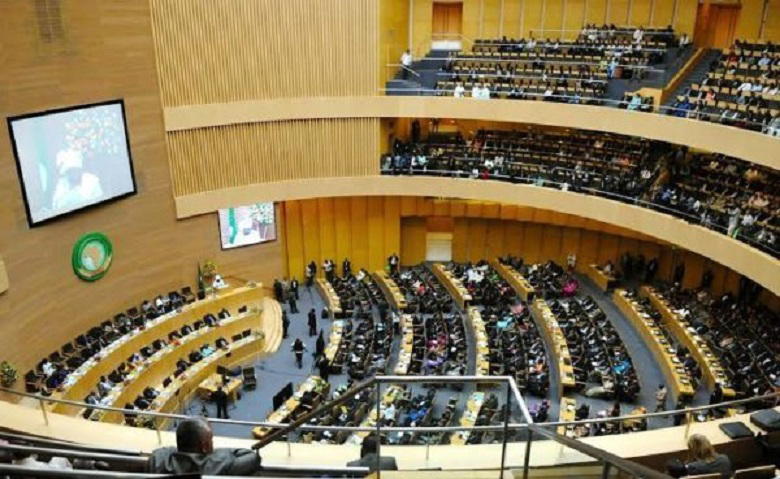
File image of ECOWAS parliament.
By Victoria Ojeme
Since it enacted democratic reforms more than two decades ago, West Africa has made substantial progress in democracy and human development. However, recent armed conflicts, corruption scandals and constitutional rights suppressions have caused recent setbacks in democracy in West Africa. One can see this in the form of undemocratic constitution modifications used to retain power, coups in several West African nations, social media restrictions and insurgencies.
Last week, the Economic Community of West African States (ECOWAS) noted that 2023 is an election year in the region because of the general elections coming up in Nigeria this February and similar elections in other three West African countries.
The Speaker of the ECOWAS parliament, Sidie Mohammed Tunis, speaking at the opening of the fifth Legislature of ECOWAS Parliament Extraordinary session in Guinea Bissau said Nigeria is the region’s biggest democracy and that a large chunk of its observer mission will be deployed for the polls.
“This year has been tagged “Elections Year” in the region. In a matter of weeks, our biggest democracy, the Federal Republic of Nigeria, will be holding Presidential and Legislative elections. In a few months, the Republics of Sierra Leone and Liberia will do the same. These have been preceded by Legislative elections in the Republic of Benin.
“In conformity with the established framework for election observation, we are working very closely with the ECOWAS Commission to ensure the scrupulous implementation of the provisions of Protocol on Democracy and Good Governance, relative to the holding of elections. Our Observers will be available to provide the necessary support to the Joint ECOWAS Mission, in anticipation of free, fair and transparent elections in the various countries,” Tunis said.
The Speaker assured Nigeria that ECOWAS will be fully involved in election observation across the country on the day of election and added the parliament is working very closely with the ECOWAS Commission and has signed a memorandum appointing observers who will be in Nigeria for the polls.
On 25 February 2023, Nigeria will hold presidential and federal parliamentary elections, followed by gubernatorial and state legislative elections on 11 March.
The high-stakes elections promise to be notably different from previous polls in several respects. First, the number of credible presidential candidates is higher than in the past. Since Nigeria restored democratic rule in 1999, presidential polls have essentially been two-horse races between the Peoples Democratic Party (PDP), which held the presidency from 1999 to 2015, and various opposition parties. The latter, which eventually merged to form the APC, won the presidency in 2015 and 2019. This time around, in addition to the major-party candidates, Atiku Abubakar (PDP) and Bola Ahmed Tinubu (APC), two other parties are also fielding popular contenders for the top job.
The Labour Party candidate, Peter Obi, who at 61 is younger than his main rivals, has particularly energised voters, precisely because he is seen as a counterweight to what many regard as the political establishment’s venality and greed. The New Nigeria Peoples Party (NNPP) candidate, Rabiu Musa Kwankwaso, is also notable, as he too offers voters an alternative to the APC and PDP, particularly in the North West and North East geopolitical zones. This novel situation, in which four presidential candidates are drawing significant attention, means that the 2023 race is less predictable than past polls.
Secondly, and relatedly, Nigerian youth are excited about the vote. A twelve-month registration drive captured over eleven million new voters, 84 per cent of whom are aged between eighteen and 34. The main driver of this trend is the sense of political agency that millions of young, tech-savvy Nigerians derive from using social media.
Thirdly, the public’s confidence in the credibility of the polls is growing, which is likely to bolster voter turnout. Following amendments to electoral laws, the electoral commission introduced several changes to the voting system, the most significant of which is that polling stations will transmit ballots electronically to the commission’s headquarters in the capital city, Abuja, in real time. Despite lingering doubts about connectivity in remote parts of the country, many Nigerians believe these innovations will be helpful in preventing anyone from altering results manually at polling stations or state collation centres, as poll workers colluding with party agents and thugs had done in the past. Indeed, commission Chair Mahmood Yakubu has predicted that the 2023 elections will be the “best” in Nigeria’s history, citing as reasons for optimism the off-cycle elections in Ekiti and Osun states, in June and July, respectively, which reported significantly fewer polling problems and violence than in prior years. Yakubu has also repeatedly offered assurances that election preparations are proceeding as planned and on schedule.
At the closing of the fifth Legislature of ECOWAS Parliament Extraordinary session in Guinea Bissau the Speaker, Sidie Mohammed Tunis, urged the Nigerian government and the citizens to exemplify a model of transparent and peaceful elections in this month’s Presidential and National Assembly Elections.
He urged the country to uphold the spirit and tenets of sportsmanship, transparency, and accountability in the polls. He said “Permit me to reiterate my earlier calls on our brothers and sisters in Nigeria, Sierra Leone, Liberia, and other Member States who are going into major elections this year, to uphold the spirit and tenets of sportsmanship, transparency, and accountability.
“Let us bear in mind that election is not a do or die affair, rather it provides a golden opportunity for our citizens to cast their votes to elect credible leaders of their choice and not disrupt the electoral processes through violence and destruction of lives and properties.
I appeal to all the citizens of these countries to uphold the principles of democracy and respect opposing opinions. Let´s be guided that the days of violence and wanton destruction of lives and properties after the declaration of the election results, will no longer be tolerated and the wish of the majority must prevail. In addition, any candidates who feel otherwise should seek redress in the court of law and follow due process.
“I urge all stakeholders in charge of organizing and conducting elections, especially Heads of Electoral Commissions, Security Agencies and Non-State Actors to ensure that the outcome of the elections is rooted in transparency and social justice.”
Tunis also urged everyone to put hands on deck to ensure that West Africa moves in the direction of progress. “I want to task and equally encourage all and sundry to remain focused and resilient towards our common goal of ensuring that our region prospers. Remember that our destinies are in our hands, and we can determine the means to arrive at our desired success. I am hopeful that at the end of this year, we will be on the positive and bright side of life,” he added.
The Speaker said the parliamentary session enabled them to hold qualitative discussions and adopt workable conclusions on pressing issues affecting the people in the region. “It is therefore hoped that the recommendations made during this Session will form the basis for policy formulations, implementations and produce outcomes needed to transform the standard of living of our people. The year 2023 presents a huge opportunity for us to re-evaluate issues militating against the shared developments of our Member States.”
Indeed, this February elections in Nigeria will be the largest in Africa and shape the democratic trajectory of not only Nigeria, but the entire region.
Disclaimer
Comments expressed here do not reflect the opinions of Vanguard newspapers or any employee thereof.