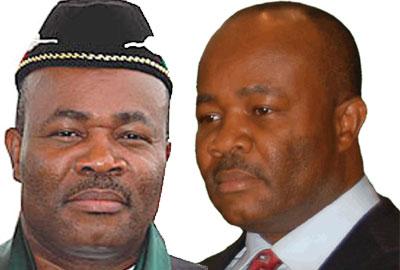
Gov Akpabio
By Ochereome Nnanna
IN Nigeria’s socio-cultural settings, the brand: “Calabar Man/Woman” often ignores the fact that the people being referred to had one of the earliest exposures to Medieval European merchants among the various Nigerian cultural groups.
It often overlooks the proud, unique, original and rich culture of the people which mirrors an ancient civilisation that has not been fully taken to the consciousness of the wider national canvass. Not much is known of the fact that this culture goes deep inland and is shared by the various ethnic groups that abound on both sides of the mighty Cross River Basin, including some Igbo cultural groups.
The picture the “Calabar Man/Woman” brings to the mind is the hackneyed one of a people who speak the English or even Pidgin language with their Efik/Ibibio musical accent, where the typical “Okon” houseboy or “Ekaette” house girl comes from; the land of great cooks and exotic delicacies (including the dog meat delicacies); a fun-loving people you look forward to encountering anywhere.
Because of their large numbers, the Akwa Ibom people have come to dominate the “Calabar Man/Woman” imagery even in Calabar, the capital of Cross River State. If you visit Calabar and you want to meet the Efik, Qua and Efut on whose land the city is built the chances are that someone from Akwa Ibom will step forward and you, as a visitor, would not know the difference.
The large population of Akwa Ibom people used to be a sticking point between them and their cousins in the old Cross River State, who resented their perceived domineering posture.
When Akwa Ibom State was created on September 23, 1987 by the regime of General Ibrahim Babangida, many who were left behind in Cross River State (especially the indigenes of Calabar) heaved a sigh of relief in the hope they now had more breathing space.
Even though civil servants moved to their new state of origin, many Akwa Ibomites remained in Calabar. The old prejudice that described the relationship between the two sides showed itself recently when the Cross River State Commissioner for Women Affairs, Mrs. Ekama Iwara, reported that majority of prostitutes in Calabar were from Akwa Ibom State.
Social and economic ladder
As things stand now, Akwa Ibom is rapidly on the rise to the top rung of Nigeria’s social and economic ladder. The first leg of the journey started from the moment that Babangida decided to create only Akwa Ibom and Katsina States. The second leg did not start until the dawn of democracy in 1999 when Obong Victor Attah was elected.
Opinions are divided as to the quality of Attah’s contributions to the development of the state. Officials in incumbent Governor Godswill Akpabio’s government are quick to point out that many roads built during that era were washed out within two rainy seasons.
Two things Attah contributed to the rise of the state from the mud to Olympian heights broke the barrier.
The first was the struggle for resource control and payment of the 13 per cent derivation based on oil royalties mined on the Continental Shelf, not just onshore. The rest of the country except the South East fought bitterly to deny the Niger Delta States their right to earn royalties from offshore oil and gas but at the end of the day justice prevailed because if you remove the sea from a riverine people you have taken life from them.
Akwa Ibom would have been no better than Edo as an oil producing state. But with this settlement, the state is now the largest revenue earner from derivation royalties. This has enabled it to commence one of the most ambitious developmental strides anywhere in the country.
Attah’s second contribution was that he appointed Barrister Godswill Obot Akpabio as Commissioner who served in various capacities between 2002 and 2006 when he started his political journey to the Government House on May 29, 2007. The exchange of batons was not smooth.
Attah wanted his son in-law to succeed him, but Akpabio clinched his party’s ticket at the primaries. Attah’s spirited (but failed) efforts to ensure Akpabio did not succeed him created the bad blood that persists till date. However, Akpabio continued from where his predecessor stopped, ensuring to complete all ongoing projects.
Today, the state is probably the only one in the country that can boast of zero abandoned projects.
To celebrate the 24th anniversary of the state, Akwa Ibom pulled all the stops because as Akpabio put it: “there is something to celebrate”. Any Cinderella story is worth celebrating. The state has undergone what President Goodluck Jonathan described as “uncommon transformation”, with world class infrastructure.
Akpabio has proved that when big money meets big ideas big things happen. When this reporter visited the state last in 2007, the Akwa Ibom International Airport runway was just being bulldozed, yet former President Olusegun Obasanjo “commissioned” it! But today, three aircraft land from Lagos alone at the Uyo Airport.
The dual carriageway to Uyo is classier than the Bill Clinton Way leading into Dr. Nnamdi Azikiwe International Airport in Abuja.
The underground drainage system has gone a long way in solving the perennial flooding of the state capital, though the work is yet to be concluded. Apart from its network of high quality roads, perhaps the most impressive thing about today’s Akwa Ibom is the educational policies.
There is free and compulsory education up to secondary school level for residents of the states, not just indigenes. Akwa Ibom is one of the few states in the federation that does not discriminate between indigenes and settlers in educating Nigerian children living in their state.
Governor Akpabio has monitoring groups in all three senatorial districts, whose job is to go round and arrest any student found wandering during school hours. Besides, primary and secondary schools in the state have been fully modernised and our touring team was able to see so many of them throughout the state.
Akwa Ibom is also preparing big for tourism, what with its massive e-library and the Ibom Tropicana complex, which is a one-stop entertainment centre. Akwa Ibom is better seen than described.
Politics in the state
However, politics in the state is vicious. This is understandable though not excusable. Any politician who visits the brand new Government House will like to live there. Anyone who knows the amount of money that flows into the coffers of the state government will like to control the purse.
The state government forwarded an Appropriation Bill of a whopping N309 billion for 2011, out of which 80 per cent is devoted to capital projects, thus making the state the highest in capital to recurrent ratio in the country.
Neighbouring Rivers State, which is also one of the best performing states in the federation, has 64 percent reserved for capital expenditure.
The signs are very positive that the oil wealth of the state will only get bigger.
The US government rated Akwa Ibom, Rivers and Edo states as states with “impressive governors” to “watch out for” in a rare positive Wikileaks diplomatic cable message. A lot of work is required to be done for Akwa Ibom to start competing with states like Lagos and Rivers in terms of internal revenue generation. Right now, Akwa Ibom is heavily oil revenue-dependent.
Due to big revenue allocation, the 2011 elections in the state were particularly nasty, and bedevilled with kidnappings, killings, unhealthy propaganda, burning of government property and subsequent detention of the most prominent challenger to Governor Akpabio, Senator Akpan Udoedehe, the candidate of the Action Congress of Nigeria (ACN). However, the bid to use tribalism as means of gaining power did not work.
All that Akwa Ibom needs for more rapid development is peace and common purpose among its political leadership. In the next five years, Akwa Ibom will be an uncommon African story going by the pace of work.
Giving Lagos a run
THE only bad major road you will see in Akwa Ibom is the Eket – Ibeno federal road, a most shoddy job being handled by the Niger Delta Development Commission (NDDC). It is an irony that the road leading into the state’s prime economic zone is the worst, though the state government has tried in vain to take it over and construct it to the standard of the rest.
Ibeno immediately reminds one of Bar beach in Lagos. But unlike Bar beach and the Lagos coastline, this is the oil and gas belt. The state’s coastline covers several local governments, and plans have reached an advanced stage to establish a deep seaport – the first in the East – at Ibaka in Mbo Local Government Area.
If properly developed, the Ibeno and Ibaka areas can be transformed into the nation’s only coastal oil city after the fashion of Houston, Texas, USA. Nigeria will then have two copies of Lagos instead of one. Agreements have been signed by the Akwa Ibom State Government and various stakeholders, including the Federal Ministry of Transport, Nigerian Ports Authority and the government of the Kingdom of Belgium.
The future of the state’s economy lies in this area of Akwa Ibom.
Disclaimer
Comments expressed here do not reflect the opinions of Vanguard newspapers or any employee thereof.