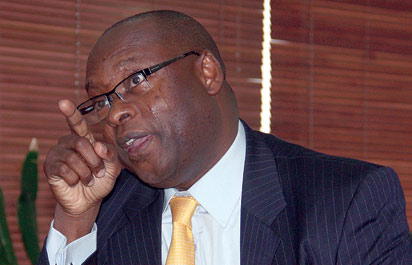
*Bukar Kyari
By Babajide Komolafe
Last week, Bukar Kyari assumed responsibilities as the Chief Executive Officer of the Central Securities and Clearing System CSCS, the clearing arm of the capital market. With a 24 years career which include 14 years at Hewlett-Packard (HP), three years as Director in charge of eelectronic Banking, Information Technology and Operations at former FSB International Bank and six years as Managing Director/Chief Executive Valucard Limited, Kyari has established a reputation as one of the top experts in the nation’s electronic payment industry. In this interview, he bares his mind on development in the electronic payment industry and how he intends to use his wealth of experience in information technology and banking to transform the CSCS.
Excerpts
What was the state of the company when you assumed office as the CEO?
The situation facing ValuCard was quite challenging when I took the job. Let me tell you an anecdotal story about two friends of mine while I was an executive director with FSB International Bank which is now part of Fidelity Bank. The two friends of mine, who were also executive directors in two different institutions called me when they heard I was about taking the job and said they can now sure that I had gone crazy, because it is only a sign of madness that anybody can leave a comfortable position in a bank to run, according to them, a ’dead’ company.
Many others asked – why did you take a job in a company that has been written off. In fact, even the competition had said that ValuCard probably had less than two years left.
So when I came in I found a broken organisation. I had been on the ValuCard board for three years before I joined the company as CEO, but I did not understand the extent of the damage the company had sustained until I was in it. The company had three fundamental flaws, any of which could kill a company. One was the wrong business model. For people that know ValuCard, it is the pioneer in the payment industry.
It introduced the e-purse called ValuCard that enables you go to your bank branch to load money and then go to the merchant to spend the money. So it is actually a low tech way of doing electronic payment transaction. It is cumbersome and inconvenient though it offers the ability to carry large cash on a plastic. Though the concept was great, the business model was wrong. The underlying sharing formula probably would take forever for ValuCard to make profit because when you do the behind-the-envelope calculation, you would have to do billions of transactions just to break even and that to me does not make sense.
The second thing that was flawed was that the company invested in proprietary technology. In this day and age, I do not care who you are, if you customized the software that will drive your business, you have started with a huge disadvantage because any little change that you want to make the software makers will hold you to ransom.
The minimum tweak in a year on software could cost the company 100,000 euros because the software company based in Ireland would say we have not hired the engineers for you alone. So every little job change can cost the company significant amount of money. And by the time I looked at what ValuCard had spent on software alone up to the time I joined and what they were planning to spend within that year that I was in the company versus the total income that ValuCard had made since its inception, the income was just a fraction of what they have spent on the software not to talk about NEPA bills, salaries etc.
Right there I knew the company was not in a viable state, moving forward, with that sort of technology architecture. The third major flaw that I discovered was the people aspect. We had, at the time, people that were not fit for the role they were playing, people that were not conditioned to respond to customers. In fact some individuals believed that the banks owe them to be there. So there was lack of customer centricity, lack of operational excellence, and the morale was low.
My diagnosis was that any of these three things can actually make a decent company go under and all three were present in ValuCard. What I did was to think about it and within three to six months I came out with a proper business plan that I presented to the board. And by the time I engaged the board on that discussion, we agreed that we needed to have the right business model.
Globally, most people are using either Visa or Mastercard and we reached out to both of them. Thus, Visa became an investor as well as a partner in this journey and they came on board. We started upgrading the skills of our people by going in and understudying the Visa business and the Visa platform. And after changing our business model, we looked for an off-the-shelf technology solution.
So we basically showed the board a roadmap on de-commissioning the valucard e-purse product. The de-commissioning and eventual introduction of Visa products into the Nigerian market took us about two years. Once that had been accomplished, we said we needed the appropriate technology platform now. And there are off-the-shelf technology that everybody in the world buys to do Visa, Mastercard, Amex and the like. With the help of Visa we ended up selecting a technology vendor. And to resolve the people issues, we did an assessment of all the people.
The people that had high learning quotient were retained, trained and up skilled. And those that we felt had low learning quotient, or were better off somewhere else, we asked them to be our good ambassadors and they moved on. So we basically instituted those changes within two to three years. My five-year business plan called for a break-even position by the fourth year but by year three we had become profitable and the company has remained sustainably profitable and continues to increase in profitability.
So I am leaving at a point where the shareholders have not only plugged the hole of negative shareholders’ funds but they now have a company that has a lot more value than the investment they have made. The company is more valuable now, the valuation has been done and the shareholders are actually happy with the state of their company. And I believe the taste of the pudding is in the eating. It is not only the shareholders, it is all other stakeholders because if you look at ValuCard employees today as stakeholders they are more engaged than the employees that I met when I first walked into the company as Chief Executive Officer.
They are now more customer centric, the same thing with one of our most important stakeholders, which is our customers. Our customers have demonstrated to us both directly and indirectly that they are actually getting value for money by moving to Visa more than any other payment token and Visa having more transactions than other schemes.
Today ValuCard has higher market share or rather the ValuCard or Visa card transactions are higher than all the other cards put together and that is a vindication of some of the things I shared with the employees earlier – that this business is a marathon and not a 100 meter dash, and if you continue to do the right things, protect your customers by giving them value, by reducing their losses, you will actually have them forever. And that is essentially what we did by having a sustainable business platform that is adding value to the customers and in the process they are engaging us to do more and more.
With your record achievements why are you now leaving the company? Is the position tenured?
No, the management position is not tenured. I have never been in the same position for more than four years in my life. I had worked in Hewlett-Packard in Silicon Valley in United States, I worked in HP for 14 years and in those 14 years I had been in five or so business divisions, each one you could actually call an entirely different company.
I have been involved in three or four start-up businesses. Some failed, some have been extremely successful, one of which today is the most successful business outfits in HP – the Inkjet Technologies which I joined in the late 1980s. So I am a restless soul, I go and fix things and then move on, and this is the longest I have ever been in any position. But I know that I could actually come in and make a difference and we have made a difference along with the colleagues I invited to join me as well as people that we hired and people that we found here.
The other thing is that since the job is not tenured I could actually sit here and retire but if you accept a challenge and the company reaches a certain stage it is better for another pair of eyes, another set of people to come and take it to the next level, and these are people you have helped groomed. Why are you grooming them if you are not ready to leave? I don’t understand third term and extensions, and things like that in Nigeria because every one of us when you are coming into the role, should not be having what the author of First Things First, Stephen Covey, said about having the end in mind? That as you are coming in you should have in view how you want to leave this company in X years and when you see yourself leaving the organisation.
I think every CEO, every leader, if you are a leader and not a manager, should be thinking about how you impact the people, in other words how they develop both personally and professionally. I mean, if you cannot have an organisation which you wish outlive you, then to me you are not a leader. So that is one of my other reasons.
The third reason to the question why I am leaving is that I am leaving to another organisation in the capital market inviting me to help bring in confidence into the capital market so that both international and domestic investors can have confidence back in the capital market, so that it would be in a position to help the economic development of the country. Capital market is one of those nerve centers of an economy and if people lack confidence in the capital market then money that would be needed to invest in companies, create jobs, so that goods and services can be generated for domestic consumption would become a problem just as the payment system is a critical aspect of the economy, because without having the right kind of payment system you cannot have a fast emerging economy.
Any economy that is relying heavily on cash is an underdeveloped or undeveloped economy.
So we have been involved in this discussion with Nigeria and it is time for me to have similar conversation in the capital market space.
What is your assessment of the electronic payment industry in Nigeria in the last five years?
As a player in the e-payment industry I find it an extremely interesting journey. Quite challenging at times because I remember some years ago when SGBN launched the first ATM in Nigeria, it was such a novel thing. Then everybody was talking about the e-payment industry as a fragile baby but nothing was happening then. But we are now at a stage where we have about 10,000 ATMs, which to me is still very small.
We should be having 100,000 if not 200,000 ATMs for a population like ours. We now have less than 15,000 PoS terminals out of which 3,000 or 4,000 are really active, and less than 20 million cards which are still a lot less than it should be. But looking back from where we started, we have made some progress. Now with additional push from regulators and industry stakeholders raising awareness there is no reason why we should not be talking of 50 to 60 million cards, maybe half a million PoS terminals, and maybe 30,000 to 40,000 ATMs in the industry.
The experimental or pilot scheme that is going to be run in Lagos June next year would actually be a vindication of what some of us have been saying for a long time, which is, if we move away from cash it would be better for the economy. And what do I mean by that? When you migrate only ten per cent of your transactions away from cash to card, some studies done around the world in similar economies to ours show that the GDP of that economy would grow by one per cent.
I know that Dr. Ngozi Okonjo Iweala and the economic management team are looking at over ten per cent GDP growth rate. Now here is a low hanging fruit, just institute policies that will migrate us away from cash, let us say by 20 or 25 per cent and that would add 2.0 to 2.5 per cent to the GDP growth. And to me that would bring in a lot of money into the banking system where lending could be increased and additional investments could be forthcoming to help economic planners plan the economy.
One of the challenges of monetary policy today is that there is really no direct correlation between interest rate manipulation and economic activity in the economy. When the Central Bank increases the interest rate there are some things that ordinarily one would expect to happen in the stock market, bond market and money market. Those things do not directly happen.
It seems to take some time before you see the effect of the monetary policy. So what the payment space has done in the last few years is just a tip of the ice berg, it is just the beginning. And I see that the more we move and embrace e-payment the more visibility and transparency would come to our monetary policy and economic activities. I think it would be better for the country to move as fast as possible.
Sometimes people say there should be incentives, yes I believe the government should offer some incentives in addition to the negative incentive or penalties that people talk about because by pushing us and by incentivising us, we can embrace it than if you just hope we would do it. Incentives can also come by way of giving discount on VAT to merchants, and the merchants would now become champions of e-payment.
A similar thing has been done in South Korea, which has made it the second most active cards country per capital, coming next to the United States. And it was by government deliberately instituting an incentive program, by telling the merchants, if you accept cards you will get discount on your taxes, but if you accept cash you will still pay the ten per cent or five per cent tax. And pretty soon everybody was embracing it. So, all the merchants and even small one-man stores were actually asking for their banks to provide them with a PoS terminal. So that is one incentive used that encouraged usage. The other thing they did was that during the Asian financial crises in the 1990s, they instituted a monthly lottery of about a million dollars or its equivalent. And those one million dollars was split into two or three bits. You don’t buy a ticket to qualify; you just use your card. By mere use of your Visa card or Mastercard or whatever, you are entered for the draw, and every month the government draws from you
r transactions.
It is only PoS transactions that will enter you. So the citizens also became encouraged. The thinking is I already buy foods, or buy drinks, why don’t I use card so that I can have the chance to be a millionaire. That incentivises the users. The merchants on one hand have incentives for accepting card transactions and the users on the other hand also have incentive for using the card so the citizens became heavy users. That transformed a country that became more active than all other economies in the world except the United States. And even after you have stopped the lottery people are now used to cards as a mode of payments. They are now addicted to cards. And that helped them in their economic activities.
The third experiment by Korea was actually the subsidy on diesel because they discovered that diesel price was tied to food price in Korea because it is large trucks that bring food from the rural areas to the urban areas. They instituted some kind of subsidy. They used to pay people subsidy through receipts and people were abusing that receipt based system because everybody was writing receipts that I have bought 10,000 liters of diesel for my truck even though the truck does not consume 10,000 liters of diesel.
The government now put that incentive on cards. There were special EMV cards that only the truck driver carry, so at the filling station the price of diesel is still the same, everybody buys it at whatever is the price but if you use that card, the discount that the government is giving will be credited directly to the account of the person buying the diesel automatically, so nobody knows you are getting a discount except you. That also helped minimise the food price inflation.
Along with the incentive given with the rebate and the lottery, was the tax receipt. You know when the Asian financial crisis happened, tax receipts went down in all countries, and in South Korea it also went down until they did these.
Disclaimer
Comments expressed here do not reflect the opinions of Vanguard newspapers or any employee thereof.