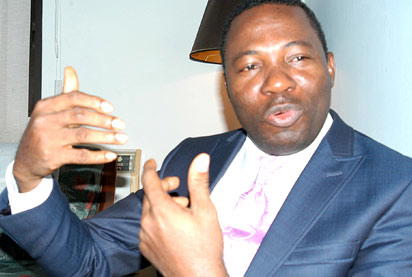
*Austin Tam-George
….Hunger for food and social justice
By Jide Ajani, Deputy Editor
For the first time, Sunday Vanguard is going beyond politicians to seek the opinion of academics and experts on the crisis of governance in Nigeria, and other issues of national interest. Today’s personality, Dr Austin Tam-George has degrees in Education, Industrial Relations and Cultural Studies. In 2007, he earned a Ph.D. from the University of Witwatersrand South Africa, with research based on the Nigeria’s Niger Delta conflict.
He was also Andrew W. Mellon Postdoctoral Research Fellow and lecturer at Centre for African Studies of University of Cape Town, South Africa. For 16 years, Dr Tam-George has taught in different universities and worked with colleagues and students from over 100 countries around the world. In 2008, he worked as Research Consultant to the New Partnership for Africa’s Development, NEPAD, in its good governance monitoring projects across Africa. As a management consultant, Tam-George divides his time between Lagos and Cape Town.
Excerpts:
The UN team of environmental experts has submitted a report to the Federal Government where it detailed the monumental scale of environmental pollution in Ogoniland by Shell over the past decades. The government is still studying the report. How would you react to the findings of the UN team?
It’s a pretty powerful indictment by the UN environmental team. But the report only confirms what has been known to villagers in the Niger Delta since 1958. Shell and other oil multi-nationals have caused the worst environmental disaster in human history, in that region. The report says Shell violates even its own environmental protection and safety standards.
They operate in almost total disregard for the people, the land and the environment. In just over 50 years, Shell and its corporate allies have turned the Niger Delta, which was one of the world’s most vibrant ecosystems, into a poisonous wasteland. It’s a horrific crime. But the report also makes it clear that Shell’s activities in that region have gone on for so long because of the complicity of the Nigerian government. That’s quite true. I think that the Jonathan administration has a unique obligation to change course, and set new standards.
How could the UN report serve as a basis for action? How should the government respond to the report?
As I said, I believe President Goodluck Jonathan understands the issue perfectly because he was literally born into it, and has lived with it. Environmental degradation is an ugly inheritance for any person born or living in the Niger Delta. The President has said he wants to convene a meeting of all stakeholders to discuss a plan of action based on the UN report.
This is a good step. But while Ogoni may be the focal point of the UN report, the problems are actually regional and widespread. Therefore, as the government seeks to implement the particular recommendations of the report, what is ultimately required is a region-wide remediation plan of action by all parties, including Shell. This is an opportunity to completely re-frame the social contract between the government, the companies and the communities in that region.

*Austin Tam-George
As part of government’s efforts to stem the tide of violence in the Niger Delta region, it introduced the amnesty programme in 2009. What’s your assessment of the programme so far?
Well, the 2009 Amnesty programme of the government has brought a fragile calm in the Niger Delta. The militants have disarmed and the government is training them in some kind of skills.
This is good. But i think that a bolder plan that addresses the systemic causes of the crisis is required. For instance, the people insist that they want a measure of control over the resources in their areas.
This is a reasonable and legitimate claim; a claim that is consistent with natural justice. How does the post-Amnesty programe in its current form address this demand? You cannot claim to be a Federal Republic and yet operate a highly centralized control of regional resources. It’s a contradiction. To establish any lasting peace in the region, all the expropriative laws that support this contradiction have to be repealed. What we have in the Niger Delta is a tragedy of double hunger – a hunger for food and for social justice.
Any measures taken to address the problems in the region should be holistic. Before his death, President Umaru Yar’Adua proclaimed that in the post-amnesty era, communities should get at least 10 per cent of revenue from the resources they bear. This was a bold vision, and Jonathan was a part of that government. I believe that this government has a responsibility to pursue that vision through a constitutional amendment.
Do you think an improved revenue allocation to the region will solve the problem?
No. Improved revenue control or allocation by itself is insufficient. There must be a vigorous fight against corruption. Almost all the states in the Niger Delta region already run budgets higherthan the budgets of some African countries. With transparent, visionary and honest application of resources, unbelievable changes can happen in the region even now.
But with corruption, greed and waste such as we see all around, nothing of course can be done even with 100 per cent revenue allocation. Finally, in the post-Amnesty era, the companies that operate in the region will need to rethink the way they relate with the local communities. During my doctoral research at the University of Witwatersrand in South Africa in 2004, I visited Bodo town in Ogoni to interview victims of military brutality in the early 1990’s, when the Ogoni protests were quite intense.
I asked a 67-year-old man (who was so brutalized he walked with a limp), what he would demand from Shell executives on behalf of the Ogoni, if he was meeting with them in a room. His sad eyes lit up for the first time, as he said. ‘All we need is respect.” I was moved by the surprising simplicity of his request. Yet it’s quite profound as well. Companies need to show respect to the local people, their cultures and environment, as well as their individual or community property rights.
Speaking of good governance and corruption, President Jonathan has proposed a single term of six years for the next President and governors, as a way of enhancing effective performance. What’s your reaction to this proposal?
Well, it’s possible that President Jonathan means well with this proposal. But I think that ultimately, the proposal itself is unnecessary. Our own history teaches us that there’s no connection whatsoever between how long a person remains in office, and the person’s actual performance in that office. To take two examples: Chief Olusegun Obasanjo was Head of State in the late 1970’s, and then returned after 20 years to occupy the same office for another eight years.
Was Nigeria better off under him or not? Certainly not! General Babangida was Head of State for eight years. He decimated the middle class, assaulted the university system and the vibrant media. The country is yet to recover from his horrendous misrule. Nearly all the governors who ruled from 1999-2007 have only a legacy of waste to show for their time in office, with unresolved corruption charges hanging over them. By contrast, in just two years in office, among other spectacular achievements, President Barack Obama has provided compulsory health insurance cover to over 30 million Americans who previously had no cover whatsoever. He recognised that the progress of any country depends on a healthy and productive citizenry.
I think Nigerians would prefer to see President Jonathan deal with corruption, job creation, and other pressing problems that beset the country; than for him to worry about the tenure of office holders who feel no connection whatsoever to the people.
But by this proposal, the President thinks that a single term will help to check the partisan acrimony and violence that tend to characterise our elections. Is this a valid point?
Look, elections everywhere in the world are a noisy and clamorous affair. A single tenure will not make elections in Nigeria any less contentious. Losers might complain.
All we need is to make the process itself free, fair and transparent. And then strengthen our institutions to deal transparently with the complaints. A committed and visionary government can make a difference in the course of four years. If it performs well, it could seek a new mandate from the people.
How would you respond to the degree of poverty in the country? And how does this affect national growth and the quality of life of Nigerians?
Well, I think that poverty in Nigeria is endemic and state-sponsored. If you look at the incredible disparity between the income of the political elite and the rest of society, you would see what I mean.With so much money going to the political class as salaries and perks, coupled with the corruption all around us, very little else trickles down to the rest of society.

*Tam-George
According to World Bank figures, more than over 70 per cent of Nigerians are desperately poor, unable to afford descent housing, food and education. More than anything else, poverty is the greatest impediment to the growth of any country. This is why responsive governments do all they can to fight it. In Singapore, more than 85 per cent of the population are accommodated in houses built by the government. In Nigeria, the state seems to have abdicated that responsibility altogether. High unemployment levels such as we have in Nigeria can only mean high poverty levels as well.
What measures can the government take in order to create jobs and alleviate poverty?
A lot can be done. Nigeria has one of the worst infrastructure in Africa among the countries not at war. An honest and massive investment in infrastructural development all over the country will create millions of jobs directly and indirectly. As highways, airports, subways and bridges, etc, are built or standardized, the economy itself will benefit from the vibrancy generated by these activities.
The country will have a more modern outlook. Investment in the power sector will mean that industries will operate optimally, and the huge costs spent on generators may be directed towards expansion, thus creating new jobs. Nigerians are generally hardworking people, and regular power supply can only release their productive and creative energies.
Government could also convene a job summit with the private sector as key partners. Short, medium and long term job creation goals could be identified and set at the summit. The summit could explore all possibilities of job creation, including out-of-school mentorships, skills trainings, and enterpreneural skills development. A massive turn-around of our educational system will be required, with investment in research and development. Our graduates must have competitive and employable skills again, as it was in the past.
Finally, on national security, the Boko Haram menace in the North is a serious national security threat. What’s your assessment of government’s reaction to the crisis so far?
Boko Haram started as a band of lawless youths in Borno State, but have grown into a murderous regional franchise in the North. They kill innocent women, children and even the elderly. The security and intelligence community will have to do a better job. The government should address youth unemployment, but it must act firmly against this murderous lawlessness and impunity by Boko Haram or any group by whatever name.
Disclaimer
Comments expressed here do not reflect the opinions of Vanguard newspapers or any employee thereof.