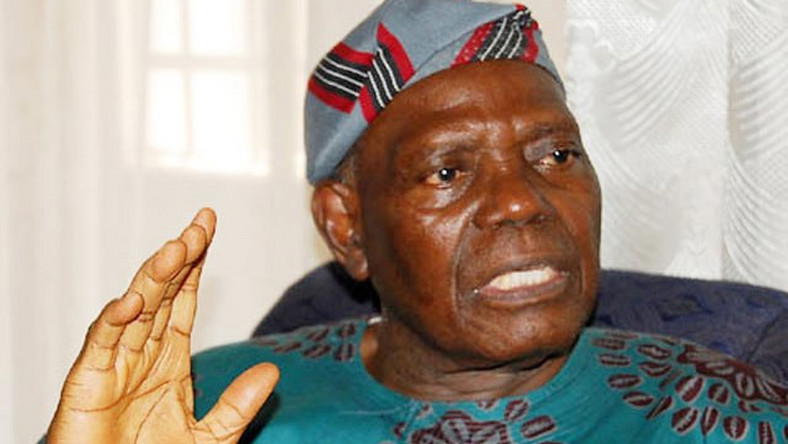
Chief Bisi Akande
This is the continuation from last week of Chief Bisi Akande’s testimony of his life presented at the Constituent Assembly on November, 1977.
NIGERIA is presently made up of two tribes, two major tribes: the tribe of the “the tribe of the red eyes” and “the tribe of the comfortable idles”. Those of us belonging to the “red eyes” tribe who are in the majority pray earnestly for the arrival of the day of total liberation. I would like to continue with the history of the development of my people within the context of the past Constitutions in order to be relevant in my contributions to the Draft Bill under debate.
READ ALSO:Reps pass 2022 Budget, raises expenditure to N17.1trn
The people of the old Ila-Orangun constituency were cajoled to leave palm-wine tapping and to go back to the land by the government of this country. The people of the whole of Ila/Odo-Otin Constituency were cajoled to leave their palm wine tapping and go back to the land by the various governments of the country.
My people eventually developed very high skill for farming. In the process, through communal efforts, they built numerous bush paths and tracks that linked them with some towns and villages in Kwara and Ondo states and with some towns and villages linking them with the rest of Oyo State.
The experiments of trading in exported goods led them to the development of wider roads to link them with the railway stations in Osogbo and Offa and the widening of the bushpaths and tracks to link them with the original economic and political associates of the immediate neighbouring towns and villages. During the period of self rule, the central governments at both the states and the Federal levels took over these roads from community.
But since the past 15 years, these roads had been left in a terrible state of disrepair, so much that the people of my constituency, which is situated at the gateway between Kwara and Ondo states and which is a large farm land within Oyo State, can no longer link itself with any of the outlying marketing areas of Oyo, Kwara and Ondo states. It has become a desolate island surrounded by roadless lands.
You need an excursion to the area to be able to guess what happens to the social and economic life of the people. No matter the remoteness of a people from the seat of government, and no matter their remoteness from the source of authority, the Constitution of my mind is the one that would cater for even development of all the communities within the state, whether rural or urban. And where the government operating the Constitution fails the Constitution should provide a means of redress for the neglected community. On the authority of one Dr J. O. Popoola of the University of Lagos, I understand that one commissioner in Oyo State, who perhaps has his eyes on the 1979 return to politics, was put in October 1975 in the Ministry of Trade and Industry. Within the six months in office at the Ministry of Trade and Industry, the only brick industry he worked upon was sited in the commissioner’s village. He was transferred from the Ministry of Trade and Industry to the Ministry of Education.
At the Ministry of Education, since the last nine months, the only College of Arts and Science he worked upon is being sited in his village. I would like the Constitution to prevent the use of the tax-payers’ money to pave way for the boosting of any commissioner’s political chances at the expense of the rest of the members of the state. Whereas at present there are no sufficient secondary school places for over 80 per cent of the primary school leavers’ own constituencies, what is funny is that the governor of that state had to go out to the people and declare the area of that commissioner as educational zone of Oyo State, while my own area, my constituency is declared as an industrial zone.
Palm wine industry, I suppose! First of all, I will be scared by any constitution that may give blessing to haphazard measures. An example is the sending of soldiers to schools. If soldiers can make better teachers, why not replace the teachers with the soldiers in the meantime? So, while the soldiers train in the art of teaching through in-service course, the teachers might be sent to the barracks to train as soldiers.
Before 1979, both teams would make adequate number of trained military teachers necessary for the national need. After all, we at present have the soldiers on the surplus and the teachers in short supply. Talking seriously, of course, I support Mr. Abraham Adesanya who would like all school leavers to train as soldiers before picking up any job or proceeding to the university.
However, I want the Constitution to make all the first level schools, that is the primary schools, to run for nine years instead of the present six years. I want all the secondary schools to be abolished and I want the number of years in the university to increase to six or seven years, depending on course. In other words, a child will enter the first level school in his sixth year, and he will come out in his 14th or 15th year. Then he will serve as a soldier in training for one year. At 15 or 16, he will either pick up a job or proceed to a vocational school or to the university.
The merit of this suggestion is that nobody will be an illiterate again after the first level school. The present system allows for pupils in their millions to leave primary school as illiterates. Nobody will be too young again to pick up a job after the primary school. As at now, you leave the primary school at the age of ten and you cannot pick up a job. There are no secondary schools for you to attend, and the very many stages of bottlenecks for entering school will have to be reduced to one. There will be no bottlenecks for the first from my level school leavers in entering secondary school. The only bottleneck will remain between the first level school and the university or vocational institutions.
Above all, because of the military training for all the school leavers, there will be road no domination of one ethnic group over the other in the art of soldiering, and if military training, as people say, can infuse discipline in the body politic of this country, it will have to run across all disciplines, that is, all engineers, all accountants, all labourers and people in all walks of life would have been trained as soldiers.
One other important and serious matter on the issue of higher education is that because of the monetary attractions in the professional fields, while more and more students opt to read
law, accountancy, architecture, engineering, et cetera less and less are now opting to read mathematics, physics, biology and chemistry in our universities.
These subjects, people claim, are reserved for school teachers, as if teaching job is a disease.
Applied sciences can lead to scientific inventions and industrial growth. Without natural sciences, I am afraid, there can be no applied sciences. Something must be done to arrest this ugly situation which may knock bottom out of our hope for greater tomorrow and the leadership of Africa. I share the sentiment of Chief Akinjide and Mr Awoniyi on the need for a constitutional financial strength and greater autonomy for the Local.
Governments. While I want the Constitution to provide for an independent guideline, supervision and control of Local Governments against corruption, inaction and unnecessary excesses, I would not like the State Government to have powers to dissolve the Local Governments.
I am born into a moslem home. The Constitution must, by its provisions, specifically abolish the State services in any of our churches. It must abolish the opening of Parliament by the clergy. It must also abolish all the religious services in connection with the opening of the Assizes. I share the sentiment of Mr Alagbe on the demand that only those things that affect all Nigerians, irrespective of religion or ethnic groups, must be promoted to the Federal level while sectional demands, religions or otherwise, must be relegated to the States. Not until then, our Federalism will not conjure true unity in diversity. If a State wants feudalism, let it have it. Sharia, to my mind, is an instrument of feudalism. It should not be made a federal matter.
In the hands of a powerful dictator, experience has shown in Africa that all measures of control were always suppressed and these are, the Parliament, the so-called independent Judiciary, the Opposition, the political parties and the Press itself. In the case of Nigeria, experience has shown that where others withered away in a feeble way, the Press always fought relentlessly to link the successive various regimes. Because of this, I would not support State ownership of the Press. It is a clandestine way through which leaders boost their personal aggrandisement, and through which tyranny can be perpetuated. I want provisions in the Constitution to paralyse and present the re-enactment of such laws as the existing obnoxious law of sedition and the Press Law of 1964.
It is a good Constitution that declares, defines and entrenches Fundamental Objectives. It is a good Constitution that prescribes the structure of the governmental institutions with the procedures for establishing them, as a means for the effective pursuit and achievement of the set objectives. It is a good Constitution that states clearly the relationship between one governmental institution and another, between the government and the citizens and make provisions for the legal enforcement of the duties of the citizens to their government and the responsibilities of the governments to the citizens to avoid drift, instability and turmoil.
I support whole-heartedly, as stipulated in the Draft, the Executive Presidency system. An elected Minister may be popular among his people yet he may be unintelligent. He may be inexperienced and corrupt. The end result is that he will always be leaving things to the civil servants to decide. Please let the President help himself by appointing a set of crooks in beautiful dresses, if he so desire! He will either rise or sink with them.
The struggle to politicise positions in the civil service has always been occasioned by the attitude of the senior civil servants themselves. They have power to appoint junior staff and to influence the appointment of the senior ones. You discover tribalism governing their decisions in playing those roles. Take a count in any office headed by an lbo, Yoruba or Ijaw-man, you will find that the majority of junior staff will either be lbo, Yoruba or Ijaw, as is the case with the senior civil servants in that office. Now that unemployment is higher at the junior staff level, who would not like his kinsmen to be equally employed I thank you very much for your co-operation.
Disclaimer
Comments expressed here do not reflect the opinions of Vanguard newspapers or any employee thereof.