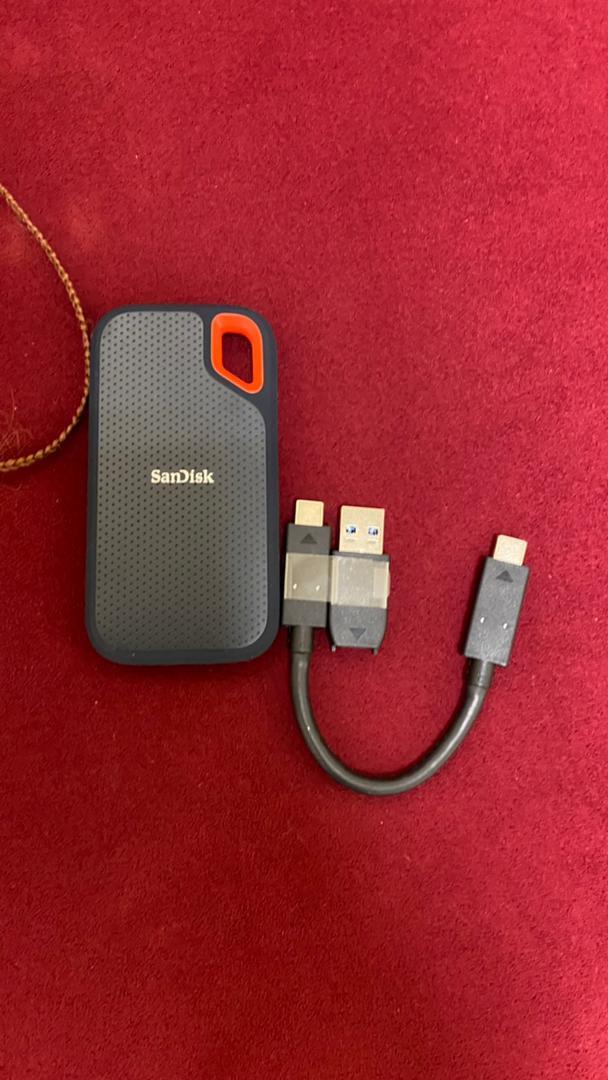
Durability and efficiency is the name of the game when it comes to the SanDisk Extreme Portable SSD. With features such as IP55 support and transfer speeds that go toe to toe with some of the higher-end solid-state drives on the market, this SanDisk offering comes at just the right time as I and numerous students like me prepare for school to resume.
At first glance, the SanDisk Extreme Portable SSD looks quite eccentric: at 0.4 x 2 x 3.8 inches and weighing 1.4 ounces, it is rectangular with rounded corners and a black rubberized finish on the back and sides. A welcome contrast comes in the form of an orange-rimmed cutout in one corner which allows one to clip it to a keychain or a backpack. A third option would be your pocket which this drive fits in quite comfortably.
IP55 support means this drive is resistant to the elements: water, shock, and dust. This is perhaps it’s highest selling point to the average Nigerian student, especially myself. Fear of hostel dust getting into your drive and ruining its internal mechanisms and affecting its upload/download functions is now a thing of the past.
That also means this SSD is immune to Nigeria’s fluctuating power supply that usually results in voltage surges and, by extension, electric shocks that damage most electrical appliances. Built to function in temperatures between 32 to 113 degrees Fahrenheit, It can also withstand not just the rain, but the humidity that comes with Nigeria’s rainy season(s). It is important to note though that the drive does not have a stopper over its USB Type-C connector so it is always a good idea to make sure the drive is dry and free of clutter before use. This is more of a preventive measure to protect your computer from potential software and hardware harm.
Performance-wise, the SanDisk Extreme Portable SSD can reach transfer speeds of up to 550MBps. My friend, an IT major, ran a Blackmagic Disk Speed Test (an application that tests drive performance when used to transfer high-quality video content) on a 2018 Macbook Pro. The SanDisk Extreme Portable SSD had read/write speeds of 512MBps and 463.9MBps which closely mirrors its advertised speeds. She also performed a Folder Transfer Test on the same laptop, moving a sizeable folder full of media (2.89GB) from the desktop to the Sandisk SSD.
It only took ten seconds for the folder’s contents to be transferred. The drive comes with both a USB Type C-to-C cable and a USB-C-to-A adapter which makes it compatible with any commonly-used USB port. The drive already comes formatted for exFAT, making it compatible with both Windows (7 or later) and MacIntosh (‘El Capitan’) operating systems.
The SanDisk Extreme Portable SSD utilizes BiCS FLASH which is a vertically-layered 3D flash that optimizes high endurance with low pricing. The SanDisk SSD comes in four storage options (pricing according to Konga): 250GB, 500GB (N58,000), 1TB (N89,000) and 2TB (N220,000). Though a bit pricey, students would definitely get their value for the money spent if the drive is viewed as an investment. I personally got the 1TB, due to the fact that I am a Mass Communications student which means lots and lots of media files of videos, pictures, newspaper articles and recordings.
With its wide range of features, the SanDisk Extreme Portable SSD is as practical a drive as they come. And practical is exactly what the average Nigerian student needs given the dash-and-go lifestyle of keeping up with deadlines, presentations, assignments and just media in general. A rough-and-ready external drive and on-the-mark speeds means the SanDisk Extreme Portable SSD is certainly the tool of choice for any student with storage needs.
Disclaimer
Comments expressed here do not reflect the opinions of Vanguard newspapers or any employee thereof.