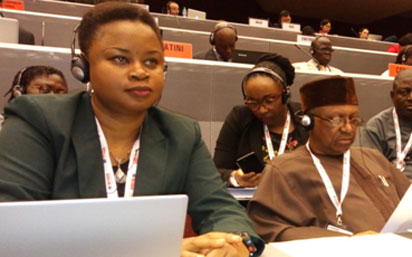
Permanent Missions, Geneva, Florence Akinyemi (left) and Minister of State for Health, Dr. Osagie Ehanire(right), at the ongoing 8th Conference of Parties of the Framework Convention on Tobacco Control, holding in Geneva, Switzerland.
By Agbonkhese Oboh
Today, at the conclusion of the eighth session of the global tobacco treaty negotiations, Eight Conference of Parties, COP8, in Geneva, governments unanimously adopted policies that eliminate loopholes Big Tobacco used to gain access to the talks, redouble defences against evolving industry tactics, and mandate a study on new tobacco products, which pose a threat to public health—particularly to children.
According to Philip Jakpor, Nigeria Spokesperson, Network for Accountability of Tobacco Transnationals, NATT, the negotiations were under constant assault as Big Tobacco attempted to undermine negotiations by stacking government delegations, commandeering industry front groups, lobbying Parties, posing as the public and employing other means to interfere with policies that would save lives and reduce tobacco consumption.
For years, he noted, the tobacco industry has exploited loopholes and sent representatives to pose as members of the public and media, and stack delegations with tobacco-friendly industries in attempts to delay, weaken, or block progress.
“Today,” he pointed out, “Parties adopted a landmark good governance policy that eliminates these loopholes, shutting out the industry and protecting the treaty from interference.”
“The tobacco industry is the single largest barrier to tobacco control policies globally—and these negotiations were no exception,” said Michel Legendre, associate campaign director at Corporate Accountability. “We applaud the delegates that stood up to the industry and staunchly rejected their rhetoric. It is thanks to them that governments have now adopted precedent-setting measures that will protect millions of people’s lives.”
Parties not only eliminated Big Tobacco’s last entryways into the talks, but also expanded the treaty’s firewall policies that protect public health policy making from the influence of emerging industry tactics.
The adopted policies included specific language to expose and counteract tactics such as funding foundations, and the Parties also called on all institutions to reject any proposed partnership, among other measures.
Delegates, NGOs react
“This deadly industry may claim it’s turning a new leaf, but we aren’t falling for its latest scam,” said Akinbode Oluwafemi, Deputy Executive Director of Environmental Rights Action/Friends of the Earth Nigeria, ERA/FoEN.
“Big Tobacco tries to confuse, sow doubt, and derail policy with its PR stunts, but governments around the world are rejecting its attempts,” he added.
“Big Tobacco will stop at nothing to try to undermine the lifesaving measures of the treaty,” said Dr. Nuntavarn Vichit-Vadakan, a delegate for Thailand. “Today,” he added, “we made great strides to keep the industry where it belongs: outside of the talks and away from public health policy.”
Parties also called on the Secretariat to fulfill its commitment and provide governments with the necessary resources to hold the tobacco industry civilly and criminally liable for its abuses — potentially unveiling a new frontier of tobacco control.
“Soon, Parties will have the tools they need to make Big Tobacco pay,” said Dr. Reina Roa, Panama Ministry of Health.
“Liability actions will unlock unlimited potential to transform the way this industry and other corporations operate globally,” Dr. Roa noted.
In his statement, Mr. Jakpor said casting out the tobacco industry, which he described as driving a deadly epidemic, could provide precedent for
insulating other policy-making spaces.
“These include corporations that drive environmental and public health harms; for example, the U.N. Framework Convention on Climate Change has no limitations on fossil fuel industry interference. And their obstruction has been at the core of the talks for the past three years,” he added.
FCTC, COP8 key points
The decisions adopted by Parties at COP8 talks will shape the implementation of World Health Organisation Framework Convention on Tobacco Control, WHO-FCTC, for the next two years and beyond. The treaty, which entered into force in 2005, contains the world’s most effective tobacco control and corporate accountability measures—estimated to save more than 200 million lives by 2050, if fully implemented.
The key outcomes from COP8 talks include eliminating public badge and delegate loopholes exploited by the tobacco industry, reaffirming Article 5.3 guidelines, safeguarding the treaty from emerging industry tactics and calling for all institutions to reject partnerships with industry-funded groups.
Others are calling for the advancement of liability in Article 19, recommending a study on heat-not-burn products and declaring that the FCTC guidelines apply to these novel and emerging products, and adopting a global strategy for tobacco reduction.
Disclaimer
Comments expressed here do not reflect the opinions of Vanguard newspapers or any employee thereof.