By Chidinma Chukwu, Abuja
The Federal Government has pledged to expand access to affordable and quality eye care services to more than 25 million vulnerable Nigerians, with plans to provide five million pairs of reading spectacles and 25,000 fully subsidised cataract surgeries by 2027.
The initiative is aimed at reducing avoidable blindness and improving access to eye care, particularly for women, older persons and underserved rural communities.
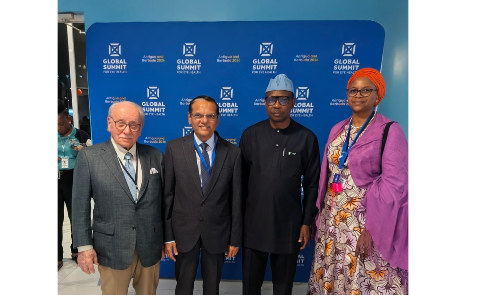
The Minister of State for Health and Social Welfare, Dr Iziaq Adekunle Salako, announced the commitment while delivering Nigeria’s closing address at the Global Summit for Eye Health in St John’s, Antigua and Barbuda, on November 2, 2026.
Salako said the government would also integrate primary eye care into the Basic Health Care Provision Fund (BHCPF) and train 15,000 primary healthcare workers to strengthen eye care delivery at the grassroots.
He added that Nigeria planned to increase its active eye care workforce by 20 per cent and raise its national Effective Cataract Surgical Coverage by 30 percentage points by 2030.
According to the minister, the commitments reflect the government’s determination to accelerate universal health coverage and ensure that vulnerable citizens have access to equitable and quality eye care.
He said the initiative builds on Nigeria’s experience with the JigiBola programme, introduced about 25 years ago in Lagos State to provide free eye screening, eyeglasses and cataract surgery.
Salako explained that the programme was now being adapted for nationwide implementation through the Effective Spectacle Coverage Initiative Nigeria, also known as JigiBola 2.0.
He stressed that sight should not be viewed merely as a medical concern but as a fundamental human right and an essential factor in enabling individuals to realise their full potential.
The minister said the initiative, which Nigeria is pursuing alongside Antigua and Barbuda, Bangladesh, Tanzania and China, would enable participating countries to demonstrate how cataract surgery could be expanded rapidly without compromising quality and while reaching underserved populations.
He urged the countries to document their achievements, measure outcomes and share implementation strategies to enable others to replicate successful approaches.
Salako also highlighted the importance of collective action in advancing global eye health, noting that governments alone could not address the challenge.
He said philanthropic partners had committed $60 million to support assistive technology, while 15 private-sector commitments represented investments of more than $468 million towards accelerating eye care implementation.
He added that about 143 other commitments had been made by organisations outside government.
“Over the course of this Summit, we have moved eye health out of the hospital clinic and placed it squarely where it belongs: at the centre of global development and the Commonwealth agenda.
“We have shown unequivocally that avoidable vision loss is a problem we can solve. As co-host, Nigeria is proud to lead and learn as we call on every defender of human progress to rise to this moment,” he said.
Reaffirming the government’s commitment on behalf of President Bola Tinubu, Salako said Nigeria would work towards transforming national eye care delivery and extending quality services to more than 25 million vulnerable citizens.
He called on governments, development partners and private-sector organisations to sustain the momentum generated by the summit and translate their commitments into measurable improvements in eye care.
The minister said Nigeria would mobilise domestic public and private-sector resources while working with Commonwealth and international partners to monitor progress and implement the resolutions reached at the summit.
Disclaimer
Comments expressed here do not reflect the opinions of Vanguard newspapers or any employee thereof.