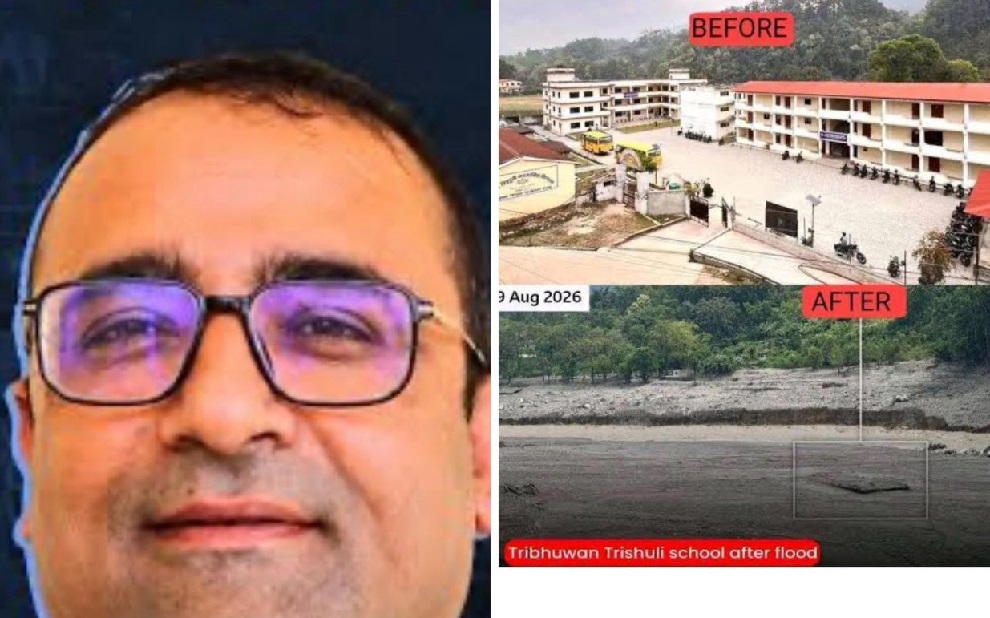
NUWAKOT, NEPAL — In the midst of one of Nepal’s most devastating flood disasters, a remarkable story of courage, leadership and quick thinking has emerged from a school in Nuwakot district.
On the morning of August 26, Headmaster Rajendra Dawadi was preparing for what appeared to be an ordinary school day at Tribhuvan Trishuli Secondary School. Inside and around the three-storey school building were 1,643 students and members of staff.
Then came the warning.
Dawadi received an urgent call that a devastating flood was moving rapidly through the Trishuli Valley. With little time to assess the situation, he made a decision that would prove life-saving: evacuate the school immediately.
He sounded the school bell and instructed teachers to get the children out of their classrooms. School buses were contacted and told to turn back, while students were directed toward higher ground.
The evacuation was carried out with extraordinary urgency.
According to Reuters, the warning gave the school only about 14 minutes to respond. Students escaped by buses, motorcycles and on foot as staff worked to move them away from the danger zone. (Reuters)
Then the flood arrived.
The force of the water was so devastating that the school building itself was swept away. Yet the children had already been moved to safety.
The contrast is difficult to comprehend: a school that had been filled with hundreds of students only moments earlier was destroyed, while the children who would have been inside it were alive because one educator chose not to wait for certainty.
Dawadi later explained that a parent arriving at the school to urgently collect a child convinced him that the warning could not be ignored.
“Parents don’t rush without a strong reason,” he said, explaining why he decided that there was no time to delay. (ABC News)
The decision came at an enormous cost to the school community. Reports say the flood claimed the life of a member of the school staff who had returned toward the river area, while the school itself was completely destroyed. (Hindustan Times)
But the overwhelming outcome of those critical minutes was survival.
1,643 children were evacuated.
The story has since resonated far beyond Nepal, becoming a powerful reminder of what decisive leadership can mean during a disaster. International reports have highlighted Dawadi’s actions as an extraordinary example of how preparedness, awareness and the courage to act quickly can make the difference between tragedy and survival. (The Times)
The wider disaster has been catastrophic. Floods and landslides across Nepal have destroyed homes and infrastructure, disrupted communities and severely affected schools. Save the Children has reported that at least 69 schools were damaged in flood-affected areas, putting the education of nearly 19,000 children at risk. (ABC News)
Against that devastating backdrop, the story of Tribhuvan Trishuli Secondary School stands out.
The building could not be saved.
But its children were.
And that distinction was made possible by one warning, one decision and a teacher who understood that, in an emergency, waiting even a few more minutes could cost lives.
For Rajendra Dawadi, the evacuation was not about becoming a hero. It was about doing what a school leader is entrusted to do: protecting the children in his care.
In the aftermath of Nepal’s devastating floods, his actions have become a powerful symbol of courage under pressure—and a reminder that sometimes, the most consequential act of leadership is simply knowing when to sound the alarm.
Disclaimer
Comments expressed here do not reflect the opinions of Vanguard newspapers or any employee thereof.