By Chioma Obinna
The National Postgraduate Medical College of Nigeria, NPMCN, on Thursday called for a one-for-one replacement of doctors leaving the country, warning that the continuing exodus of medical practitioners is worsening manpower shortages, increasing workloads and putting postgraduate medical training under pressure.
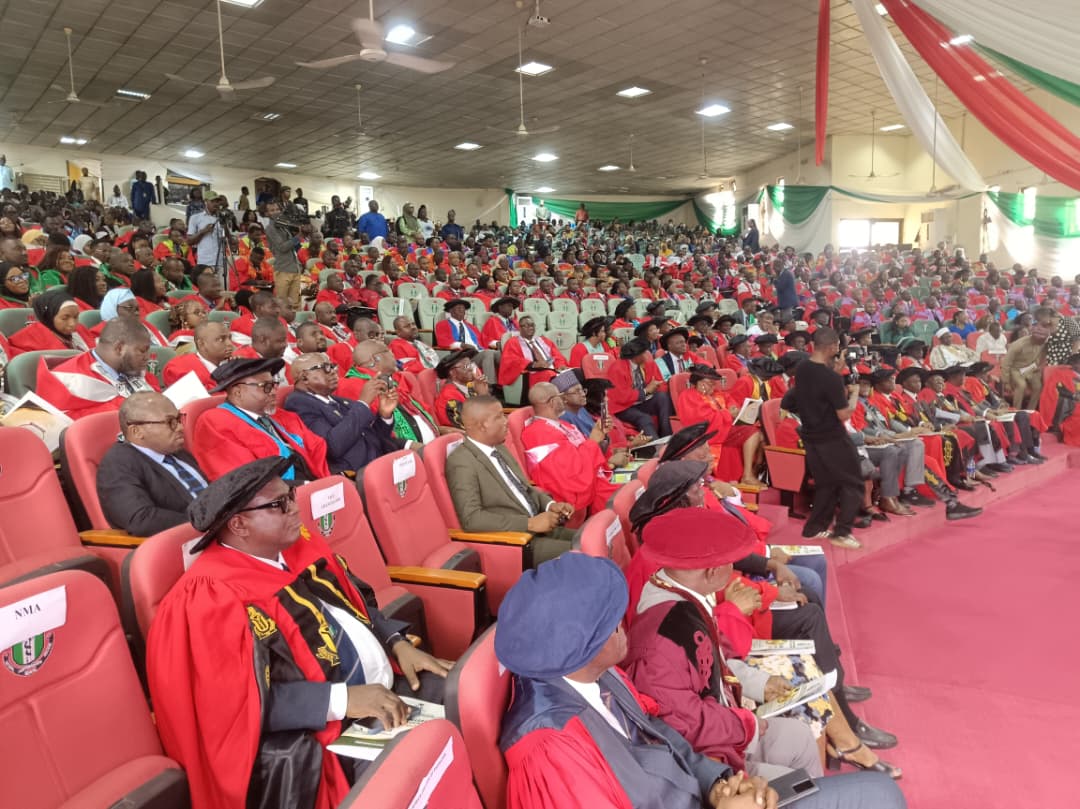
President of the College, Prof. Anthony Ikefuna, made the call at the 44th Annual Convocation Ceremony of the NPMCN in Lagos, saying resident doctors were already combining specialist training with frontline healthcare delivery.
He warned that the situation could expose residents to burnout, reduce work efficiency and weaken mentorship, urging the Federal Government to strengthen the health workforce and increase residency enrolment.
Ikefuna said: “While we may not avert the exodus of doctors from this country, we may alleviate the challenge through workload restructuring and workforce strengthening by implementing a 1-to-1 replacement policy of doctors who emigrate, in order to ease the severe manpower shortages that burden the remaining doctors in training in addition to providing them with psychological support.”
He also appealed to the Federal Government to increase funding support for postgraduate medical examinations, saying the rising costs of logistics, examination materials, examiners’ allowances, accommodation, transportation, information technology and other operational requirements were placing a financial burden on the College.
According to him, the College incurred a huge deficit in conducting its last Fellowship examination, resulting in delays in settling the full entitlements of some examiners.
He urged the Federal Government to intervene, particularly ahead of the implementation of new Duty Tour Allowance rates from October 1, 2026.
Meanwhile, the Director-General of the Nigerian Institute of Medical Research, NIMR, Prof. John Oladapo Obafunwa, has warned that Nigeria is also facing a widening physician-scientist gap, with implications for the country’s ability to translate medical research into improved patient care.
Obafunwa, who delivered the College’s 44th Annual Convocation Lecture, disclosed that only seven of NIMR’s 59 research fellows are medically qualified, while just five are Fellows of postgraduate medical colleges.
He said Nigeria needed to deliberately strengthen the pipeline of doctors combining clinical practice with biomedical research, calling for the introduction of MBBS-PhD programmes and dedicated physician-scientist tracks in postgraduate medical training.
According to him, physician-scientists are needed to ensure that research questions are rooted in real clinical challenges and that discoveries made in laboratories are translated into effective patient care.
“It is perhaps time for the Medical and Dental Council of Nigeria to start looking into the introduction of the MBBS-PhD programme in the medical schools,” Obafunwa said.
“This will help to encourage and start the training of physician-scientists at an early stage; such graduates can still proceed to residency training in clinical areas of their fancy.”
Obafunwa attributed the shortage of physician-scientists to heavy clinical workloads, inadequate research funding, weak career incentives, regulatory bottlenecks and the loss of skilled professionals through brain drain.
He advocated protected research time for clinicians, joint appointments between universities and NIMR, formal mentorship programmes and increased investment in translational research infrastructure.
The NIMR boss also urged stronger integration of medicine, law and ethics in medical education, saying doctors must understand their professional and legal responsibilities before assuming full responsibility for patients.
He advised doctors to improve documentation, obtain informed consent, communicate risks and alternatives clearly and report errors promptly to reduce medical negligence and medico-legal disputes.
“Doctors should maintain thorough, objective documentation with time-stamps and witnesses when relevant. They should seek second opinions and involve ethics or risk management committees,” he said.
Obafunwa cautioned doctors against altering medical records to conceal errors, dismissing patient concerns or responding defensively when adverse events occur.
He also called on the NPMCN to establish a formal physician-scientist track combining specialist clinical training, translational research and ethical-legal governance.
On postgraduate training, Ikefuna announced that the College had received the approval of the National Universities Commission, NUC, for a PhD programme for clinicians.
The programme, he said, would run independently alongside the existing Doctor of Medicine, MD, programme as a pre-Fellowship degree.
He disclosed that about 473 candidates had been conferred with the MD degree since its introduction in 2020, while more than 55 recipients were expected to receive the degree at the 2026 convocation.
He explained that while the MD focuses on core clinical sciences, the PhD would cover clinical and allied sciences.
Ikefuna also announced plans to expand digital technology in postgraduate training and assessment through competency-based work-based assessment, electronic portfolios and telemedicine.
He said electronic portfolios would enable trainers to track residents’ performance milestones in real time, provide feedback and generate reports, reducing some of the limitations associated with manual logbooks.
He, however, cautioned against excessive dependence on artificial intelligence in clinical practice, noting that AI-generated information could be affected by algorithmic bias and might not apply uniformly across different clinical situations.
The College President further announced the establishment of its 17th faculty, the Faculty of Radiation and Clinical Oncology, which emerged from the Faculty of Radiology.
He said the new faculty would strengthen specialist training in cancer care and promote research into advanced approaches to the management of malignant diseases.
Ikefuna also called for the establishment of clinical skills and simulation laboratories in Lagos, Kano, Enugu and Abuja, saying high-fidelity simulation equipment would strengthen practical skills, competency assessment and clinical decision-making among trainees.
He highlighted the acquisition of Eyesi high-fidelity simulation equipment for ophthalmology training, describing it as the first of its kind in West Africa.
Representing the Minister of Health and Social Welfare, the Director of Hospital Services in the Ministry, Dr. Abisola Adegoke, congratulated the Governing Board, Management, Fellows, graduands and staff of the College, commending its contribution to the training and development of medical specialists.
Adegoke, who delivered a goodwill message on behalf of the Permanent Secretary, urged the graduands to uphold professionalism, integrity, compassion and lifelong learning, stressing that their expertise should be deployed in the service of humanity and efforts to improve the quality, accessibility and resilience of healthcare delivery in Nigeria.
Disclaimer
Comments expressed here do not reflect the opinions of Vanguard newspapers or any employee thereof.