.Tasks stakeholders to end power sector excuses
By Olasunkanmi Akoni
The Lagos State Government has targeted an increase in available electricity supply to about 3,500 megawatts (MW) through coordinated action on generation as part of efforts to end persistent blackouts in the State.
Meanwhile, the State Governor, Babajide Sanwo-Olu, has called for stronger coordination, smart metering, better data management, enforcement and revenue assurance in increased power supply, saying stakeholders must work together to build consumer confidence and attract investment.
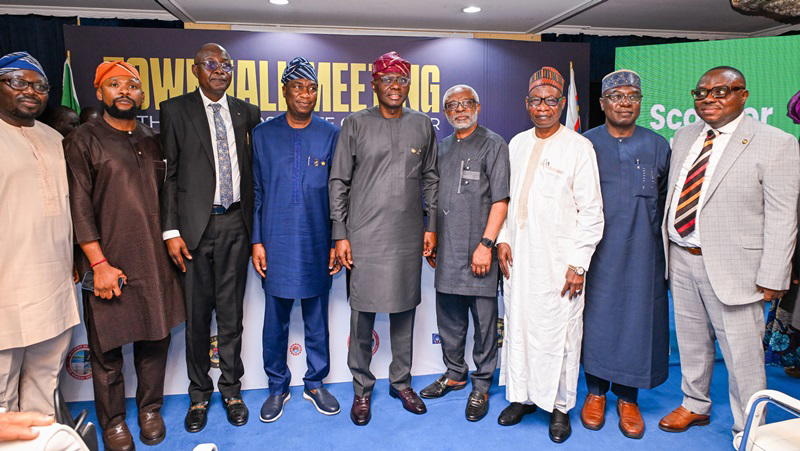
Sanwo-Olu, in company of his deputy, Dr. Obafemi Hamzat, made the remarks on Thursday, at a stakeholders’ meeting, tagged:” Lagos State Government high-level strategic town hall meeting on ending the culture of blackouts and building a sustainable 24/7 power economy in Lagos State,” held at State House, Marina.
The forum brought together key public and private sector leaders to formulate concrete action plans for achieving reliable, 24 hours power in the State.
The event also featured prominent representatives from key corporate and regulatory bodies, including; the Nigerian National Petroleum Company Limited (NNPC), the Nigerian Upstream Petroleum Regulatory Commission (NUPRC), the International Finance Corporation (IFC), the Africa Finance Corporation (AFC), as well as state power authorities such as the Lagos State Electricity Regulatory Commission (LASERC) and the Independent System Operator.
Delivering a frank and impassioned address, Sanwo-Olu called on stakeholders “to drop corporate egos, abandon long-standing excuses, and confront the harsh realities obstructing progress in the power sector.”
The governor acknowledged the frustration felt across both public and private sectors regarding repeated discussions that yield little practical outcome.
Sanwo-Olu, called for stronger coordination, smart metering, better data management, enforcement and revenue assurance, saying stakeholders must work together to build consumer confidence and attract investment.
He proposed a review meeting in five to six months to assess implementation of the commitments.
Earlier, the Minister of Power, Joseph Tegbe, who was represented by the ministry’s Director of Distribution Services, Mr Baba Mustapha, said Lagos requires more than 6,000MW, but currently receives far less from the national grid.
Tegbe stressed that increased generation would have limited impact without adequate transmission and distribution infrastructure, identifying gas supply, generation, transmission capacity, distribution bottlenecks and metering as key priorities.
He said Lagos had secured 400MW from private producers and should continue to explore gas-fired, embedded and renewable generation.
The Commissioner for Energy and Mineral Resources, Mr Abiodun Ogunleye, said Lagos was determined to end what he described as a “culture of blackout.”
Ogunleye said Lagos currently receives less than one gigawatt from the national grid, despite the Transmission Company of Nigeria having about 3.5GW of wheeling capacity.
He said the state’s immediate goal was to add about 2GW to existing supply, bringing available power closer to 3.5GW and enabling more feeders to serve homes and industries.
Ogunleye also said the state would develop clear action points and establish a baseline for measuring progress at the proposed six-month review.
On tariffs, Ogunleye stressed that improved electricity supply must accompany payment, insisting that consumers should not be made to pay for darkness.
Power sector reset
The Special Adviser to the President on Power and Chairman of the Presidential Taskforce on Power Sector Reset and Restoration, Dr. Rilwan Babalola, said the challenge goes beyond adding megawatts.
He said Nigeria must move from managing electricity shortages to building a functioning electricity market where energy, contracts and money move predictably across the value chain.
Babalola said the proposed initial 500MW must first prove that electricity can be reliably generated, delivered, metered, accounted for and paid for before the model is scaled.
He said the ultimate objective of the Power Sector Reset was to move “from megawatts announced to electricity delivered; from government interventions to functioning markets; and from managing scarcity to building a sustainable electricity industry.”
Disclaimer
Comments expressed here do not reflect the opinions of Vanguard newspapers or any employee thereof.