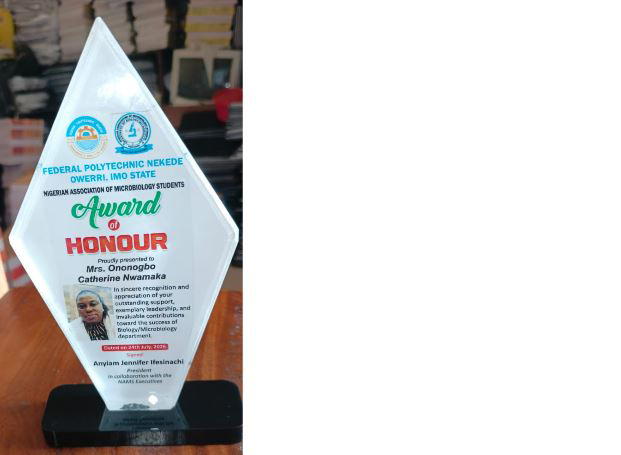
*Guest speaker receives an Award of Honor and urges Microbiology students to embrace artificial intelligence, genomics, entrepreneurship, ethical leadership, and interdisciplinary collaboration.
OWERRI, NIGERIA — Public health researcher, educator, and microbiologist Mrs. Catherine Nwamaka Ononogbo has challenged microbiology students to develop the scientific, technological, and leadership skills required to remain relevant in a rapidly changing world.
Mrs. Ononogbo delivered the keynote address at the Nigeria Association of Microbiology Students’ One-Day Program at Federal Polytechnic Nekede, Owerri, which was held under the theme “Microbial Revolution.”
The program was held with the approval of the amiable Rector of Federal Polytechnic Nekede, Dr. Basilia Nkemdirim Igbokwe, and with support from the Head of the Department of Biology/Microbiology, Mrs. Chinyere A. M. Abba-Father, and the NAMS Adviser, Mrs. Nwamaka Chimereze. The event was coordinated by the NAMS President, Comrade Jennifer Ifesinachi Anyiam, in collaboration with the association’s executive council. Faculty members, students, invited guests, and the department’s alumni also attended.
During the event, Mrs. Ononogbo received an Award of Honor in recognition of her leadership and contributions to microbiology education, research, student mentorship, and professional development. The award was presented by Mrs. Abba-Father and accepted on Mrs. Ononogbo’s behalf by Mrs. Chimereze.
In her keynote address, titled “The Microbiologist of the Future: Skills, Innovation, and Opportunities in a Changing World,” Dr. Ononogbo encouraged students to move beyond the traditional perception of microbiologists as professionals whose work is limited to microscopes, culture media, staining procedures, and laboratory benches.
She explained that while foundational competencies including aseptic techniques, microbial culture, microscopy, biochemical testing, quality control, and laboratory safety remain essential, future microbiologists must also develop skills in artificial intelligence, genomics, bioinformatics, data analysis, public health, biotechnology, environmental management, food production, and entrepreneurship.
“The future will require microbiologists who can move confidently from the laboratory to the community, from the microscope to the computer, and from scientific discovery to practical solutions,” she said.
Mrs. Ononogbo highlighted artificial intelligence, molecular technologies, genomics, and data science as key drivers of modern microbiology. She encouraged students to become familiar with statistical software, data-visualization tools, bioinformatics platforms, spreadsheets, and basic programming.
“The question is not whether artificial intelligence will become part of microbiology. It already has. The real question is: Are you prepared to work with it?” she asked.
She also identified antimicrobial resistance as a major global challenge requiring collaboration among microbiologists, health professionals, environmental scientists, veterinarians, pharmacists, policymakers, and other stakeholders. According to her, future microbiologists must embrace the One Health approach, which recognizes the connections among human, animal, and environmental health.
Mrs. Ononogbo urged the students to view challenges such as unsafe water, poor sanitation, food contamination, environmental pollution, indiscriminate waste disposal, and inadequate laboratory infrastructure as opportunities for scientific innovation. She challenged them to consider developing low-cost microbial testing methods, safer food-preservation techniques, improved water-treatment systems, community-surveillance programs, and microbial solutions for waste conversion and environmental restoration.
She further encouraged students to explore entrepreneurship and job creation through laboratory services, food processing, agriculture, biotechnology, fermentation, environmental services, and industrial microbiology. Mrs. Ononogbo emphasized that scientific communication, integrity, biosafety, ethical leadership, mentorship, interdisciplinary learning, and lifelong professional development would be essential to the success of future microbiologists.
“The future does not need microbiologists who merely memorize established facts,” she said. “It needs microbiologists who can question, investigate, innovate, collaborate, communicate, and lead.”
She concluded by encouraging the students to build their skills, professional networks, research interests, and portfolios before graduation.
“The world of microbes may be invisible, but your impact should be visible,” she said. “Let us not merely observe the microbial revolution. Let us lead it.”
About Mrs. Catherine Nwamaka Ononogbo
Mrs. Catherine Nwamaka Ononogbo is a public health researcher, educator, microbiologist, and health-promotion advocate with more than two decades of experience in teaching, research, laboratory science, student mentorship, and workforce development.
Her expertise includes microbiology, medical parasitology, infectious-disease surveillance, environmental health, water quality, antimicrobial resistance, public health education, and community-based research.
Disclaimer
Comments expressed here do not reflect the opinions of Vanguard newspapers or any employee thereof.