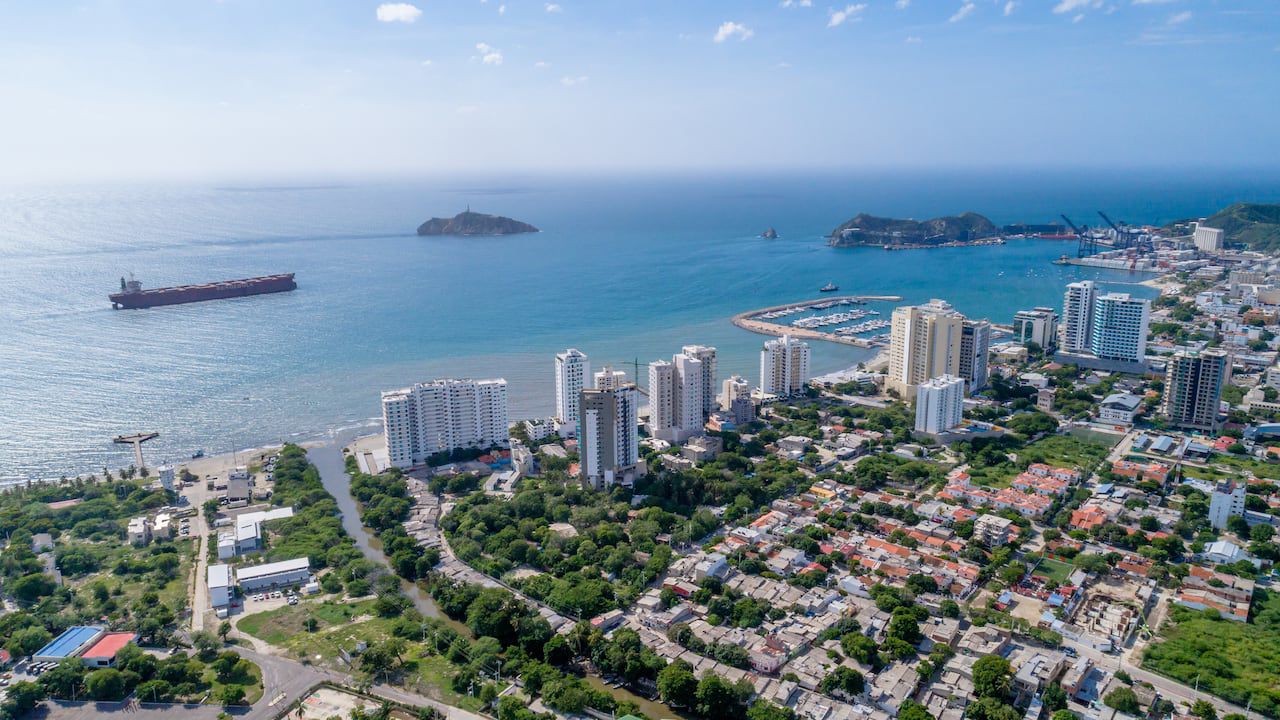
World leaders, diplomats and environmentalists are gathering in Santa Marta, Colombia, for the First International Conference on Transitioning Away from Fossil Fuels from the 24th to the 29th of April 2026.
Speaking at the sidelines pre-conference, Youth Climate Ambassador Kayinajah Inyang laid out the agenda for what the world must deliver in Colombia.
“In Santa Marta, the mission is to do the hard work that the moment demands. We need a formation of a coalition of the willing to initiate a concrete, science-led process for phasing out fossil fuels. We need to shift the focus from negotiation to implementing actionable, equitable transition pathways, including ending new licensing and subsidies, while aligning with 1.5°C targets.”
The landmark Santa Marta conference, co-hosted by the governments of Colombia and the Netherlands, draws more than fifty countries and marked the first dedicated international conference and forum outside the traditional United Nations Framework Convention on Climate Change (UNFCCC) framework focused entirely on accelerating a just, orderly, and equitable phase-out of fossil fuels.
In terms of climate tech and finance goals at the conference, which is one of Inyang’s strong areas of expertise, he said: “For my dear country Nigeria, the best result from this conference is securing financial partnerships and technology to support the $1.9 trillion Renewed Hope Energy Transition Plan (ETF). From a broader African perspective, the best result includes debt cancellation to create fiscal space, funding for renewable infrastructure, and concrete steps toward a Fossil Fuel Non-Proliferation Treaty that enables green industrialisation rather than just halting energy projects.”
For Inyang, who had represented the African youth voice at the UN Climate Conferences and the Davos World Economic Forum, the Santa Marta conference represents a step forward in international climate diplomacy, one that he argued was long overdue for the African continent.
“Africa did not cause this crisis, but Africa is bleeding from it every single day. The floods, the droughts, the displacement, and the dystopian climate induced conflict. These are not projections. They are happening now, in our communities, to our people. At Santa Marta, the world must act, and to act with Africa, not around it.”
Inyang reframed the transition debate away from its perception as a purely environmental cause, arguing that for nations like Nigeria, the economic case is equally compelling.
“This transition is not just for the earth. It is for our economies. Continued dependence on fossil fuels is not economically sustainable. My country, Nigeria’s national budget, has for decades risen and fallen with the price of crude oil. When the oil price sneezes, our economy catches pneumonia. We saw it in 1986, in 2016, and again in recent years. This is the structural trap of fossil fuel dependency.”
Inyang also pushed back against narratives that position Africa as waiting to be rescued, pointing to concrete examples of the transition already underway.
“Let me tell you what is happening at home. Nigeria’s Presidential Complex, the Aso Villa, has completed its transition to 100 per cent sustainable energy. The office and home of my President no longer draw from the fossil fuel grid but from solar. If that is not a statement of intent, I do not know what is.”
The Aso Villa solar project, completed in late 2025 and brought fully online in early 2026, involved a dedicated solar mini-grid with battery storage, disconnecting Nigeria’s seat of government entirely from the national electricity grid. The Federal Government invested over ₦17 billion across two budget cycles to deliver the project.
Inyang was quick to situate the Aso Villa milestone within a broader continental story of clean energy ambition.
“Our North African brothers in Morocco have built one of the world’s largest concentrated solar power complexes at Noor Ouarzazate, 580 megawatts with molten-salt storage that delivers power hours after the sun sets. Our brothers in Kenya already derive more than 90 per cent of their electricity from renewables. How many G7 nations can say that? In 2025 alone, Africa added 54% more solar capacity than the previous year. These are the building blocks of an African green industrial revolution, being built with a fraction of the finance that developed nations enjoy.”
Named by Forbes as one of “the African environmentalists to watch in 2026,” Kayinajah Inyang played a significant behind-the-scenes role at last year’s UN COP 30 in Belém, Brazil, where he helped shape what is now known as the Belém Action Mechanism (BAM), the official Just Transition framework that forms the groundwork for the Santa Marta conference.
He also successfully lobbied for the New Collective Quantified Goal (NCQG) to include dedicated youth-access windows, arguing that even when climate finance exists, bureaucratic barriers routinely prevent young African startups from accessing it. This January in Davos at the World Economic Forum, he doubled down on that position, calling for grant-based investment and concessional finance over traditional loans, meeting directly with private sector leaders and development finance institutions to press his case.
At the sidelines of the pre-conference, when the conversation shifted to climate finance, Inyang called for funding frameworks that prioritise youth-led adaptation projects in the Global South over loan structures that deepen debt burdens on developing economies.
“The green industrial revolution in Africa is real, but it is being starved of the oxygen it needs: funding. As I always say, we are not asking for charity. We are asking for investment in the most innovative and resilient workforce on the planet. We demand an equitable distribution of resources to ensure that the next generation of climate solutions is born and scaled in Africa and the Global South.”
Disclaimer
Comments expressed here do not reflect the opinions of Vanguard newspapers or any employee thereof.