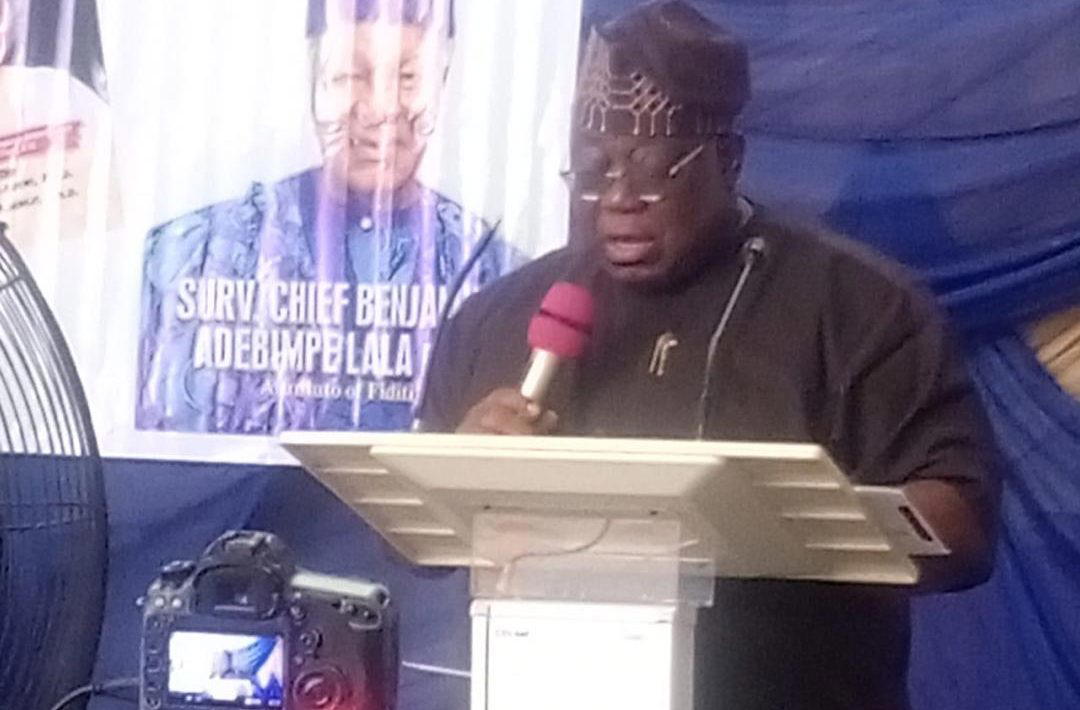
The Chairman, Federal Civil Service Commission, Prof. Tunji Olaopa, has proposed various forms of reform that should be carried out in the country’s local government system in order to optimise its benefits for the citizens.
Olaopa made the recommendations while delivering the ninth yearly lecture of the Binuyo Foundation titled “Strengthening Local Governance as Framework for Nigeria’s National Transformation” at the Federal School of Surveying, Oyo, on Saturday, April 25, 2026.
To Olaopa, in taking local governance reform to the next level,
the most fundamental starting point is constitutional. According to him, the structural basis of Nigeria’s federation lies in the constitutional stipulation of the relationships between the tiers of government.
“It is this legal framework that must be adequately rethought especially within the ongoing discourse on restructuring of the Nigerian polity”, he said.
According to him, this constitutional framework also entails the necessity of stipulating how the states, local governments and community/traditional authorities, structures and community-based organizations could collaborate in boosting local governance through self-help and service provision that build on social capital and the subsidiarity principle which enable capabilities.
To Olaopa, institutional reform initiative also demands the strengthening of inter-governmental development collaboration that constitutes the structural instigation for survival and consolidation of federalism in Nigeria.
He recommended the deepening of the systems of checks and balances that tie governance and democratic structures and practices. Underscoring the necessity for this, he cited the World Bank’s Local Fiscal Transparency, Accountability and Sustainability (LFTAS) protocol which facilitates performance tracking of local government and community-based development programmes, projects and initiatives.
For effective reform of the local government system, Olaopa stressed the importance of interrogating the local governments themselves in terms of capacity deficit that would limit their ability for service delivery to the people.
To him, grassroots development is best served through the social mobilization that organizes members of the communities into cooperative networks for development. According to him, This is where the OPTICOM and the IDIPR models become critical for understanding local governance.
In the course of his lecture, Olaopa had earlier credited his clansman and mentor, the late Professor Ojetunji Aboyade, and his friend and collaborator, Professor Akin Mabogunje with the ideas of OPTICOM and the IDIPR.
“They both experimented with what they tagged the Optimum Community (OPTICOM) development model that draws on the inherent strength of local structures and worldviews as a foundation for development.
“It was a model of rural development. The model mandates the identification of community groupings like cooperative societies, etc. that can facilitate development insights and ideas.
“The underlying thesis of OPTICOM rests on the assumption that community-based structures and traditional institutions possess the inherent capacity, borne out of centuries of adaptability and resilience to bear the weight of responsible policy initiatives if properly managed by responsible and development-minded leadership. Its methodology entailed researcher-masses interaction in the mode of extension services, social mobilization and strategic communication-rooted culture change dynamic. It was an attempt at establishing interactive platforms between researchers and grassroots producers in a unique synergy that facilitates the critical flow and fusion of knowledge and expertise”, he said.
He stated that this was the experiment which the late Chief Obafemi Awolowo wanted to implement if he won the 1979 general election, and which Mabogunje much later iterated as DFRRI and the Ijebu Development Initiative on Poverty Reduction (IDIPR) in partnership with the Awujale of Ijebuland. He also disclosed that the experiment would later constitute the focus of his first doctoral thesis effort.
Disclaimer
Comments expressed here do not reflect the opinions of Vanguard newspapers or any employee thereof.