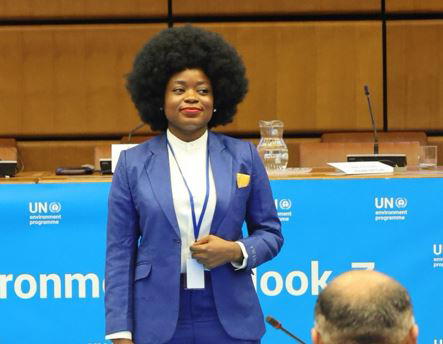
Dr. Adenike A. Akinsemolu
Nigerian environmentalist and sustainability expert, Dr. Adenike A. Akinsemolu, has contributed as a Lead Author to the newly published Global Environment Outlook 7, released by the United Nations Environment Programme (UNEP).
Dr. Akinsemolu served as a Lead Author of Chapter 8, titled “Interlinkages Across Environmental Changes, Scales and Geographic Regions and Subregions,” a key section of the report that explores how environmental challenges are connected across systems, regions and scales.
The Global Environment Outlook 7 is UNEP’s most comprehensive environmental assessment to date, bringing together leading experts from around the world to evaluate the state of the planet and outline practical pathways towards a sustainable future. The report is widely recognised as a major scientific foundation for global environmental policy and action.
Dr. Akinsemolu’s contribution highlights Nigeria’s growing presence in global environmental research and policy. Her work in Chapter 8 draws attention to the urgent need for integrated approaches to tackling interconnected challenges such as climate change, biodiversity loss and pollution.
Speaking on the publication, Dr. Akinsemolu noted that environmental problems cannot be addressed in isolation. She emphasised the importance of coordinated responses that recognise the links between ecosystems, economies and societies across different regions of the world.
A pioneer in the emerging field of Green Microbiology, Dr. Akinsemolu continues to advance sustainability science through research, education and policy engagement. Her work bridges scientific knowledge with practical solutions that support sustainable development in Africa and globally.
“Environmental challenges do not exist in silos. What happens in one system, region, or sector inevitably shapes outcomes in another. The future of our planet depends on how well we understand and act on these interconnections,” she said.
This milestone reflects not only her contribution to one of the world’s most important environmental assessments, but also the increasing role of African experts in shaping global sustainability conversations.
As the world confronts escalating environmental crises, contributions such as this reaffirm that African leadership is not only relevant, but essential in defining the pathways to a sustainable global future.
Disclaimer
Comments expressed here do not reflect the opinions of Vanguard newspapers or any employee thereof.