By Adetutu Audu
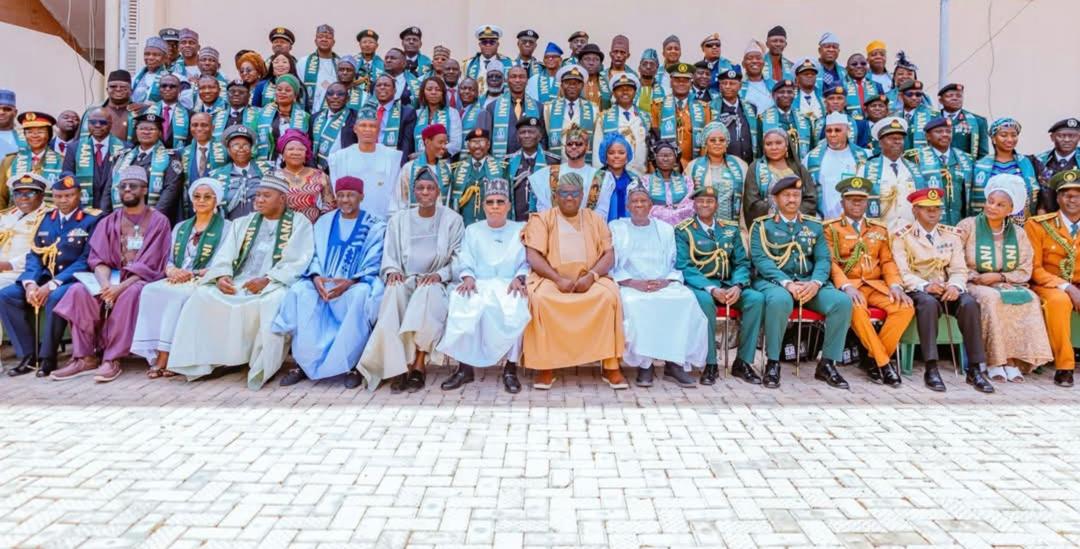
The hall at the National Institute for Policy and Strategic Studies carried the familiar air of ceremony and quiet prestige on February 28, 2025, as Nigeria’s strategic elite gathered for the graduation of participants in the institute’s Senior Executive Course 46. Senior military officers, top civil servants, diplomats and private sector leaders filled the hall, marking the end of a rigorous ten-month programme designed to shape the country’s highest cadre of policy thinkers. Representing President Bola Ahmed Tinubu, Vice President Kashim Shettima stood before the audience with a message that went beyond the ceremonial. Nigeria’s foremost policy school, he said, must embrace digital transformation and automation if it is to remain relevant in a world increasingly shaped by data, technology and knowledge systems.
In his address, delivered on behalf of the president, Shettima spoke about modernising the institute’s infrastructure through advanced e-libraries, digital research systems and virtual learning platforms. The goal was not merely institutional improvement but the repositioning of the institute as a globally competitive centre for strategic thought and leadership training. The message reflected a growing recognition within government that policy institutions must evolve alongside the technological transformations shaping governance worldwide.
Yet the journey towards automation at the institute did not begin on that February afternoon in Kuru. Long before the promise of a digital transformation was articulated from the podium, quiet groundwork had been taking place behind the scenes. Among those associated with the institute’s early automation initiatives is Mrs Silvia Gambo. Between September 2005 and September 2006, Mrs Gambo, who served as Head of IT, led a team that included Ruth Okewole and other young professionals whose work quietly strengthened the organisation’s information management capacity. Under her supervision, the team played a critical role in transforming raw operational data into meaningful intelligence that could guide decision-making.
The team helped lay the foundation for the gradual digitisation of research and knowledge management processes within the institution.
Thier efforts formed part of a broader shift aimed at reducing reliance on paper-heavy archives and introducing digital tools capable of managing the institute’s vast body of policy research.
A significant part of their work revolved around data analysis and insight generation. Using available Management Information Systems tools, the team collected, processed and analysed large volumes of operational data. The results were translated into clear, actionable insights that helped management understand performance trends, identify operational gaps and make more informed strategic decisions. In an environment where reliable data was becoming increasingly important, this work enhanced overall efficiency and strengthened the organisation’s ability to respond to emerging challenges.
Equally important was the team’s commitment to technical support. They provided first-level troubleshooting for system users across different units, responding quickly to technical issues that could have disrupted daily operations. By resolving problems promptly and ensuring that systems remained functional, they minimised downtime and helped maintain a smooth user experience for staff who depended on these digital tools to carry out their responsibilities.
The team also placed strong emphasis on documentation and knowledge management. Recognising that systems are only as effective as the people who use them, they developed detailed user guides and standard operating procedures that simplified processes and improved staff understanding of the tools at their disposal. These documents became an important reference point for both new and existing users, helping to standardise procedures and promote more consistent use of the organisation’s technology infrastructure.
Another core responsibility involved maintaining the accuracy and integrity of data stored within the MIS platforms. The team handled the careful entry, validation and updating of critical operational information, ensuring that the databases reflected accurate and current records. This attention to detail helped build trust in the organisation’s information systems and supported reliable reporting across several key functions.
For decades, the intellectual wealth of the institute existed largely in physical form. Shelves and cabinets carried volumes of research papers, strategic studies, brainstorming reports and policy memoranda produced by participants of the Senior Executive Course. These documents capture the reflections of generations of Nigerian leaders on issues ranging from economic reform and national security to governance and development strategy.
But the sheer scale of this archive often made it difficult to navigate. Retrieving a single document could require a laborious manual search through files and catalogues. Automation began to change that landscape.
Through gradual digitalisation efforts, the institute started introducing electronic knowledge repositories designed to catalogue and store research outputs. Policy papers, brainstorming session reports and strategic studies could be indexed and retrieved through searchable databases. What once required hours of physical searching could now be completed in minutes through automated metadata systems.
The shift represented more than administrative efficiency. It marked a transformation in how knowledge generated at the institute could be used. Researchers and policymakers gained the ability to cross-reference past recommendations with current policy debates, allowing the institution’s intellectual capital to remain relevant long after individual programmes ended.
The Senior Executive Course itself has increasingly benefited from these technological shifts. Participants drawn from Nigeria’s military, civil service and private sector now engage with digital research platforms and electronic knowledge resources as part of their studies. These systems enable faster analysis of policy issues and encourage collaborative research among participants who often occupy strategic positions in national institutions.
Automation has also begun to shape the institute’s approach to data analysis. Training programmes increasingly incorporate analytical tools such as data mining and geospatial intelligence, reflecting a global shift toward evidence-driven policymaking. These tools allow policymakers to examine patterns in security incidents, economic indicators and demographic trends with a level of depth that traditional methods rarely achieved.
For instance, geospatial mapping can reveal patterns in regional security challenges, while data analytics can help identify economic trends that inform fiscal planning and development policy. In this sense, automation functions not as a replacement for human judgment but as a powerful support system for strategic decision-making.
Administrative operations at the institute have also begun to benefit from digitalisation. Processes such as course nominations, documentation, communication and research circulation increasingly rely on electronic systems rather than manual paperwork. The shift helps streamline the management of the large number of senior officials who pass through the institute each year.
These developments carry significance beyond the walls of the institute itself. As Nigeria’s apex policy think-tank, the institute has trained thousands of senior leaders who later occupy influential positions in government, the military and the corporate world. Many ideas that shape national policy have their roots in the debates and research undertaken in Kuru.
This makes the institute not just a training ground but an intellectual engine room for governance. When automation improves the way knowledge is generated, stored and analysed within the institution, it indirectly strengthens the policymaking capacity of the country.
That is why the remarks delivered by Shettima at the graduation ceremony resonated beyond the immediate audience. The vice president emphasised that the federal government intends to transform the institute into a digitally driven global centre of excellence by 2030, underscoring its role as a platform for developing thinkers, reformers and innovators who shape the direction of national policy.
Such a transformation would require sustained investment in digital infrastructure, research automation and technology-enabled education. Advanced e-libraries could provide instant access to global academic resources. Virtual learning platforms could allow executives to participate in programmes from different parts of the world. Automated research tools could enable deeper policy analysis and faster knowledge dissemination.
If realised, these reforms would significantly expand the institute’s influence. A technologically empowered policy school can collaborate more easily with international think-tanks, universities and development institutions. It can also respond more rapidly to emerging national challenges by drawing on real-time data and digital analytical tools.
Institutional change, however, rarely happens overnight. The institute’s reputation has been built over decades of intellectual tradition and rigorous leadership training. Integrating automation into that tradition requires a careful balance between innovation and continuity.
From the early digitalisation efforts associated with figures such as Gambo and Okewole to the broader transformation agenda articulated by the presidency, the institute is gradually redefining how policy knowledge is produced and managed.
And so the scene from that February day in 2025 in Kuru remains symbolic. As the graduating participants listened to the vice president speak on behalf of the president, the future of Nigeria’s most prestigious policy school seemed to be taking shape in real time. The ceremony marked not only the end of a course but also a moment in the ongoing evolution of an institution preparing to navigate the digital age.
Disclaimer
Comments expressed here do not reflect the opinions of Vanguard newspapers or any employee thereof.