By Marie-Therese Nanlong
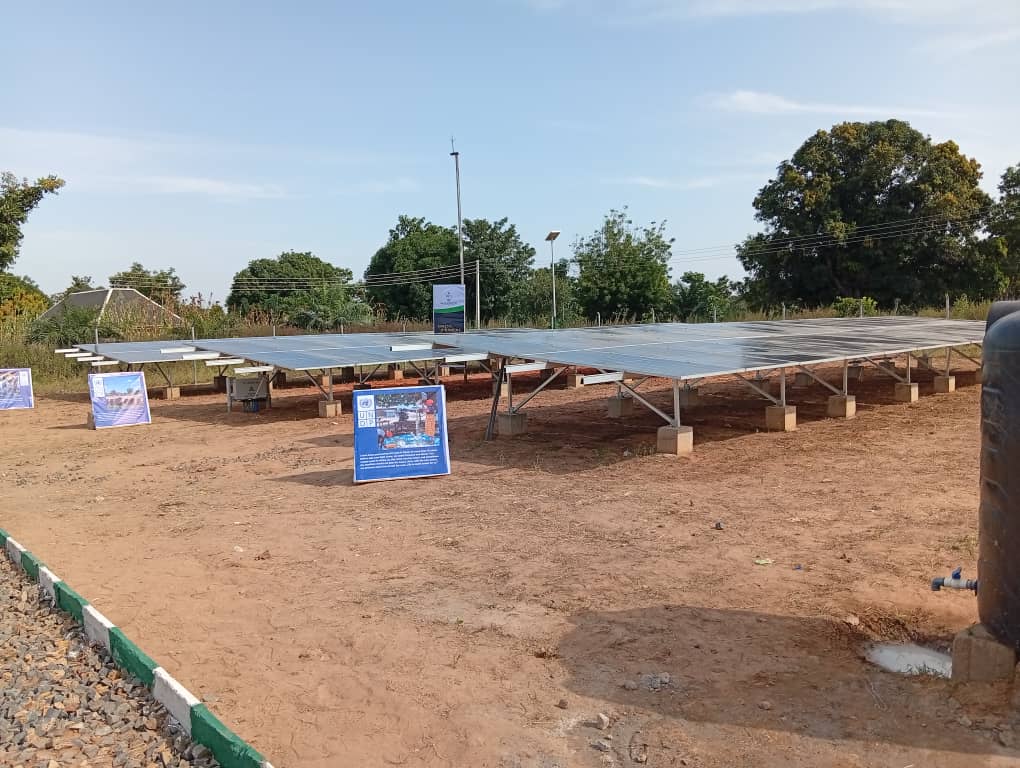
Jos – Residents of the Namu community in the Qua’an Pan Local Government Area of Plateau State came out in their numbers to express joy as the Rural Electrification Agency (REA) led other State and non-state actors to commission a 50-kilowatt solar mini-grid, in line with Nigeria’s expanding clean-energy programme.
The project, implemented via partnership with the Global Environment Facility (GEF), Cloud Energy, Plateau State Energy Corporation, and supported by the United Nations Development Programme (UNDP), forms part of an initiative aimed at transforming underserved communities through sustainable power solutions.
Namu is known for its large-scale rice production but over the decades, the community has been limited due to the lack of access to electricity and water but with the facility, an agro-processing unit, is now connected to the mini-power grid to enhance large-scale rice production.
The commissioning ceremony attracted federal and State government officials, development partners, energy experts, Community leaders, and enthusiastic residents who described the event as a historic turning point for rural development.
In his remarks, the Managing Director/Chief Executive Officer of the REA, Abba Aliyu, explained the Africa Mini-grid Programme, AMP of REA is a flagship initiative to support access to clean energy and enhance financial viability, promoting large-scale commercial investment in renewable energy in Africa.
He said the Namu project reflects President Bola Tinubu’s directive to accelerate rural electrification through renewable solutions, and announced that the Federal Government has approved a $750 million initiative under the World Bank supported distributed access to renewable energy scale-up project.
Aliyu maintained the project will provide clean renewable energy to over 17.5 million Nigerians by developing over 1,350 mini-grids across the country, out of which 42 projects will be sited in Plateau State where 48,000 households will be connected.
Performing the commissioning, Governor Caleb Mutfwang declared that the project symbolises “the beginning of a new journey toward transforming rural economies and empowering local communities.”
He noted that stable and clean electricity remains central to his administration’s strategy for improving agro-allied production, stimulating local enterprises, and expanding the rural economy.
“This project demonstrates our commitment to walk the talk by delivering infrastructure that will unlock rural wealth… Energy is the backbone of every economy.”
Governor Mutfwang outlined three priority interventions for Qua’an Pan, including access to electricity, expansion of rural road networks, and provision of clean water, and thanked the federal government, REA, UNDP, GEF, and others for partnering in efforts to reposition Plateau communities for growth.
Mutfwang noted the initiative aligns with his commitment to rural communities especially those engaged in agro-allied production to have access to electricity to boost productivity and development.
According to him, Plateau State has become a priority zone for the programme due to its enabling environment for investment and its recently established State Energy Corporation.
“Out of the approved facilities, Plateau will host 42 mini-grids, with 10 located in Qua’an Pan alone. This is evidence of the State’s commitment and readiness to lead Nigeria’s clean-energy revolution,” he said.
UNDP Resident Representative, Elsie Attafuah, commended the robust collaboration which she said will empower the community, noting that sustainable energy remains a key driver of economic resilience, climate-action goals, and local peacebuilding.
She, and other speakers urged the community to safeguard the installation and use it to strengthen livelihoods and small businesses.
Also speaking, the Project Manager of the Africa Mini-Grid Programme, Bala Tyoden, said Namu people will make productive use of the facility as there is a large demand for energy saying the facility will power only one agricultural centre, and light up over 100 households.
Energy developer and CEO of Cloud Energy Photoelectric, Theophilus Weke, pointed out the potential in the community where he said millions of dollars are locked up in agro-productivity, and promised to push for the up-scale of the initiative to 2-megawatt capacity.
Ponzing Gamde, the MD of Plateau State Energy Corporation, who highlighted the economic opportunities that will emerge from sustained energy access, said the problem is far from being over, requesting for an immediate upscale as the facility is extendable.
The Chairman of Qua’an Pan LGA, Christopher Manship, described the solar project as “a leap from poverty to productivity,” thanked every partner for “bringing light to Namu” and pledging to ensure proper maintenance and optimal utilisation of the facility.
Disclaimer
Comments expressed here do not reflect the opinions of Vanguard newspapers or any employee thereof.