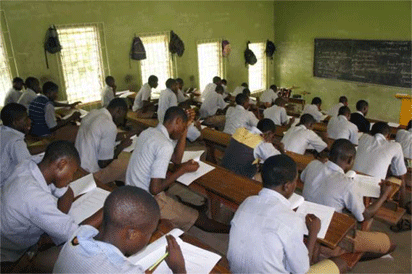
The United Nations International Children’s Education Fund, UNICEF’s, warning is clear: every child has the right to education, but Nigeria is failing to uphold this most basic of rights.
With one in every five out-of-school children in the world found in Nigeria, the crisis has reached a breaking point. Indeed, Nigeria holds the dubious “world record” of harbouring the largest number of Out-of-School, OOSC – over 20 million. Despite free and compulsory basic education being enshrined in law, 10.5 million children between ages five and 14 are not in school. Even those who do attend often find themselves in dilapidated classrooms, with leaking roofs, broken toilets, no electricity, no ICT, and sometimes no classrooms at all. A lot of children enroll but soon drop out due to poverty or are withdrawn for hawking or early marriage.
If education is the bedrock of national development, then Nigeria’s foundation is dangerously fragile. Out-of-school children today are tomorrow’s child labourers, child brides, and recruits for violent groups. For the country, the cost will echo for decades in lost productivity, entrenched poverty, worsening insecurity and diminished global competitiveness. Government officials are not blind to these realities. Insecurity and archaic cultural practices have driven children from classrooms, especially in the North. They know many teachers are underpaid, undertrained and overwhelmed. Billions of naira meant for education are misappropriated or remain locked up in bureaucracy, with several states failing to access matching grants from the Universal Basic Education Commission, UBEC.
Emergency steps must be taken to revive the fortunes of basic education in Nigeria. Our schools must be safe. Parents will not send their children to classrooms in an atmosphere of insecurity. Education budgets should be increased and school feeding programmes expanded to encourage the poorest families keep their children in school. At the same time, neglected basics – roofs, clean water, toilets and teacher training – must be restored with seriousness.
Beyond quick fixes, Nigeria needs a long-term national education compact: a binding pact among federal, state and local governments, supported by civil society and the private sector, with clear and measurable targets on enrolment, retention and learning outcomes. Without such a framework, every administration will recycle old promises while children continue to sit on bare floors under leaking roofs. We need leaders who have a sound knowledge of the burden of responsibility that their exalted positions imposes on them. Only shameless leaders will watch children roaming the streets with begging bowls and fail to do something to address it.
Billions of Naira are trapped in the coffers of the UBEC due to the refusal of state governments to provide their counterpart funds to access them. In 2022, 29 states failed to access N68bn because they had other ideas about how to spend their revenues. This must change.
Disclaimer
Comments expressed here do not reflect the opinions of Vanguard newspapers or any employee thereof.