…as report shows domestic workers in precarious working conditions
By Joseph Erunke, Abuja
Critical stakeholders in Nigeria’s labour sector have emphasised the need for both unionisation and the enactment of a legal framework to protect the rights of domestic workers in the country.
This call followed a report from a study conducted by the Centre for Children’s Health Education, Orientation and Protection (CEE-HOPE), with support from the Rosa Luxemburg Foundation West Africa, which revealed that domestic workers are “largely in precarious working conditions, with inadequate legal protection to seek redress when abused by their employers.”
The report also showed that domestic workers are generally poorly paid, often work long hours, and are vulnerable to physical, emotional, and sexual abuse, without channels for redress. The findings led the researchers to recommend enhanced rights protections and the unionisation of domestic workers.
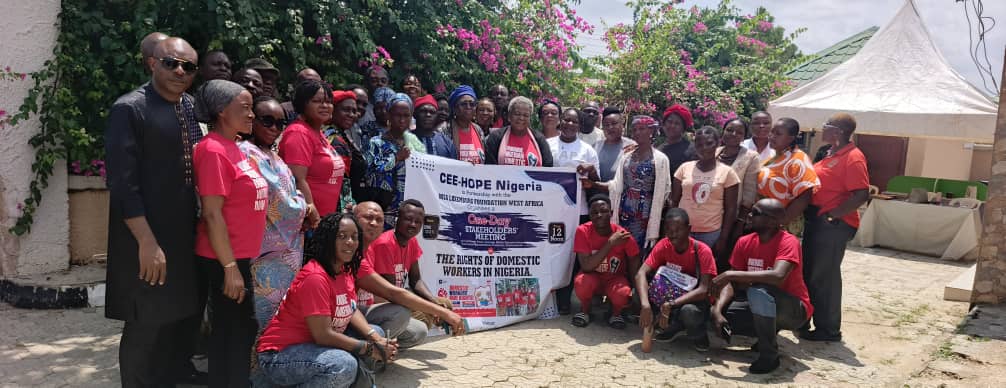
Speaking at a one-day stakeholders’ meeting involving unionists, labour activists, researchers, media representatives, opinion leaders, government agencies, employers, and community leaders, held in Abuja on Friday, the participants agreed that there is a need for legislation to regulate terms of employment and provide mechanisms for resolving disputes between domestic workers and their employers.
The event formed part of efforts under the Rosa Luxemburg-supported project, titled “The Rights of Domestic Workers in Nigeria and the Imperatives for Their Unionisation.”
Speaking at the meeting, Founder of CEE-HOPE, Betty Abah, lamented the attitudes of many employers towards domestic workers, noting that their working conditions remain unsatisfactory.
She further decried the poor remuneration and vulnerability of domestic workers to various forms of abuse. She also highlighted the inadequacy of labour laws in covering domestic work, explaining that the meeting aimed to galvanise stakeholder support for unionisation and a legal framework for domestic workers in the country.
“Due to the weak institutional framework guiding the domestic work environment or protecting domestic workers’ rights, the precarity in the sector persists unchallenged. There should be more effort by labour scholars, trade unionists, and other labour support organisations and individuals to advocate for better working conditions for domestic workers,” she said.
Speaking further, she lamented what she described as a “silent epidemic of rape among domestic workers”, adding: “Many domestic workers are molested by their employers, who take advantage of the absence of binding laws to protect them.”
She reminded participants that a bill is currently before the National Assembly and stressed the need for widespread support to ensure its passage. “Unionisation is key to giving domestic workers a sense of self-worth,” she said.
Also speaking, Mrs Hauwa Mustapha, a resource person at the event, stated that domestic workers should enjoy rights such as fair employment contracts, decent working conditions, and the right to unionise for collective bargaining.
The labour activist and researcher praised the organisers for bringing attention to the plight of domestic workers. However, she noted that assembling data on domestic workers remains difficult due to their limited accessibility.
“Domestic workers play a vital role in homes, yet they are often denied rest and dignity. In South Africa, for instance, they work for a regulated eight hours. We need to give domestic workers the power and dignity they deserve, and this begins with unionism,” she said.
She observed that domestic workers in Nigeria—most of whom are women and girls under the age of 18—are employed under informal and precarious conditions.
According to her, they often lack defined working hours, receive non-commensurate pay, and are sometimes subjected to abusive employer-employee relationships.
She noted that while many domestic workers take on responsibilities equivalent to those of professionals, they are often poorly paid. She insisted that a law to protect and dignify them has become imperative in the country.
“Employment contracts and terms of agreement should specify the work schedule and duties of workers, as well as the obligations of the employer. The duties of domestic workers include, but are not limited to, washing and ironing, cooking and kitchen maintenance, babysitting and nanny work, gardening, security, and driving. Many workers are employed on verbal agreements for specific tasks but end up performing far more than initially agreed,” she stated.
Also speaking, the Country Manager of the Rosa Luxemburg Foundation West Africa, Angela Ogodo-Odah, condemned what she described as the “inhuman treatment” of domestic workers, including sexual abuse. She said it was time for domestic workers to have specific duties and formal, documented contracts.
Urging neighbours to speak out when they witness mistreatment of domestic workers, she said:
“Your domestic staff are there to work, not to be used as sex objects. House helps are employed for specific tasks, not to carry the entire burden of a household.”
On her part, the Chief Facilitator of Equity Advocates, Ene Ede, called on employers to treat domestic workers with dignity, stressing that they are human beings and not invisible.
Former Chairman of the Nigeria Union of Journalists (NUJ), Abuja Chapter, Emmanuel Ogbeche, and the Deputy Chairperson of the Nigeria Association of Women Journalists (NAWOJ), Mrs Chizoba Ogbeche, in their separate remarks, urged employers to treat their domestic workers the same way they treat their own children.
In his contribution, the National General Secretary of the Nigeria Labour Congress (NLC), Comrade Ismail Bello, said the time had come for domestic workers—most of whom are young women—to unite under a recognised union.
Disclaimer
Comments expressed here do not reflect the opinions of Vanguard newspapers or any employee thereof.