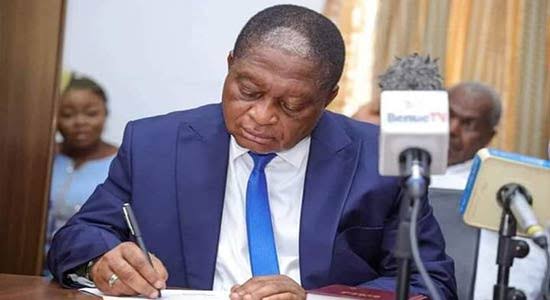
Maurice Ikpambese
By Abraham Aerfa
The Brouhaha:
In Benue State, there is a significant controversy surrounding the removal of the Chief Judge, Mr. Maurice Ikpambese.
The Benue State House of Assembly recently recommended the suspension of Justice Maurice Ikpambese, citing allegations of gross misconduct, including abuse of office and mismanagement of judicial finances.
This recommendation was made after a letter from Governor Hyacinth Alia was presented during a plenary session, where 23 out of 31 members voted in favor of the motion to remove him.
Both the National Judicial Council (NJC) and the Nigerian Bar Association (NBA) have condemned the actions of the Benue State House of Assembly, labeling the resolution to remove the Chief Judge as unlawful and a breach of the rule of law
They have variously asserted that the removal is unconstitutional. The NJC emphasized that Justice Ikpambese remains the Chief Judge until a proper investigation into the allegations is conducted.
They pointed out that the constitutional process for removing a Chief Judge involves a recommendation from the NJC and a two-thirds majority vote from the House of Assembly, which they argue was not followed in this case.
The Position of the Law:
Section 153(1) of the Constitution of the Federal Republic of Nigeria, 1999 (as amended) has established the National Judicial Council (NJC). Sub section (2) of Section 153 provides for the powers of the NJC, which powers, as contained in Part 1 of the Third Schedule to the Constitution, include recommending to the Governors of the States the removal from office of judicial officers appointed to the offices of the Chief Judges of the States and Judges of the High Courts of the States.
Section 292(1) (a) (ii) of the Constitution, on the other hand has made the following critical provision, namely, that a judicial officer shall not be removed from his office or appointment before his age of retirement but that in the case of Chief Judge of a State, it is permissible for the Governor to remove the Chief Judge when acting on an address supported by two-thirds majority of the House of Assembly of the State praying that the Chief Judge be removed. Also critical is the provision of paragraph (b) of sub section 1 of the said section 292 of the Constitution. It states that the judicial officers other than the Chief Judge of a State, Grand Kadi of a Sharia Court of Appeal or President of a Customary Court of Appeal shall be removed from his office or appointment by the Governor acting on the recommendation of the NJC that the officer be so removed for his inability to discharge the functions of his office or appointment or for misconduct.
A combined reading of the powers of the NJC as it relates to the removal of a Chief Judge of a State as contained in Part 1 of the Third Schedule to the Constitution, and Section 292 (1) (a) (ii) of the same Constitution reveals that the two provisions of the Constitution cover the same ground or deal with the same subject matter in ways that cannot legally co-exist. On one hand, the Constitution says the NJC is to recommend to the Governor the removal from the office of judicial officers appointed to the office of Chief Judges of States and Judges of the High Courts of the States. On the other hand, the Constitution provides that the Chief Judge can be removed by the Governor acting on an address supported by two-thirds majority of the House of Assembly.
In this latter position, no mention is made of the NJC.
We are, therefore, faced with two contradictory provisions. The trite position of the law in answer to this contradiction is that the later provision, which in this case is section 292 (1) (a) (ii) of the Constitution takes precedence over the earlier one, which is section 153 of the Constitution.
Furthermore, the provisions of section 292 (1) (a) (ii) and (b) of the Constitution are couched in very clear and specific statements. In these provisions, there is a distinction between a Chief Judge and other judicial officers. It is the removal of other judicial officers by the Governor of a State that is made subject to the recommendation of the NJC, as provided by section 292 (1) (b). This is not the case with section 292 (1) (a) (ii), which has made no mention of the NJC.
In light of the above analysis, it is humbly submitted that the resolution of the Benue State House of Assembly is in consonance with the provisions of section 292 (1) (a) (ii) of the Constitution. Nowhere in this provision has the Constitution placed any obligation on the Governor of Benue State to receive recommendations from the NJC before removing the Chief Judge of Benue State, Justice Maurice Ikpambese, from office. If the removal of Justice Ikpambese was pursuant to Section 292 (1) (b), it is only then that the matter would have required the recommendation of the NJC.
The Governor of Benue State and the Benue State House of Assembly are constituted authorities. Their decision to remove Justice Ikpambese from the office of the Chief Judge of Benue State can only be challenged in a court of law. The Nigerian Bar Association (NBA), the NJC and other bodies or associations are not courts of law and, therefore, lack the competence to invalidate the action of the Governor as it relates to the removal of Justice Ikpambese. Until a competent court of law sets aside the removal, it stands and can be enforced.
•Aerfa ESQ lives in Jalingo, Taraba State.
Disclaimer
Comments expressed here do not reflect the opinions of Vanguard newspapers or any employee thereof.