Oluseun Olowofoyehan
In a world where the opioid epidemic and drug-resistant cancers continue to devastate lives, Millicent Akere, a PhD candidate at the University of Toledo, is making revolutionary strides in medicinal chemistry. Millicent is pioneering the development of novel in vivo photoaffinity labeling (PAL) probes aimed at reversing the effects of synthetic opioids, a small yet critical advancement in the fight against opioid overdoses. Her cutting-edge research has the potential to surpass current treatments like naloxone, offering a new hope for individuals battling opioid addiction. With over 80,000 opioid-related overdose deaths reported in the United States in 2022, Akere’s innovative approach could redefine the landscape of overdose treatments globally, including in countries like Nigeria, where 14.4% of adults misuse opioids such as tramadol.
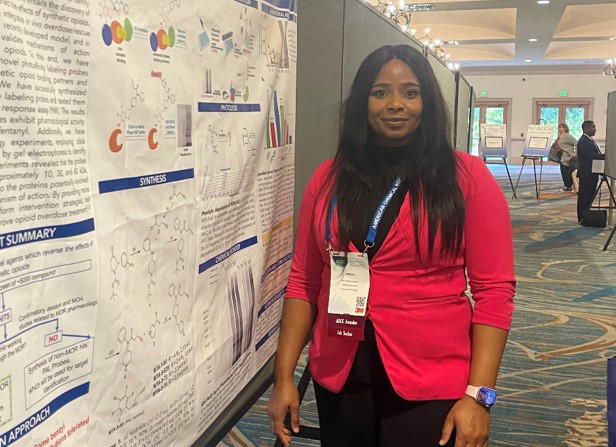
At the forefront of Millicent’s research is her synthesis of novel fentanyl photoaffinity labeling probes, which she is using in in vivo competition experiments to identify new mu-opioid receptor ligands. This work could lead to the development of more effective reversal agents that go beyond current therapies, addressing the limitations of naloxone in opioid overdose treatment.
Millicent’s research doesn’t stop there. Her contributions extend into prostate cancer treatments, where she is targeting drug-resistant forms of the disease that affect millions worldwide. Prostate cancer, particularly in advanced stages, is notoriously difficult to treat, especially in regions like Nigeria, where late-stage diagnoses and a lack of oncologists contribute to high mortality rates. Millicent’s work focuses on synthesizing dual-mechanism EZH2 inhibitors that show potent activity, with nanomolar IC50 values, against enzalutamide-resistant prostate cancer cells. Her work could be pivotal in transforming the treatment landscape for patients facing resistance to existing therapies.
Her expertise spans critical areas of medicinal and analytical chemistry, including drug design, cell culture, NMR, HPLC, LC-MS/MS, and zebrafish husbandry, allowing her to push the boundaries of both opioid and cancer research. With her commitment to drug discovery and her focus on underserved populations, Millicent’s research offers promising solutions for global healthcare crises.
Millicent Akere’s influence reaches beyond the lab. As a prominent figure in the scientific community, she has presented her findings at prestigious conferences such as the National Organization for the Professional Advancement of Black Chemists and Chemical Engineers (NOBCChE) and the American Chemical Society (ACS), receiving widespread recognition for her work. Her scholarly contributions include articles in renowned journals, such as Brain Sciences and Results in Chemistry, further cementing her as a thought leader in medicinal chemistry.
As the Vice-President of the NOBCChE Student Chapter at the University of Toledo, Millicent Akere’s advocacy for diversity, equity, and inclusion highlights her commitment to fostering a more inclusive scientific community. Her leadership in this role demonstrates her dedication to promoting opportunities for underrepresented groups in STEM and encouraging a culture where everyone can thrive. Whether through her groundbreaking research, leadership initiatives, or community service, Millicent Akere’s journey exemplifies resilience, innovation, and an unwavering dedication to addressing some of the world’s most pressing healthcare challenges.
As a rising star in drug discovery and a relentless advocate for global health, Millicent’s work promises to leave a lasting impact on the opioid crisis, cancer treatment, and beyond.
Disclaimer
Comments expressed here do not reflect the opinions of Vanguard newspapers or any employee thereof.