By Ayo Onikoyi
Temitope Awe, a seasoned molecular bioscientist with research experience in Nigeria and the United States, is helping shed light on the on some of the most puzzling questions in sensory biology and animal navigation.
Awe’s research aims to enhance biodiversity, conservation, and ecosystem health by investigating the molecular and cellular mechanisms that govern the animal’s interaction with the surrounding stimuli.
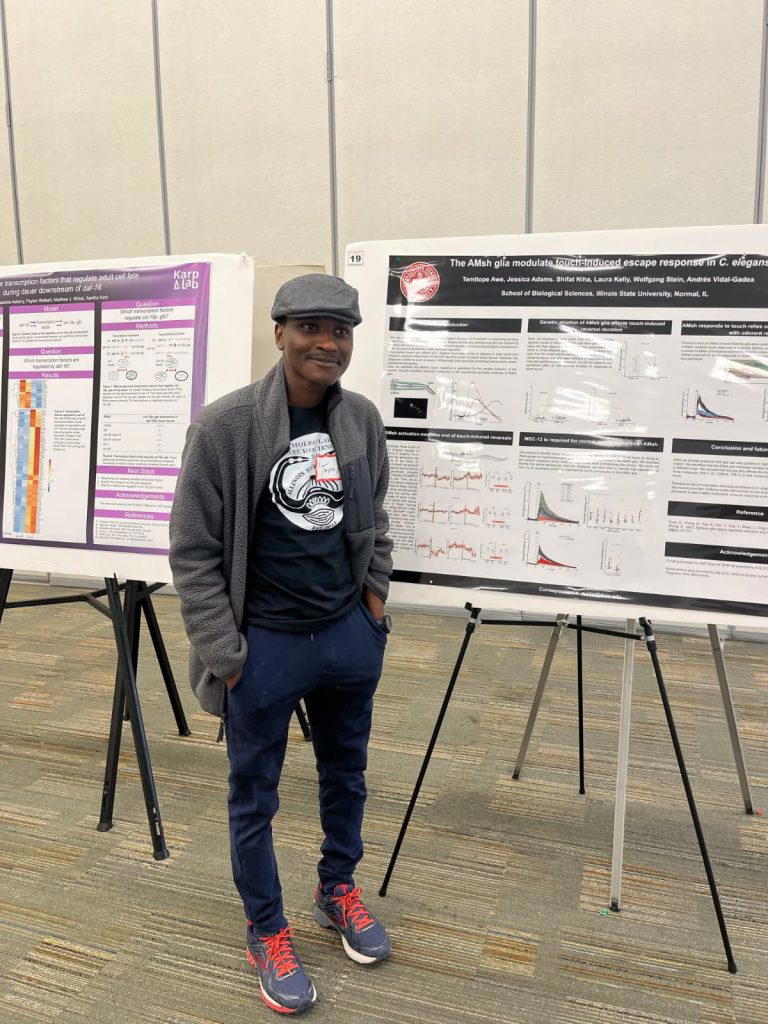
Awe, a Ph.D. candidate and research associate in molecular neuroscience at Illinois State University, uses advanced molecular and imaging techniques to understand how animals navigate through their environments. He approaches the task by asking two questions: First is how do migratory animals’ sense and harness magnetic fields of the earth’s for navigation?
Many animals rely on magnetic fields for navigation, and human-generated magnetic fields, such as those from power lines, could distract these animals, rendering unreliable the information from the Earth’s magnetic fields in guiding them to their destination. Understanding how the nervous system of these animals interact with ambient magnetic fields could help shed light on on the extent of the impact of artificial magnetic fields made by humans on the animals.
The second challenge faced by animals during navigation is the ability to recognize and avoid dangers in their environment. Animals have evolved to use several environmental cues to avoid dangers, including mechanical, odorants etc. A question Awe is asking is: How do animals regulate the extent of their escape behaviors? “We know about the ‘fight or flight’ response to danger,” Awe explains, “but how do we know when to stop fleeing from danger?” Understanding this is crucial because expending too much energy fleeing can impact an animal’s reproductive success and immune function, potentially leading to biodiversity loss.
Awe’s findings on animal magnetosensation highlight the role of iron nanoparticles, possibly located within sensory structures, in helping animals orient themselves using geomagnetic cues. Additionally, Awe has identified the critical role of glia in regulating escape responses to environmental stimuli, ensuring that the energy cost of fleeing does not jeopardize the animal’s survival.
Beyond expanding our fundamental scientific knowledge, Awe’s research holds significant implications for conservation. If we can understand how our electronic devices, electrical connections that generates magnetic fields affect the survival of animals, maybe that could inspire policy makers to provide regulations that would drive development of animal friendly electrical devices and appliances.
Looking ahead, Awe envisions practical applications for his research, such as developing novel sensors and navigational systems inspired by animals’ natural abilities. Echoing Albert Einstein’s 1949 prediction that studying migratory birds and carrier pigeons could uncover unknown physical processes, Awe believes that understanding animal magnetoreception could lead to breakthroughs in sensor technology.
In summary, Temitope Awe’s pioneering research on animal navigation and magnetoreception is not only advancing scientific knowledge but also offering vital tools for conservation efforts, with the potential to inspire innovative technologies based on the principles used by nature itself.
Disclaimer
Comments expressed here do not reflect the opinions of Vanguard newspapers or any employee thereof.