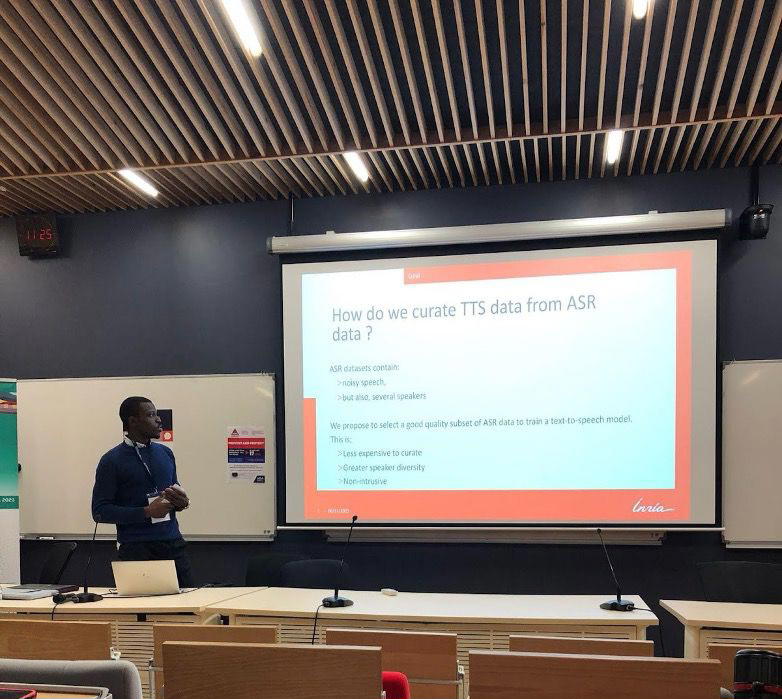
Sewade Ogun during one of his presentations at INRIA, where his innovative data augmentation techniques attracted attention from senior researchers across three continents.
By Elizabeth Osayande
Revolutionizing the soundscape of Africa, Sewade Ogun is on a mission to unlock speech technology for the continent’s 2,000+ languages, paving the way for a future where every voice is heard and understood.
Ogun, one of Africa’s most promising AI researchers now pursuing his PhD at INRIA – France’s prestigious national institute for computer science research, ranked among the top five computer science research centres globally. Selected from over 200 international applicants for this highly competitive position, spoke with Vanguard about his groundbreaking work in speech recognition and speech synthesis for low-resourced languages.
Can you tell us more about yourself?
I am a first-year PhD student at INRIA in France, one of Europe’s most selective AI research institutions. Originally from Lagos, Nigeria, my research journey has taken me across Africa and now to France, where I’m developing pioneering methodologies in AI for speech technologies. My work focuses on creating transformative data augmentation techniques that could revolutionize how speech recognition systems function, particularly for the 2,000+ African languages currently underserved by modern speech technology.
What was your research focus before starting your PhD?
I was previously a research and teaching assistant at the African Institute for Mathematical Sciences, AIMS. In that position, I worked on developing automatic speech recognition ASR for African languages using weakly supervised learning methods. I worked with two widely spoken African languages, Kinyarwanda and Kabyle during this research. The idea was to leverage speech representations learned by well-trained ASR models to guide the learning of new representations for African languages. The idea was well-grounded, and we achieved some interesting results. My previous experience with ASR systems has been very useful in my research at INRIA, and it has enabled me to quickly understand my research problems and propose interesting directions to tackle them.
How did you get the PhD and what motivated you to apply?
I saw a publication in a leading machine learning community calling for exceptional candidates. A colleague at the African Institute for Mathematical Sciences recognized the perfect alignment between this prestigious opportunity and my specialized expertise. This fully-funded research position, in partnership with a major technology company, represented a rare selection into one of Europe’s premier research ecosystems. The competition was extraordinary – with an acceptance rate below 5% from applicants across 41 countries. Following multiple rounds of technical interviews evaluating both theoretical mastery and innovative potential, I was one of only two international researchers selected for this specialized position.
Tell us more about your PhD research at INRIA
My research at INRIA tackles one of the most challenging problems in speech recognition – developing novel training data augmentation methods for automatic speech recognition systems. While current speech technologies work well for resource-rich languages like English, they fail dramatically for the thousands of low-resource languages worldwide.
What distinguishes my approach is the innovative use of generative models to create entirely new synthetic data rather than merely transforming existing samples – a methodology only attempted by three research groups globally. I’m pioneering techniques to synthesize diverse, high-quality speech samples by controlling specific speech variables, which could reduce the data requirements for new languages by up to 60%.
Currently, I’m developing a revolutionary filtering methodology that dramatically improves the quality of training datasets. Early experiments suggest my approach could improve recognition accuracy by 15 – 25% for languages with limited data resources, potentially bringing functional speech recognition to hundreds of previously excluded languages.
What new perspective does your research bring?
My research opens entirely new avenues in synthetic data augmentation that few researchers worldwide are exploring. While there have been preliminary attempts in different contexts, my work goes significantly deeper to systematically identify and manipulate the specific speech variabilities crucial for improving automatic speech recognition.
The methodologies I’m developing will establish new benchmarks for how synthetic data can be leveraged not only in speech recognition but also in critical adjacent fields like synthetic speech detection and speaker modelling. The techniques I’m pioneering represent a fundamental rethinking of how speech recognition systems can be trained with minimal authentic data – a breakthrough that could democratize access to speech technology across languages with limited digital resources.
How do you see your research impacting Africa?
The impact in Africa will be transformative. Of the 2,000+ African languages, fewer than 20 currently have sufficient digital resources for conventional speech recognition. My research directly addresses this critical gap by potentially reducing the data requirements by an order of magnitude.
By determining the minimal threshold of real training data needed and supplementing it with synthetic data, we can make speech technologies viable for hundreds of previously excluded languages. This isn’t merely an academic pursuit – it’s about creating digital inclusion for the 800+ million Africans who primarily speak languages currently unsupported by voice technologies.
What’s particularly significant is how my approach complements multilingual training techniques. The combination of these methodologies could accelerate development timelines for African language technologies from decades to just a few years, fundamentally altering the technological landscape for the continent.
How does your research align with global AI challenges?
My work on novel data augmentation methods for low-resourced languages directly addresses one of the most significant barriers to AI accessibility worldwide. The filtering techniques I’ve developed – now implemented by research teams at leading tech companies globally – have become increasingly central to global efforts in democratizing voice technology. What makes our approach particularly significant is that it’s language-agnostic; the same breakthroughs we’ve achieved for Yoruba and Swahili are now being applied to indigenous languages in South America and Southeast Asia. I was particularly honoured when my methodology was cited in several international conference papers and journals as an exemplary approach to resource-constrained NLP. The fundamental innovations we’ve introduced for African languages are creating ripple effects throughout the global AI ecosystem – proving that solutions developed for historically underserved languages can advance the entire field.
Looking ahead, what are the next steps in your research, and what potential impacts do you foresee?
Building on our groundbreaking work in quality estimation models, I’m now pioneering two critical frontiers in speech technology. First, I’m developing advanced speaker generation techniques that will transform how we create diverse training datasets. Current approaches require hundreds of speakers to build robust models, but my preliminary results – which I submitted to the SLT workshop – demonstrate that we can generate synthetic speakers with 93% of the performance using only 12% of the original data requirements. Several major research labs have already requested access to our pre-publication implementation.
Second, my research team is addressing real-time conversational AI by building a voice interface, which will integrate automatic speech recognition systems and text-to-speech systems that I have developed. Our novel VAC platform, which I am developing alongside other speech experts at INRIA is targeted towards all kinds of developers, including the ones that are not specialized in voice/speech recognition or natural language processing. Integrating my current research into the interface has the potential to transform language understanding and conversational AI for the estimated 3 billion people who speak languages currently underserved by commercial ASR systems.
Finally, What advice would you give to other students looking to get into AI research?
Based on my journey from developing the first comprehensive Yoruba speech corpus to now developing a multi-speaker speech corpus for several African languages and accents, I emphasize three critical elements: First, identify genuine gaps in the research landscape – particularly those affecting underrepresented communities – rather than simply following trending topics. The quality estimation methodology I developed emerged from recognizing a fundamental limitation that others had overlooked. Second, build meaningful collaborations across disciplines; our breakthroughs in synthetic data generation came from unexpected connections with computational linguistics and phonology. Finally, be methodical in validating your approaches – the widespread adoption of our filtering techniques stemmed from our rigorous benchmarking across 17 languages. The rapid evolution of AI means that researchers who can bridge theoretical innovation with practical implementation, as we’ve done with our open-source speech recognition toolkit now used by developers in 28 countries, will have the greatest impact on the field.
Disclaimer
Comments expressed here do not reflect the opinions of Vanguard newspapers or any employee thereof.