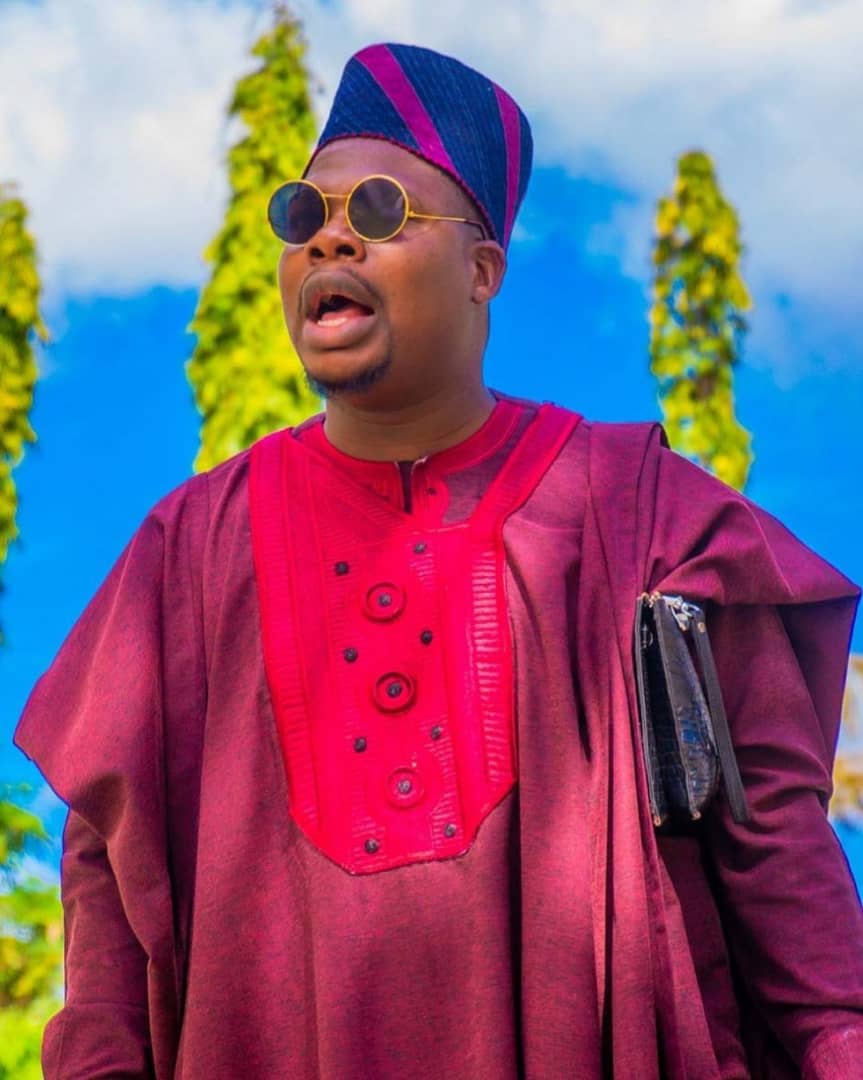
Adedayo, Mr. ‘Macaroni’
Having trained at the university as a thespian, successful social media comic and content creator, Debo Adedayo, also known as Mr. Macaroni, has revealed how his desperation to use his craft to impact his world for good drove him into embracing the resources of social media platforms, stressing that there is an urgent need for all theatre practitioners to utilise the multi-dimensional opportunities that the digital space provides.
Mr. Macaroni, as he is fondly called by his swelling fan base, buttressed this while fielding questions on the impact of social media, his rise to stardom, theatre performance, governance in Nigeria, youth empowerment and political mobilization, gender-based issues, among several others. He was speaking at an interactive virtual platform called the Toyin Falola Interview series put together by Nigerian historian and professor of African Studies, Professor Toyin Falola who is currently the Jacob and Frances Sanger Mossiker Chair in the Humanities at the University of Texas at Austin, United States of America.
The virtual interview session held on Sunday, June 12, 2022, was streamed on various social media platforms. It was viewed by a global audience which comprised theatre practitioners, academics, politicians, students, industry players, among many others. The panel headed by Professor Falola had theatre practitioner, Yemi Shodimu; playwright and scholar, Professor Ahmed Yerima; and film critic, gender advocate, Dr. (Mrs.) Olufadekemi Adagbada, while Professor Femi Osofisan, Professor Ebun Clark, Professor Ademola Dasylva, Professor Pamela Smith, Professor Nuhu Yaqub, Dr. Chido Onumah, Dr. Abimbola Adelakun, and many others, were prominent members of the audience.
Answering Professor Yerima’s question on his embrace of social media as veritable platform to push his craft, Mr. Macaroni stated that “I say to myself that I started very late on social media and that was because of you. I remember the stage strength and theatre performances that I got under your tutelage in school. I saw what was being done on social media and felt that I could not do that. As a thespian at that time, I felt content creation for online media was beneath me. I felt it was only professional to do stage performances. I spent a lot of time going for auditions for TV films, soap operas; but I was only getting those tiny roles. This was not really what I wanted. While in school, I was always playing the lead role in most of the theatre performances. I began to question myself: ‘Is it that I am not a good actor and maybe I was being deceived in school.’ I was frustrated and depressed. One thing that I didn’t explore was to go back to stage performances. It was not coming for me at the film industry. I saw the likes of Maraji, Shaggi who were already online sensations. I said to myself: ‘This thing to me doesn’t make sense but it is not as if I cannot do it.’ I also remember that aside what you taught us on stage performance, you also said that the world is dynamic and we must roll with its dynamism. My piece of advice to fellow thespians is that they should not feel embarrassed to join in the changing phases of global dynamism. You must be conscious of what you are doing and remember your roots. This is why I embraced social media, although when I started, it was out of desperation. I did what came to my head. I later discovered that people were actually watching. I saw hundreds of thousands of viewers. After this, I had to go back to theatre which is my roots. I recalled that I had been taught in school that theatre should educate the society and that inasmuch as I wanted to be popular, I must also not forget my training as a theatre performer.
“Theatre students must explore even right from school. It is true that theatre is the mantra; it will always be but I want to strongly say that what Professors Osofisan and Yerima are teaching us in school can be used as tools. What we are simply doing is to make it digital media. Short clips during rehearsals can be put online. They have the theatre background but also have a presence on digital media. In all honesty, the world is moving at a fast pace. I still go for stage performances but a lot of people are online now. The skills that thespians have, a lot of people do not have it outside there.”
He added that if the likes of renowned playwrights such as Yerima, Osofisan had the privilege of the digital space in their formative years in their careers, they would have made greater impact. According to him, “if social media had become a thing when they started writing (of course they are still writing), they would have been greater. I still read some of their works and I am always amazed. It is a lot of work. I believe my generation is lazy. Social media helped us a great deal. The disciplines will remain but a lot of things have changed. We are in a digital age. The lecturers should help their students embrace it. It is not to leave the doctrines of theatre that we have imbibed but to see digital media as an addition to further propagate theatre.”
Speaking on his turbulent years as a student and his desire to be a lawyer, Mr. Macaroni said in retrospect he would have done things differently while in school. “I attended four universities. There were things I would have done differently. At Lead City University, while we were in school and I was studying Law, we suddenly heard that the NUC Secretary went on national television that the Law program we were running was not accredited at that time, and that any student studying law at that time at Lead City would have no certificate. And then, we had a president of the Law Students’ Society. But we could not see any action. So, the students came around. Of course I was there and we stated to speak up. We demanded to see the Chancellor. As tension started to build, I remember there was a time we went at the middle of the night to show our displeasure; we punctured the tires of the school buses. This was because the school would bring in police men and bouncers into the school to restrict us. If I had the opportunity to go back, I would have done it differently. At Cotonou, I had a confrontation with a lecturer; I was studying law too. We were having a disagreement and he locked my shirt. I was finding it hard to breathe. I told him that if he refused to leave my shirt, I would lock his too. He did not leave it and so I locked his shirt. At Redeemer’s University, I did a write-up which caused a fracas. I would have still written the message but avoided certain words,” he said.
He, however, promised to devote his craft in pushing gender balance, political mobilization, and social reconstruction. For instance while reacting to Dr. Adagbada’s inquiry on female inclusion in his arts, Mr. Macaroni stated that “Female inclusion is a very valid point. When you raised it, my mind raced down to these issues that you have mentioned and how we have overlooked a number of them. When it comes to female inclusion in my work, I try to talk about rape and domestic violence. There was a particular content that I made called ‘Boxing Day’. It is on YouTube. We lost count of the feedbacks we received from women who actually left abusive relationships because of that content. I was very brutal with that content. I insisted that staying in an abusive relationship could lead to loss of lives. For these other points that you have raised, I think it is time we started looking at them. I believe that by God’s grace I will commit my art to exploring the other areas that you have mentioned.”
Disclaimer
Comments expressed here do not reflect the opinions of Vanguard newspapers or any employee thereof.