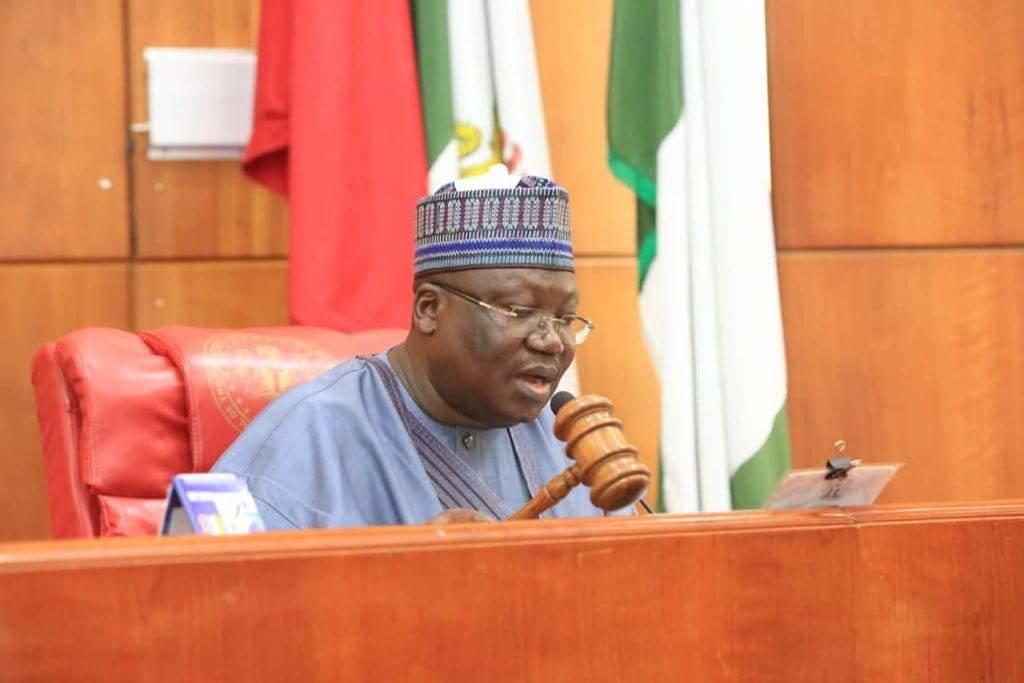
Ahmed Lawan, SenatePresident
By Dirisu Yakubu
Renowned economist, Marcel Okeke recently chided Senate President, Ahmed Lawan for justifying the federal government’s resort to borrowing in the past six years of President Muhammadu Buhari administration to fund infrastructural development
Speaking to journalists at the State House, Abuja, earlier in the week, the Senate President had said:
“Our options are really very limited as a country. First, we don’t have the necessary revenues. Nigeria is poor; we shouldn’t deceive ourselves,” he said.
“Nigeria is not rich, given the circumstances we live in, given the challenges we have. Our resources are so low; our revenues are so low, and therefore, the option of not doing anything, just to sit — because we have no money, we shouldn’t go for infrastructure development — is not even an option worthy of consideration.
“You cannot keep the economy stagnant. Two, you cannot, in my view and judgement, tax Nigerians further for you to raise the money for infrastructure development. Other countries do that, but we have serious situations across the country, so you cannot put taxes on people.
“The other option is public-private partnership. You need to create the environment to attract investors to come into our country; because of the security challenges we face today, not many investors would like to come to Nigeria.
“In fact, even those inside Nigeria may not like to invest properly in this sector of infrastructure development.
“So, the only option left is for us to borrow — borrow responsibly, utilise prudently and economically, and ensure that the projects are self-sustaining so that they can pay back the loans, so that the Nigerian economy will benefit from the implementation of such infrastructure development.”
Appearing as a guest on Channels Television breakfast show, Sunrise Daily, Okeke who is the lead Consultant at Mascot Consult Limited faulted Lawan, insisting that the country is where it is because of mismanagement of her economy.
The Senate President said the country has no option but to borrow to fund the budget. Is that right?
Okeke: There is a background statement he made that Nigeria is a poor country. I disagree with him. Nigerian being poor as he is saying came from the mismanagement of the economy. The thing that consumes the money that we have, which are our scarce foreign exchange earnings from the sale of crude oil, is that much of it goes into importation of refined petroleum products.
If the refineries here are working, if the managers of our economy have been business-like and kept the refineries running, we won’t be talking of the importation of petroleum products into this economy that is a major oil producing country.
He (Lawan) puts it in such a way as if we are already in a corner and that the only way out is to keep borrowing. We don’t have to keep borrowing because it will get to a point that those who want to lend to us will no longer lend because we have the challenge of how to service the one we have borrowed and so it becomes an unsustainable arrangement.
You have a volume of debt that is there and you are saying more borrowing is the only option that you have? We have options and the options are fix the economy effectively by diversifying and then, we won’t have ourselves in a cul-de-sac in which you don’t have anywhere to run to than to keep borrowing. Is that how other economies are run?
He also talked about responsible borrowing, i.e, borrowing to fund infrastructural development
What is the meaning of responsible borrowing? We know the challenge huge debt overhang constitutes to this economy. We knew where we were in 1999 and in 2000 going forward. We had a huge debt that the Obasanjo administration led by Ngozi Okonjo-Iweala had to do something to get debt write off and forgiveness. Our external debt came down to as low as $3.3 billion.
So, it is always a problem when you have a huge debt because what that means is that the money you should have committed to other developmental needs within the local economy is committed to debt servicing and payment.
Infrastructural development is a long term thing. If government plans well, it will factor infrastructural development into its larger plan. It wouldn’t be handled as an emergency as he is putting it, that the only option we have is to go and borrow. Other economies don’t function that way.
The budget for instance is an annual plan. Where is the long term plan of the government? What are they looking at in five years, in ten years? How to run infrastructural development becomes a part of that developmental plan, not to be running helter-skelter looking for short term money to borrow.
They say borrow responsibly but how are you sure the money would be well handled? There is the human factor in all this.
We all know of the level of embezzlement here, mismanagement of public funds. Before you realize how the money was mismanaged, it becomes something that happened a long time ago and the actors may have disappeared. You can sometimes see how shabbily these infrastructures they are talking about are built.
Is Nigeria a poor country?
The current state we find ourselves is largely man-made. It has to do with the mismanagement of the economy. By Gross Domestic Product, GDP, Nigeria has the largest economy in Africa. We are a major oil producer and exporter.
So, what are we talking about? So, what is the indicator he (Senate President) used in talking about being a poor country, except he is talking about GDP per capital because of our population…
Governments over the years should have factored in the population, and not allow a situation where our population is growing at more than three per cent and the GDP is growing at less than one per cent.
The problem is man-made. If you a poor country and you keep borrowing, don’t you think it will get to a point that you will over borrowed? We have been an independent country for 61 years now. So why is infrastructure becoming an excuse for massive borrowing?
Disclaimer
Comments expressed here do not reflect the opinions of Vanguard newspapers or any employee thereof.