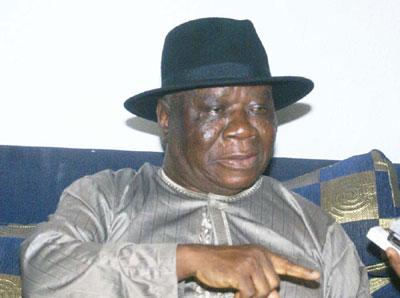
Chief Edwin Clark
By Prince Akpo Abugo
We cannot describe Chief Edwin Kiagbodo Clark in one episode. Like the divided opinion of the blind who touched different parts of the elephant, many similarly describe him in several ways, their divergent views representing the many parts in him.
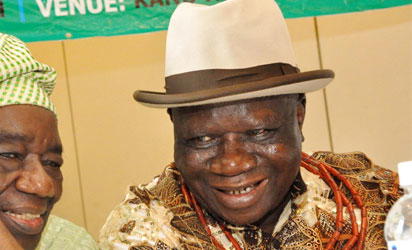
*Chief Edwin Clark
In the Niger-Delta, every ethnic group regards Clark as a leader, a fearless crusader, educationist, philanthropist, legal luminary, the conscience of the South-South, a politician with track records of service and a national colossus whose sense of unity is anchored on true federalism. He is also viewed as an anti-corruption crusader who prefers justice to compromise, and that is why he abhors injustice against minorities in Nigeria.
May 25, 2019, was his birthday. He is a cult hero, a reincarnated Chief Bekederemo of blessed memory in his native Delta State. Bekederemo was his great grandfather, a wealthy merchant who took up battles on behalf of the poor; he reduced prices of commodities and had several conflicts with Chief Dore Numa.
Bekederemo had a steamship, and according to the National Archives, “built a palace that is as big and comparable to the palace of the Oba of Benin.” That edifice is still standing today. Clark’s grandfather, Fuludu Bekederemo, was also a man of substance, a warrant chief, a politician of note who attended the Western Region Chief’s Conference of 1941 in Ibadan.
Fuludu Bekederemo gave birth to Chief Clark Fuludu, father of Edwin Clark. He became a wealthy merchant who traded in several coastal cities in the tradition of the family business and was involved in community service and politics as a councillor. He rose to be a customary court judge of appeal in Bomadi. Chief Clark Fuludu understood early the importance of educating his children; he saw the next day and invested in their education. He instilled in them the tradition of public service he inherited from his forebears. The result is what we see today in the larger family. Edwin Clark was groomed for leadership through education and mastery of Ijaw language and culture and was sent to Okrika. The name Edwin was given to him by his teacher, Thompson Okitikpi.
Edwin started political activism early; he was a councillor in his community, as was his father, Chief Clark Fuludu. While at home, the bond between father and son was strong but in service, public interest prevailed above family ties. That was why father and son could disagree on matters of policy. Edwin Clark was a teacher and became headmaster before travelling to the United Kingdom to study law. A member of NCNC in the UK, he was elected Secretary of the Zikist Movement. As a lawyer, he offered his services for the emancipation of Ijaw people and succeeded.
Also read: Why northern leaders fear restructuring —Ekweremadu
He used the law as a tool for emancipation rather than a source of wealth acquisition. The 1966 coup that killed Northern leaders was a turning point for Edwin Clark; the killings and their aftermath were shocking and he condemned the celebration of the death of Sardauna of Sokoto by some Igbos, describing it as unfortunate. He also condemned the pogrom that was the consequence of the coup. As the crisis escalated, Clark was among the few who called for national understanding in averting war. Though Clark admitted the Igbo aggravated the situation, he equally condemned Northern soldiers’ killing of Igbos.
Col. Ogbemudia appointed him Commissioner of Education, but when the cabinet was later reshuffled, Clark became Commissioner for Finance and Establishment. He continued his selfless services, giving scholarships and building new secondary schools to open Ijaw hinterlands. He gave Ijaw girls interested in education scholarship; Ijaw in higher institutions enjoyed the same gesture. Clark was among the team that championed the creation of the higher institution that metamorphosed into the University of Benin when all efforts to affiliate the new institution to the University of Ibadan, University of Ife and others failed.
He embarked on foreign trips for recognition, visited Stanford University, California, U.S.A. to recruit lecturers and went on a students recruitment drive, after which he was eventually appointed pro-chancellor of the institution.
Clark’s performance under Ogbemudia was widely acknowledged; his bonding with people and appreciation expressed by them led General Yakubu Gowon to invite him to join his government. This was while he was still serving as Commissioner of Finance under Ogbemudia. Clark took over from Anthony Enahoro and held this position until the coup that toppled Gen. Gowon. In the Second Republic, Clark, a member of the National Party of Nigeria, NPN, supported Shehu Shagari’s presidential bid and was appointed pro-chancellor and chairman of the council, University of Minna. He was also elected Senator of Bendel South.
Clark speaks truth to power, especially political leaders who pilfer state resources. He is respected by restive youths because of his track records. The leadership of ethnic groups in the region defer to him because he bears the burden of the people. In 2005, President Olusegun Obasanjo convened a political reform conference with each state producing six delegates. Under the prompting of the late Governor Diepreye Alamieyeseigha of Bayelsa, the delegates from the Niger-Delta nominated Edwin Clark as South-South leader. Under his leadership, they rejected the 18 per cent derivation and argued for 25 per cent. But when others refused, Clark led the boycott that was tagged the First walk out. In President Goodluck Jonathan’s conference, Clark was made the automatic leader of the South-South and he tirelessly worked for the success of that conference.
Clark has fought many battles. When Rivers State was engulfed in cult crisis, he called for a state of emergency, alleging that most political leaders in the state were sponsors.
In Delta, his home state, he single-handedly fought ex-governor James Ibori’s adversaries over the ex-convict saga but later fell out with him. He similarly fought other political leaders over corruption allegations because to him, “corruption is an evil that must be crushed.” Clark also criticised Northern leaders’ insensitivity to the plight of their people despite years in power. He frowns at the Almajiri system and the poverty in the north which he attributes to poor leadership.
His struggles reflect the story of the founding fathers of Nigeria who recognised our diversity in cultures and gave a federal constitution that gives each section space to develop at its own pace.
The Edwin Clark University Kiagbodo which he founded is a legacy of service and dedication which define his personality. Clark’s life is a book, a history of dedication. He is an enigma still unfolding. We wish him good health on his birthday.
- Abugo, a social analyst, wrote from Uzere, Delta State.
Disclaimer
Comments expressed here do not reflect the opinions of Vanguard newspapers or any employee thereof.