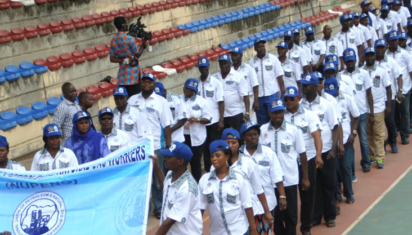
Workers celebrating May Day at the Ahmadu Bello Stadium,Kaduna on Tuesday
By Victor Ahiuma- Young
LAST week, the Tech-nical Sub-committee of the tripartite committee on minimum wage set up by President Muhammadu Buhari, held public hearing across the six geographical regions and the Federal Capital Territory, FCT, Abuja.

While there is no doubt that workers as represented by Organised Labour are determined to achieve a new minimum wage, the body language of government especially state governments, shows that there is serious battle ahead if a new national minimum wage is to be realised.
Open disagreement
The public disagreement by leaders of Nigeria Labour Congress, NLC, Trade Union Congress of Nigeria, TUC, and United Labour Congress of Nigeria, ULC, over figure for new minimum wage at the South-West zone of the public hearing left much to be desired.
While the NLC and TUC on one hand insisted on the fresh demand of N66,500 as against the N52, 500 earlier demanded, ULC on the other hand, maintained its stand on N96,000 new minimum wage it has demanded at the hearing held in Alausa, Lagos.
Though the division in Labour manifested in 2015 after the NLC delegates’ conference and widened about two years ago after the inauguration of ULC, one had expected the leaders of NLC, TUC and ULC to keep their differences aside and come out with a common position on the issue of a new minimum wage.
The earlier these differences are harmonised and a common position taken, the better to avoid giving the unwilling government a leeway to further procrastinate. Whatever the difference among Labour leaders, workers’ welfare should take the driving seat.
Governors’ antics
It is common knowledge that government at all levels, and indeed, employers, will not be willing to increase the wages of workers without being pushed. This again was manifested at the hearing.
In his presentation, Governor Akinwunmi Ambode of Lagos, who was represented by the Head of Service, Folasade Adesoye, argued among others, that before any minimum wage is fixed, Internally Generated Revenue, IGR, of every state should be seriously considered as a major factor.
According to him, at N18,000 minimum wage, “the state’s monthly wage bill was in excess of N10 billion for a workforce of 103,000, asides retirement benefits obligations.
“In this instance, the revenue profile of each state becomes a major determinant of what can reasonably be afforded in terms of wages, without jeopardizing the ability of the government to fund social services that are critical to the well-being of the entire citizens,” the governor stated.
For Governor Nyesom Wike of Rivers State, Nigerian workers will be better off when states are allowed to fix their separate minimum wages in line with their financial capacity to pay.
Speaking at the South-South geo-political zone hearing in Port Harcourt, Wike said: “And for us, therefore, the single national minimum wage system is yet, another lie that betrays the distortions in our federation and the structured dislocation of the states in the power equation between the Federal Government and the federating states.
It is our view that the country and its workers would be better off if states are allowed to fix and pay their own minimum wages indexed to the prevailing cost of living and ability to pay. When this happens, it is possible that some states may go beyond the minimum threshold to pay a living wage, which is what our workers truly need.”
To crown it all, Governor Rauf Aregbesola of Osun State, and Chairman of the Technical Sub-committee of the tripartite committee, put it more succinctly, when at the Abuja hearing, pleaded with Organised Labour to demand what he considered as an implementable minimum wage that government could afford.
Aregbesola said: “We have all along been concentrating on cost of living which is also important. However, in your contribution, let us also look at productivity index so as to get the best for the economy. By so doing, we will be enriching the outcome of this debate and making it less controversial and more amenable to implementation.”
Disclaimer
Comments expressed here do not reflect the opinions of Vanguard newspapers or any employee thereof.