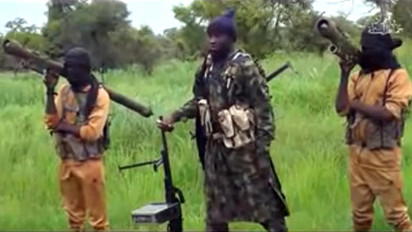
This screengrab taken on August 8, 2016 from a Boko Haram video released by the Nigerian Islamist extremist group Boko Haram and obtained by AFP shows Boko Haram’s shadowy leader Abubakar Shekau as he appeares in a new video vowing to fight on, shrugging off an apparent split in the hardline jihadist group blamed for thousands of deaths since 2009. “I… Abubakar Ash-Shakawy (Shekau), the leader of Jama’atu Ahlissunnah Lidda’awati Wal Jihad, made it a duty for myself (to fight) Nigeria and the whole world,” Shekau said in the video released on August 7, 2016, using the group’s name since it declared allegiance to the so-called Islamic State. Vanguard
THE Islamic State in West African, ISWA, a faction that split out of the Boko Haram sect, is in control of territories in the north-eastern part of the country, according to a report by Reuters.
This is contrary to the claim of the Federal Government that the insurgent group no longer holds any territory in the country.
In its report, Reuters said it spoke with witnesses, people familiar with the insurgency in the north-east, researchers and Western diplomats who provided details of ISWA’s growing efforts to establish a form of administration in the Lake Chad area.

Boko Haram members
But the military dismissed the report, insisting that Boko Haram no longer hold territories in any local government in Nigeria.
”A map produced by the U.S. development agency in February and seen by Reuters shows how ISWA territory extends more than 100 miles into the northeastern Nigerian states of Borno and Yobe, where government has in many areas all but vanished after a decade of conflict.
“The Islamists have not been defeated, as Nigeria says, and researchers say ISWA, less extreme than Boko Haram, has evolved into the dominant group. The US map paints a similar picture, with ISWA operating in much of Borno,” the report said.
It added that there were occasions when ISWA protected residents from Boko Haram fighters, quoting a local herder, whose identity was protected, as saying: “If you are a herder, driver or trader, they won’t touch you – just follow their rules and regulations governing the territory. They don’t touch civilians, just security personnel.”
Reuters said ISWA has over twice the number of fighters owned by Boko Haram and may pose a greater threat than the group it split from.
“Analysts estimate that ISWA has 3,000-5,000 fighters, about double Boko Haram’s strength,” the report read.
It added that the Nigerian military categorises ISWA as Boko Haram.
In January, security service organisations, including the Department of State Service, DSS, reportedly discovered ISWA network operating within some north-central and south-south states including Kogi, Edo and Benue.
“Nigeria’s armed forces ‘just see them as Boko Haram,” the report quotes John Agim, defence spokesman, as saying at a briefing.
“We are not interested in the faction, what has that got to do with it? They are not a government, they kidnap girls from schools.”Agim: Any story that the insurgents are in charge of any part in this country is completely false.
The report added that despite its name, experts believe ISWA’s ties to Islamic State in the middle east are limited.
Jacob Zenn of the Jamestown Foundation in Washington DC said: “What’s clear from ISWA primary source documents is that ISWA has asked IS for theological guidance on who it is lawful to attack. Daily activities, including military operations, are left to its own leaders. ISWA is the largest IS affiliate, but it’s very much a Nigerian organisation. It doesn’t have foreign fighters coming, it’s hard to get to this place.”
But the military authorities said insurgents no longer control any part of the country.
“We started from Adamawa and moved to Borno and Yobe. I have been to the three states. We inspected places there. You can call someone, even a civilian in any of those states, they will tell you that Boko Haram is not occupying any territory. We’ve cleared them.”
On his part, Agim said the only area where the military is experiencing difficulties is Sambisa forest in Borno.
“As of today, there is no part in the northeast under the insurgents. The insurgents have been driven out of those areas as far back as 2015, 2016. Where we are fighting them mainly no is the Sambisa forest. We drive them out, but because of the size of that forest they come back when we leave,” he told TheCable.
“We drive them, they run into neighboring counties of Niger, Chad and Cameroon. That is why we having an international joint task force with these countries. Any story that the insurgents are in charge of any part in this country is completely false.”
Disclaimer
Comments expressed here do not reflect the opinions of Vanguard newspapers or any employee thereof.