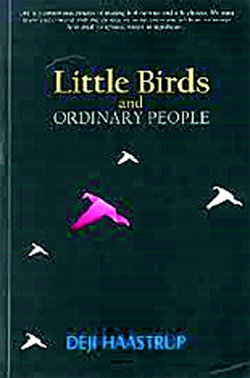
The pleasure of encounter-ing Little Birds and Ordinary People, a work straddling the nexus between the written meditation and the compte rendu was a welcome relief from the monuments of literary dross littering the landscape much like what passes, for the most part, for contemporary Nigerian architecture or legal practice or broadcasting.

There is a high-mindedness to this book which separates it from the muster of tired resolve to ‘write a book’ at the end of active careers – the apparent motivation for most of these other painful texts in the market. There is, also, a certain grit to the telling of this many stories that gives fresh perspectives to the reader regarding the intractable problems of Nigeria, the Niger-Delta and the oil and gas industry.
At times, the work reads like an audi alteram partem brief for the demonised oil and gas industry. A compromise this reviewer worked out is to see this book as an oriel into realities we may not ordinarily access except through specialist documents of no aesthetic value whatsoever.
The main strength of the book, in my view, is the vast canvass of history it erects and the complex nature of the society it portrays. Artists say it all boils down to perspective. From the plastic arts to the literary arts, the inherent value in the work is in its power to persuade the audience to see things from new points of view. Like his grandfather before him, the author eventually chooses the urbane. It may be argued that the Ibadan which provided the ambience for the author’s formative years cannot be properly defined as a village.
Little Birds and Ordinary People goes further than the past and present, venturing into the future. With very deft shifting of the gears, the author even convinces the reader to see the journey not in linear terms but as a gyre. This, in my opinion, is when the author is at his most mystical and African. The great thing, though, is the conviction in the writing that the journey can be improved, that the cycle isn’t a closed one, that there can be what the Japanese call Kaizen.
Away from the preoccupation with work and career, the book, dedicated to the memory of the author’s brother, Adesina Haastrup, works at an even deeper emotional substratum as a memorial and as a celebration of life and not of loss. They say we are truly gone when the last human mentions our name. Deji Haastrup has erected a more lasting monument than marble to his late brother in this regard; this book will be read as long as humankind is literate.
Without fishing for a hook, the account in Little Birds and Ordinary People finds one nonetheless in its deliberately understated case for the better half of humankind, the women. I’m tempted to read women into the Ordinary People in the title of the book. Through most of human history, the women have borne the brunt and the species as a whole has suffered for the obtuse choice by men in the status quo.
It is even more gratifying that the prose in the book (and the cameo appearance of poetry) all add up to a thoroughly enlightening if a little frightening, read. If the words do not come as easily as leaves to a tree, let them not come at all, urged Keats, the poet. But the words in this book come as readily to the author’s pen as streams flow. It is evident in the kinesis. This is a book to recommend to those who are genuinely curious about Nigeria and Nigerians. Never judge a book by its cover, don’t judge us by the names we are called, we are made of more, proverbial still waters run deep.
Disclaimer
Comments expressed here do not reflect the opinions of Vanguard newspapers or any employee thereof.