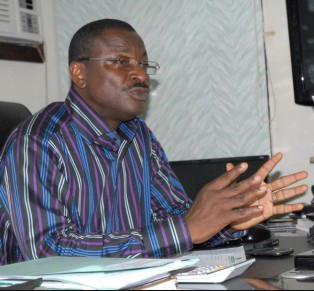
Solomon Edebiri
Dr. Solomon Edebiri is the President of the Nigeria Institute of the Welding, NIW. In this interview he speaks on efforts to improve awareness of welding in the country. Excerpts:
Recently, you announced the formation of the African Welding Federation (AWF) as part of move to standardize welding activities in Africa. What is the motivation for this?
All over the world, regions, and indeed continents have common standards and codes to manage the practice of welding and related fields. This will make it easy for management of things within neighbouring countries and people. In the Americas, you have the American Welding Society, in Europe it is European Welding Society.

•Solomon Edebiri
This way whatever is obtainable in France is the same with that of Germany. Italy, Spain e.t.c. With this, the continent is able to harmonise training schemes and industry practice regulations. That exactly is the motivation and the reason for the formation of the African Welding Federation.
It is being created in order to have a common standard and codes for the continent on welding and related fields.
This is a daunting objective. How are you going about it?
That is true. It is a daunting task, yet we must achieve our objectives. I have just returned from a meeting with the Southern African Institute of Welding (SAIW), Johannesburg where we agreed that the SAIW and the NIW being the two leading members of the International Institute of Welding (IIW) on the continent must act on the issues of standards and codes for the continent in line with what is obtainable the world over as recommended by the world body. We took the decision to midwife the establishment of the African Welding Federation.
Although discussion about the AWF has been on for over three years now, this meeting finally put in place the drafting of the aims and objectives of the AWF. The meeting also concluded that the AWF will be formally unveiled at the annual regional conference of the West African Welding Federation taking place in Ghana in April, 2017.
Is there any urgent need for the AWF?
After the SAIW, and until the coming of the Nigerian Institute of Welding, the only active members of the IIW from the continent were Egypt, Libya and Algeria. That left the continent venerable for the dumping of all kinds of unregulated systems, standards and codes.
To set up a continental body like the AWF, we must have the involvement of at least membership from three regions. In Africa, we have five regions – North African, East African, West African, Central African and Southern African regions – we have attained that milestone. Even Zambia and Namibia are on the verge of joining as full members. With these countries ready to go, the continent is ready for a continental body like the AWF.
Many Nigerians think welding is all about artisans plying their trade by the road side. What do you say to them?
Over the years, we have been doing all we can to correct this impression about welding; that welding is not dirty, it is not dusty and that it is not about the artisans alone as assumed by many Nigerians. That position has been underscored by the numbers of professionals and highly trained Nigerians who are plying their trades as welding engineers. Some of them have qualifications as high as Masters of Science and engineering degrees!
So, basically, the misconception has changed over the years with the involvement of more educated people. Even with the artisans and those in the informal sector, we are doing all we can to ensure that a code of practice is established for them.
Standard and code of practice
We in fact want to sanitize that part of the industry by creating a standard and code of practice for them.
Today, the impression has changed. More people are now interested in what welding is all about. It may interest you to know that welding is all about man. It is all about development. Without welding, there cannot be development. That is why people are taking more interest.
Can you tell us the story of NIW in the last 10years?
Yes, it has been a long and exciting journey for the institute. The road was never paved in gold, but I can assure you that within this period we have not only learnt along the way, but we have achieved a lot also. Let me summarize some of our achievements so far.
The most important part of our achievements is that we have increased and sustained our membership, it has increased very tremendously. Within this period, we have also sustained our membership of the International Institute of Welding (IIW) with the attainment of the status of Authorized National Body (ANB) of the IIW which gives us the authority certify International welders and other cadres of welding personnel up to international welding engineers level.
Having gotten to this level, the NIW has accredited some Approved Training Bodies (ATB). In the last 10 years, some six centres have gained full approval; additional three will soon be approved with over 20 waiting to meet the standard required for their approval under the NIW/ANB for welding personnel training using the guidelines of the IIW.
Within the same period, we have grown our collaboration with government through such agencies as the NCDMB, PTDF and the NDDC. There is also the United Nations Office of Project Services. We also have a good relationship with the Federal Ministries in the areas of job creation, research and development.
We have helped to grow and stabilized welding training in a number of tertiary institutions. Before now, most Nigerian universities and polytechnics did not understand the need for welding engineering, but now a number of them including the University of Benin, Federal University of Technology, Minna, Abubakar Tafawa Balewa University, Bauchi, Federal University of Petroleum Resources, Effurun, have committed themselves to setting up full-fledged welding engineering department in their campuses.
We have also synergised with some private institutions to develop welding training in all parts of the country. I think we have achieved a lot. Within this period, you will also remember that in 2008, we started the development of a National Centre of Excellence for welding engineering and technology in Edo State. Today, we have been able to put on ground the process of achieving this lofty dream.
We have inside the complex right now an administrative building, a block of well equipped classroom building and a laboratory which will ensure that all welding engineering tests and analysis are carried out in-country. This laboratory was actually completed and equipped by Shell Nigeria Exploration and production Company Ltd (SNECO).
I believe that we have come a long way. Also with the collaboration of Federal government interventionist agencies like the PTDF and NDDC, we have been able to train highly competent Nigerians in various welding fields including underwater welding.
We have been able to close the skill gaps that were identified in 2006 that the gap of about 2,600 professional welders must be bridged. So far, the PTDF alone has been able to train up to 1,200 of these people with about 960 fully certified in different cadres of welding processes. We are hoping that within the next couple of years, that gap will be completely close.
You spoke about the support of Shell to the NIW, what has been the cooperation level of other international oil companies in your effort to raise the bar in welding activities in Nigeria?
What I can tell you is that the other companies are interested in the activities of the NIW and are willing to support, I sincerely believe that once the laboratory is completed and equipped by Shell begging to make its impact in the industry, other companies will come to our support to provide the other facilities required in the centre.
Disclaimer
Comments expressed here do not reflect the opinions of Vanguard newspapers or any employee thereof.